“Sure, but do we really need AI and 3D imaging to tell us cancer grows weird?” That is the fair eye-roll version of the criticism. The new Cell paper by Caire and colleagues basically answers: yes, because the weirdness is the clue. Metastases are not just blobs getting bigger like a sourdough starter with a lawyer. In breast cancer, the dangerous ones may follow a reusable architectural plan.
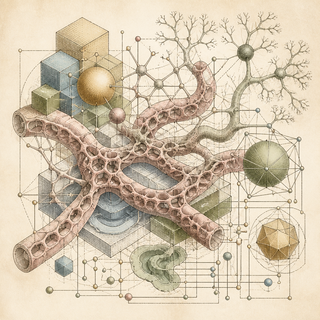
The researchers call it metastatic trabecular morphogenesis, or MTM, because biomedical science refuses to let a good discovery leave the building without a name that sounds like a municipal zoning permit.
The Tumor Has a Floor Plan
Metastasis is usually discussed like a travel problem: cancer cells escape the primary tumor, survive the bloodstream, land somewhere else, and start over. That is already rude enough. But this paper focuses on a later question: once cells arrive, how do they build a large metastatic colony?
Caire et al. combined single-cell RNA sequencing, spatial transcriptomics, AI-supported 3D imaging, organoids, human breast cancer samples, and mouse experiments. In normal-person terms: they checked which genes were active, where those cells sat in the tissue, and what the whole tumor looked like in three dimensions. Not just one microscope slice, which is like judging a lasagna by licking one noodle.
What they found is striking: macrometastases often activate a developmental branching program, the kind of biological construction logic embryos use to build tubes, ducts, and branching organs. Instead of forming a compact lump, these tumors assemble a 3D lattice of epithelial cords. Imagine a cancer colony deciding that a tangled subway map is better real estate than a bowling ball.
Baby Development, But Make It Sinister
Morphogenesis means “making shape.” During development, cells do not just multiply. They move, stick, fold, branch, and organize, like a renovation crew that somehow has no foreman but still builds a lung. Branching morphogenesis helps form structures such as mammary ducts and airways. The awkward plot twist is that cancer can borrow these old developmental recipes.
The paper reports that MTM-high cells already appear in some primary tumors that later metastasize. MTM-low tumors, by contrast, tend to grow in a more compact, expansile way and were less associated with metastasis in the models studied. That suggests architecture might be more than decoration. It may be a behavior readout, like noticing your houseplant is leaning toward the window and realizing it has a whole agenda.
This is where AI earns its keep. The imaging challenge is not “find the tumor,” but “measure the tumor’s 3D geometry in a way humans can compare across samples without squinting themselves into another tax bracket.” AI-supported image analysis can help quantify branching, topology, and trabecular structure. Speaking of making messy images more usable, tools like combb2.io sit in the same broad family of image enhancement problems, although this study’s biological imaging is a much more specialized beast.
The Usual Suspects: ETV and FGF
The team also dug into the machinery behind this shape-shifting. They identified ETV1, ETV4, and ETV5 transcription factors as master regulators of the MTM program. Transcription factors are gene-control proteins, basically tiny clipboard managers telling cells which instructions to run. In this case, the ETV family seems to help metastatic cells execute the branching architecture.
Here is the especially useful bit: the authors found that this program depends on FGF-FGFR signaling from the surrounding stroma. FGF signals are normal developmental and repair cues. In the tumor context, they become more like a helpful neighbor accidentally supplying scaffolding to a bank robbery. In functional experiments, blocking FGFR signaling interfered with macrometastatic outgrowth, while not necessarily stopping the first seeding step.
That distinction matters. Many therapies try to stop cancer cells from spreading. This paper points at a different vulnerability: maybe some metastatic cells land successfully, but cannot build the big lethal structure without their branching toolkit.
Why This Lands in the AI/ML Bucket
This is not a “the model predicts everything, please clap” paper. The AI is part of a larger biological detective kit. That is actually refreshing. The machine learning here supports 3D pathology and morphology analysis, while the authors cross-check with transcriptomics and experiments.
Recent work is moving in the same direction. A 2024 Nature Medicine atlas mapped metastatic breast cancer biopsies with single-cell and spatial methods across many sites. Reviews in 2024 and 2025 have also argued that spatial transcriptomics and computational pathology are becoming central to breast cancer research. Another 2026 Cell paper, Path2Space, pushes the idea further by predicting spatial gene expression from histology images. Translation: pathology slides may eventually tell us not just “what does this look like?” but “what molecular neighborhood is this tumor running?”
That is a big deal, but not magic. Models need diverse cohorts, careful validation, reproducible pipelines, and clinical tests that survive contact with the glorious chaos of real hospitals. Otherwise AI in pathology becomes a very expensive fortune cookie.
The Big Takeaway
This paper suggests metastatic breast cancer may not simply grow more. It may build differently. The shape is part of the biology.
If future studies validate MTM across larger patient cohorts, tumor subtypes, and treatment settings, clinicians might one day use 3D architecture and gene programs to identify high-risk tumors or choose FGFR-targeted strategies for patients whose metastases depend on this branching machinery. That is not a cure announcement. It is more like finding the contractor’s blueprint in the villain’s briefcase. Still useful. Very useful.
References
-
Caire R, Bordo R, Zanconato F, et al. A 3D morphogenetic blueprint for metastatic outgrowth in breast cancer. Cell. 2026. DOI: 10.1016/j.cell.2026.03.009. PMID: 41923644
-
Klughammer J, Abravanel DL, Segerstolpe Å, et al. A multi-modal single-cell and spatial expression map of metastatic breast cancer biopsies across clinicopathological features. Nature Medicine. 2024;30:3236-3249. DOI: 10.1038/s41591-024-03215-z
-
An J, Lu Y, Chen Y, et al. Spatial transcriptomics in breast cancer: providing insight into tumor heterogeneity and promoting individualized therapy. Frontiers in Immunology. 2024;15:1499301. DOI: 10.3389/fimmu.2024.1499301
-
Frascarelli C, Venetis K, Marra A, et al. Computational pathology in breast cancer: optimizing molecular prediction through task-oriented AI models. npj Breast Cancer. 2025;11:141. DOI: 10.1038/s41523-025-00857-1
-
Shulman ED, Campagnolo EM, Lodha R, et al. AI-predicted spatial transcriptomics unlocks breast cancer biomarkers from pathology. Cell. 2026. DOI: 10.1016/j.cell.2026.04.023. PMID: 42105763
Disclaimer: This blog post is a simplified summary of published research for educational purposes. The accompanying illustration is artistic and does not depict actual model architectures, data, or experimental results. Always refer to the original paper for technical details.