A fully printed, bendable artificial brain synapse just hit 93.91% image recognition accuracy - and it's made from ink.
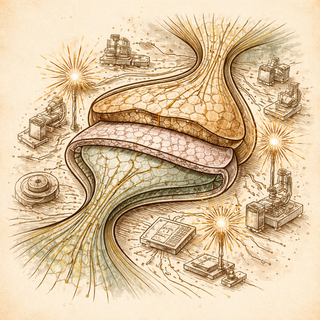
Researchers at Ocean University of China and the Chinese Academy of Sciences squeezed a working artificial synapse out of a printer. Not a million-dollar cleanroom. Not a vacuum chamber the size of a sedan. A printer. Three inks - tellurene for the brain-like channel, hexagonal boron nitride (h-BN) for the insulating layer, graphene for the wires - and the result is a flexible transistor that mimics how your neurons talk to each other (Shen et al., 2026).
A fully printed, bendable artificial brain synapse just hit 93.91% image recognition accuracy - and it's made from ink.
Researchers at Ocean University of China and the Chinese Academy of Sciences squeezed a working artificial synapse out of a printer. Not a million-dollar cleanroom. Not a vacuum chamber the size of a sedan. A printer. Three inks. One flexible device that mimics how your neurons talk to each other (Shen et al., 2026).
The human brain operates on roughly 20 watts - two LED bulbs' worth of electricity - while performing the equivalent of an exaflop of computation. Meanwhile, training GPT-3 consumed enough energy to power 120 homes for a year. GPT-4 used an estimated 50 times more than that (PNAS, 2025).
Neuromorphic computing wants to close that gap. The idea: build hardware that works like biological synapses instead of forcing everything through traditional silicon logic gates. Intel's Hala Point system already packs 1.15 billion artificial neurons into a box the size of a microwave, hitting up to 15 trillion operations per second per watt (Intel, 2024). But those chips are rigid. They don't bend. They definitely don't go on your wrist.
This paper changes the conversation.
Three Inks and a Dream
The device is a memtransistor - a three-terminal gadget that combines the memory of a memristor with the tunability of a transistor. Think of it as a synapse with a volume knob. Two-terminal memristors can remember, but memtransistors can remember and be told how loudly to remember. That extra terminal gives researchers the kind of control biological synapses actually have: multiple inputs, adjustable strength, the ability to shift from short-term to long-term memory (APL Materials, 2025).
The magic ingredients:
- Tellurene (the semiconductor channel): A 2D form of tellurium first fabricated in 2017. Unlike graphene, it has a real bandgap. Unlike black phosphorus, it doesn't decompose when you look at it wrong. Carrier mobility around 700 cm²/V·s. And critically, you can cook it up in water using a simple hydrothermal process - no exotic equipment required (Nature Electronics, 2018).
- h-BN (the gate dielectric): Hexagonal boron nitride, the "white graphene." Atomically smooth, electrically insulating, chemically inert. The bouncer at the club door, deciding which signals get through.
- Graphene (the electrodes): The material that launched a thousand PhD theses. Excellent conductor, printable, flexible.
All three get formulated into inks and deposited layer by layer. The whole stack is printed. Every. Single. Layer.
Bend It Like a Neuron
The printed device survived 10,000 bending cycles at a curvature radius of 11.05 mm with stable electrical performance. For context, that's roughly the curve of your finger. Bend it, unbend it, ten thousand times - it keeps working.
When electrical pulses hit the h-BN layer, the device exhibits paired-pulse facilitation (two quick taps produce a bigger response than one, just like real synapses), transitions from short-term to long-term plasticity (it learns to hold onto information longer with repeated stimulation), and tunable synaptic weight updates.
Plugged into a simulated artificial neural network for handwritten digit recognition on the MNIST dataset, it scored 93.91% accuracy. Throw Gaussian noise at it (σ = 0.7), and it still maintained 78.33%. Not shabby for something that came out of an inkjet.
Why This Matters Beyond the Lab
The neuromorphic chip market is projected to hit $3.3 billion by 2034. The printed electronics market could reach $198 billion by 2040. This paper sits squarely at the intersection - proving you can print brain-inspired hardware on flexible substrates using solution-processed 2D materials.
Imagine wearable health monitors that process sensor data locally, right on your skin, without shipping everything to the cloud. Or flexible patches that recognize patterns in real time - abnormal heart rhythms, seizure precursors, environmental hazards - using hardware that bends with your body and sips power like a sleeping cat.
The gap between "lab demo" and "product on your wrist" remains wide. Scaling up printing processes, improving device-to-device uniformity, and pushing accuracy higher are all open problems. But every revolution in electronics started with someone proving the physics works. This team proved the physics works - and you can print it.
References
- Shen, D., Zhou, Y., Li, R., Xia, S., Meng, L., Zhang, L., & Zhang, M. (2026). Flexible and Fully Printed Artificial Synaptic Devices Based on h-BN-Gated Tellurene Memtransistor. ACS Nano. DOI: 10.1021/acsnano.6c00995
- Intel Corporation. (2024). Intel Builds World's Largest Neuromorphic System. Intel Newsroom
- Qiu, G., et al. (2018). High-performance few-layer tellurium CMOS devices enabled by substrate engineering. Nature Electronics, 1, 228-236. DOI: 10.1038/s41928-018-0058-4
- Memtransistor for bio-inspired neuromorphic computing. (2025). APL Materials, 14(2), 020901. DOI: 10.1063/5.0248833
- Can neuromorphic computing help reduce AI's high energy cost? (2025). PNAS. DOI: 10.1073/pnas.2528654122
Disclaimer: This blog post is a simplified summary of published research for educational purposes. The accompanying illustration is artistic and does not depict actual model architectures, data, or experimental results. Always refer to the original paper for technical details.