Most people treat chromosome mix-ups in pregnancy like a one-variable math problem: older eggs, higher risk, end of story. This review politely walks into the room, clears its throat, and says not so fast - maternal age matters, but a mother's own genetic variants may help explain why some younger women still face repeated aneuploid conceptions while others do not.[1]
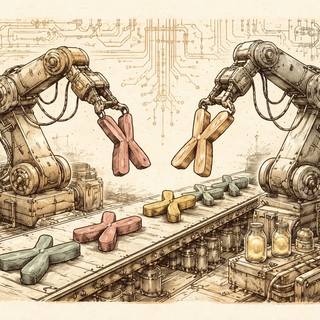
That matters because aneuploidy - having too many or too few chromosomes - sits behind a huge share of infertility, miscarriage, embryo arrest, and some congenital conditions, including Down syndrome. The classic explanation is aging oocytes. Fair enough. Human eggs are asked to pause mid-meiosis for years, sometimes decades, then wake up and divide perfectly like an employee returning from a 17-year lunch break. Naturally, things can go sideways.
But this paper reviews evidence that the egg's machinery itself can come with inherited weak spots.
The Egg Is Running a Very Stressful Factory
To make a healthy embryo, chromosomes need to separate with absurd precision. That requires a lot of cellular choreography: recombination has to happen in the right places, the spindle has to pull chromosomes cleanly, checkpoints have to stop bad divisions, and the embryo has to survive the maternal-to-zygotic transition, when control shifts from the egg's stored instructions to the embryo's own genome.[2][3][4]
The review pulls together 28 studies and groups the suspect genes into four buckets: meiotic recombination, spindle dynamics, checkpoint enforcement, and the maternal-to-zygotic transition.[1] In plain English, these are the parts list for the world's least forgiving assembly line. If one component wobbles, you may get the biological equivalent of shipping a box with three left shoes and no right one.
Among the stronger leads are rare variants in KIF18A, ELL3, and CEP120, plus common variants in PLK4 and CCDC66.[1] That does not mean these genes are destiny. It means researchers are starting to identify repeat offenders in the chromosome-segregation chaos.
The Plot Twist: Some Risk May Be Personal, Not Just Statistical
The most useful idea in the review is what the authors call aneuploidy predisposition.[1] Instead of thinking only in terms of clinical outcomes like recurrent miscarriage or failed IVF, they suggest a mechanism-based lens: some women may be genetically more prone to producing aneuploid eggs or embryos, even with a normal karyotype and even before age alone would predict trouble.
That idea lines up with newer studies. A 2024 PNAS paper linked maternal kinesin variants, including in KIF18A, to prematurely increased egg aneuploidy and accelerated reproductive aging.[5] A 2023 study in The American Journal of Human Genetics used ultra-low-coverage genome data from preimplantation testing to identify common variant associations with embryo aneuploidy risk, including CCDC66.[6] And a 2024 Current Biology paper showed age-related loss of cohesion protection in human oocytes, giving a mechanistic explanation for why chromosome separation gets sloppier over time.[7]
Then a 2025 Nature study added another wrinkle: common variation in meiosis genes appears to shape both recombination patterns and aneuploidy risk, suggesting there really is a shared inherited architecture here, even if it is messy and polygenic.[8]
Translation: biology is not reading from a single script. Two women of the same age may not be playing the same odds.
Why This Could Change Fertility Care
No, this does not mean your fertility clinic will hand you a magical "aneuploidy risk score" next Tuesday. Biology enjoys ruining tidy product roadmaps. The evidence is still uneven, sample sizes are often small, and some genes already appearing on commercial infertility panels still lack direct, well-validated links to aneuploidy.[1]
Still, the direction is clear. If these signals hold up, clinicians could move beyond broad labels like unexplained infertility and ask a more pointed question: is there a maternal genetic tendency toward chromosome segregation errors?
That could affect counseling, testing strategy, and how researchers design IVF studies. It may also be one of those rare places where AI could actually be useful without acting like a TED Talk intern. The review explicitly calls for AI-enhanced clinico-genomic studies and polygenic risk models that combine genetic variants with age and clinical history.[1] In other words, not "let the algorithm do medicine," but "please help us untangle this spaghetti bowl of interacting risk factors."
The Honest Buzzkill Section
There are still plenty of problems. Many reported variants are rare. Different studies define cases differently. Some associations may not generalize across ancestries. And aneuploidy can arise at multiple stages - during oocyte meiosis or later during embryonic mitosis - which makes cause-and-effect maddeningly hard to pin down.[1][6]
That is why this review is useful. It does not oversell. It says, basically: here are the best leads, here is the biological logic, and here is where the evidence is still held together with optimism and grant funding.
Which, to be fair, is how a lot of science gets started.
References
[1] Ha S, Liu W, Yuan P, et al. Maternal genetic variants associated with aneuploid conception: a narrative review. Human Reproduction Update. 2026. DOI: 10.1093/humupd/dmag012. PubMed: 42124334
[2] Schuh M. Aneuploidy in mammalian oocytes and the impact of maternal ageing. Nature Reviews Molecular Cell Biology. 2022;23:743-766. DOI: 10.1038/s41580-022-00517-3
[3] Wikipedia contributors. Meiosis. Wikipedia. https://en.wikipedia.org/wiki/Meiosis
[4] Wikipedia contributors. Maternal-to-zygotic transition. Wikipedia. https://en.wikipedia.org/wiki/Maternal_to_zygotic_transition
[5] Biswas L, Tyc KM, Aboelenain M, et al. Maternal genetic variants in kinesin motor domains prematurely increase egg aneuploidy. Proceedings of the National Academy of Sciences. 2024;121(45):e2414963121. DOI: 10.1073/pnas.2414963121
[6] Sun S, Liu J, Guo V, et al. Identifying risk variants for embryo aneuploidy using ultra-low coverage whole-genome sequencing from preimplantation genetic testing. The American Journal of Human Genetics. 2023. DOI: 10.1016/j.ajhg.2023.11.002
[7] Mihalas BP, Pieper GH, Aboelenain M, et al. Age-dependent loss of cohesion protection in human oocytes. Current Biology. 2024;34(1):117-131.e5. DOI: 10.1016/j.cub.2023.11.061. PubMed: 38134935
[8] McCoy RC, Xing J, Liu J, et al. Common variation in meiosis genes shapes human recombination and aneuploidy. Nature. 2025. DOI: 10.1038/s41586-025-09964-2
Disclaimer: This blog post is a simplified summary of published research for educational purposes. The accompanying illustration is artistic and does not depict actual model architectures, data, or experimental results. Always refer to the original paper for technical details.