A search-and-rescue drone cuts through morning fog over collapsed rubble. Its camera scans for survivors - tiny figures against a chaotic landscape. Somewhere in its slim chassis, a neural network fires. Not the heavy, power-hungry kind that would drain the battery in twenty minutes, but something quieter. Something that spikes.
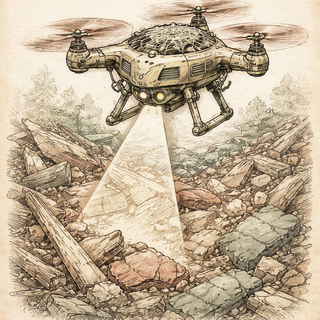
This is the world EMM-Det was built for.
Less Is More (Literally)
Traditional neural networks are gluttons. They process every pixel, every frame, every neuron firing continuously like a room full of people all talking at once. Spiking neural networks (SNNs) take a different approach - neurons only speak when they have something to say. A spike here, a spike there. Silence between. It's the computational equivalent of a haiku versus a dissertation.
The energy savings are not trivial. On neuromorphic hardware, SNNs can run at up to 280x lower power consumption than their conventional counterparts. The catch? They've historically been worse at, well, seeing things. Especially tiny things photographed from hundreds of feet in the air by a battery-constrained drone.
EMM-Det, published in IEEE Transactions on Neural Networks and Learning Systems by Cai et al. (DOI: 10.1109/TNNLS.2026.3680142), closes that gap with an almost meditative precision.
Three Strokes, One Painting
The system rests on three design choices, each solving a distinct problem:
Memory-enhanced spiking neurons. Standard spiking neurons have a forgetting problem - their signals decay over time like ink fading from wet paper. EMM-Det introduces dynamic leakage constants that let neurons hold onto information longer, boosting firing rates without increasing power draw. Think of it as giving each neuron a better short-term memory instead of just turning up the volume.
Wavelet-encoded inputs. Rather than feeding raw pixels into the network, EMM-Det uses wavelet transforms to decompose images into frequency layers at multiple scales. This captures both the broad shapes and the fine-grained textures simultaneously - useful when the "object" you're detecting is twelve pixels wide and partially occluded by smoke. Wavelets have been gaining traction across deep learning for exactly this kind of multi-resolution reasoning.
Federated learning across the swarm. Here's where it gets interesting. Multiple drones share what they've learned without sharing what they've seen. Each drone trains locally, sends only model updates to a coordinator, and never transmits raw footage. In disaster zones or security patrols, this isn't just a nice feature - it's a privacy requirement. Recent work on federated anomaly detection for drone fleets confirms this architecture can resist data poisoning attacks too.
The Numbers That Matter
On the team's custom dataset, EMM-Det hits 81.8% mAP@50:95 - beating the second-best method by 3.2% and outperforming traditional ANNs by 14.5%. All at what the paper calls "extremely low power consumption."
For context, SUHD recently slashed SNN inference latency by 750x, and SpikeYOLO pushed spike-driven detection to 66.2% mAP on COCO. EMM-Det builds on this momentum but adds the multi-drone coordination layer that neither addressed.
From Paper to Sky
This isn't purely theoretical. Intel's Loihi 3 chip now packs 8 million neurons per chip. Innatera's Pulsar microcontroller shipped for real-world edge deployments in 2026. Researchers at the University of Zurich already flew a neuromorphic drone at 80 km/h using event cameras and a Loihi 2 chip - 30% faster than frame-based systems.
The hardware is arriving. Architectures like EMM-Det are the software that makes it useful.
The Imperfect Beauty of Sparse Computation
There's something quietly appealing about a system that does more by computing less. Not every synapse needs to fire. Not every pixel needs attention. The empty space between spikes carries its own kind of information - a computational ma, if you will.
One honest caveat: recent analysis warns that SNNs only beat quantized ANNs when average spike rates stay below about 6.4%. EMM-Det's memory-enhanced neurons seem designed to maintain accuracy at low spike rates, but the paper's power measurements come from simulation, not deployed neuromorphic silicon. The gap between simulated efficiency and real-world battery life is one the field still needs to cross.
Still, when your drone fleet can detect a child's backpack in rubble, coordinate without leaking footage, and fly thirty minutes longer per charge - that's not a marginal improvement. That's a rescue that happens instead of one that doesn't.
References:
- Cai, Z. et al. (2026). EMM-Det: Energy-Efficient Multidrone Tiny Object Detection by Memory-Enhanced Spiking Neural Networks. IEEE Trans. Neural Netw. Learn. Syst. DOI: 10.1109/TNNLS.2026.3680142 | PMID: 41945841
- Kim, S. et al. (2020). Spiking-YOLO: Spiking Neural Network for Energy-Efficient Object Detection. AAAI 2020. arXiv: 1903.06530
- Luo, X. et al. (2024). SUHD: Spiking Neural Network for Ultrafast and High-Accuracy Object Detection. IEEE Trans. Neural Netw. Learn. Syst. PMID: 38498737
- Li, G. et al. (2024). SpikeYOLO: Integer-Valued Training and Spike-Driven Inference. ECCV 2024. GitHub
- Stöckl, C. et al. (2024). Burst-Dependent Neuromorphic On-Chip Learning. bioRxiv. DOI: 10.1101/2024.07.19.604308
- Lemaire, E. et al. (2024). Reconsidering SNN Energy Efficiency. arXiv: 2409.08290
Disclaimer: This blog post is a simplified summary of published research for educational purposes. The accompanying illustration is artistic and does not depict actual model architectures, data, or experimental results. Always refer to the original paper for technical details.