When your phone battery decides that 42 percent now means "farewell, cruel world," you are, whether you wished it or not, in the presence of crystal structure. The atoms inside materials arrange themselves with all the fussy order of a Victorian dinner party, and that arrangement decides whether a substance becomes a battery hero, a magnet, or an expensive lump with delusions of grandeur.
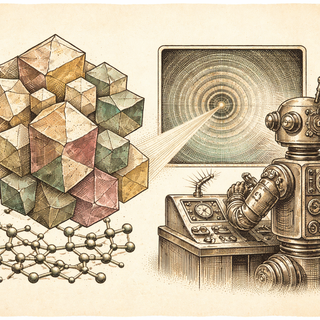
It is with considerable astonishment that we report a new specimen in the wilds of machine learning: CrystalX, a deep-learning system built to automate routine crystal-structure analysis from X-ray diffraction data at the full-atom level (Zheng et al., 2025). In plain English, it looks at the strange stripe-and-peak patterns produced when X-rays bounce off a crystal and tries to infer where the atoms actually are.
That sounds tidy when written in one sentence. In practice, crystallography has long been a noble struggle involving expertise, software gymnastics, and occasional muttering at plots that resemble a barcode designed by a poltergeist. X-ray crystallography works because crystals are repeating atomic lattices, so scattered X-rays carry clues about atomic positions. The trick is that the clues arrive scrambled, partial, and in no mood to explain themselves.
CrystalX was trained on more than 50,000 real experimental X-ray diffraction measurements, not just synthetic toy examples, and evaluated with a strict time-based split separating older training papers from newer test papers (Zheng et al., 2025). That matters. Many models look brilliant right up until reality enters the room carrying coffee stains and instrument noise.
A Most Impertinent Machine
The cheekiest part of the paper is not merely that CrystalX beats an automated baseline. It is that the model also spots mistakes in peer-reviewed published structures that slipped past serious validation checks, then corrects them (Zheng et al., 2025). Imagine a junior clerk quietly fixing the accounting ledger while the auditors nod approvingly at the wrong numbers. Awkward, yes. Useful, also yes.
The authors say CrystalX is already running in their day-to-day workflow, enabling fully automated, human-free analysis of newly discovered compounds. That puts it squarely in the orbit of the modern self-driving laboratory: machines that synthesize, measure, analyze, and decide what to try next while humans supervise the larger scientific game plan instead of hand-cranking every step (Szymanski et al., 2023).
This is why the paper is interesting beyond crystallography nerd-dom. Structure is not a decorative detail. It tells you how a material behaves. If you can solve structures faster and more reliably, you accelerate the search for better batteries, catalysts, magnets, semiconductors, and other objects upon which civilization has become embarrassingly dependent.
The Field Is Getting Crowded, and That Is Good
CrystalX did not appear out of a vacuum like an overconfident startup pitch. Over the last few years, researchers have been teaching models to classify diffraction patterns, guide adaptive measurements, and even generate candidate crystal structures directly from powder diffraction data.
A 2023 review summed up the trend neatly: machine learning is becoming a serious tool for XRD analysis, but data quality, diversity, and real-world robustness remain persistent headaches (Bunn et al., 2023). Salgado and colleagues built deep-learning models for large XRD datasets and improved crystal-system and space-group classification (Salgado et al., 2023). Szymanski and colleagues used machine learning to decide which diffraction measurements to take next, shaving time off autonomous phase identification (Szymanski et al., 2023). Other recent systems such as XtalNet and PXRDGen push toward end-to-end structure prediction from powder X-ray diffraction (XtalNet, arXiv:2401.03862), (PXRDGen, arXiv:2409.04727).
Meanwhile, the larger materials-AI world has been showing off. Google DeepMind’s GNoME project and related autonomous-lab work helped popularize the notion that AI can speed the discovery of new materials at industrially relevant scales (DeepMind, 2023), (Merchant et al., 2023). CrystalX fits that mood perfectly. It is less "chatbot writes your essay" and more "machine clears a scientific bottleneck that has annoyed experts for decades."
The Fine Print, Which Nature Always Hides in the Basement
Before anyone declares the robots masters of the crystal universe, a few cautions are in order. Diffraction data are noisy. Experimental setups vary. Some structures are much nastier than others. And a model that performs beautifully in one lab may discover, in another lab, the ancient truth that instruments are weird and humans label things inconsistently.
If this line of work keeps improving, the future materials lab may feel less like solitary detective work and more like directing an efficient, slightly eerie orchestra of instruments and models. The scientist still matters. The machine just stops making them spend half the afternoon deciphering atomic Sudoku.
References
Zheng K, Huang W, Ouyang W, Zhong HS, Li Y. CrystalX: High-Accuracy Crystal Structure Analysis Using Deep Learning. Journal of the American Chemical Society. 2025. DOI: 10.1021/jacs.5c21832. PubMed: 42007550
Bunn JK, Zhirnov AV, Bunn CJ, Cherukara MJ. X-ray Diffraction Data Analysis by Machine Learning Methods - A Review. Applied Sciences. 2023;13(17):9992. DOI: 10.3390/app13179992
Salgado JE, Lerman S, Du Z, Xu C, Abdolrahim N, et al. Automated classification of big X-ray diffraction data using deep learning models. npj Computational Materials. 2023;9:214. DOI: 10.1038/s41524-023-01164-8
Szymanski NJ, Bartel CJ, Zeng Y, Diallo M, Kim H, Ceder G, et al. Adaptively driven X-ray diffraction guided by machine learning for autonomous phase identification. npj Computational Materials. 2023;9:31. DOI: 10.1038/s41524-023-00984-y
Riesel EA, Mackey T, Nilforoshan H, Freedman DE, Leskovec J, et al. Crystal Structure Determination from Powder Diffraction Patterns with Generative Machine Learning. Journal of the American Chemical Society. 2024;146(44):30340-30348. DOI: 10.1021/jacs.4c10244
XtalNet. End-to-End Crystal Structure Prediction from Powder X-Ray Diffraction. arXiv:2401.03862 (2024)
PXRDGen. Powder Diffraction Crystal Structure Determination Using Generative Models. arXiv:2409.04727 (2024)
DeepMind. Millions of new materials discovered with deep learning. November 29, 2023. https://deepmind.google/discover/blog/millions-of-new-materials-discovered-with-deep-learning/
Merchant A, et al. Google AI and robots join forces to build new materials. Nature News. 2023. https://www.nature.com/articles/d41586-023-03745-5
Disclaimer: This blog post is a simplified summary of published research for educational purposes. The accompanying illustration is artistic and does not depict actual model architectures, data, or experimental results. Always refer to the original paper for technical details.