A bicycle can get you across town, but you do not send a bike courier to race a bullet train full of forever chemicals. That, roughly, is the problem with environmental cleanup: one hardworking microbe may nibble at one pollutant, but polluted soil often shows up as a chemical group chat from hell.
The new paper by De la Vega-Camarillo and colleagues asks a very fun question: what if we stopped hoping one heroic bacterium would save the day and instead used machine learning to assemble a microbial cleanup crew? Their system, called GENIA, designs synthetic microbial communities, or SynComs, that can tackle multiple stubborn pollutants at once: lignin, atrazine, and PFOS, a member of the PFAS family better known as "forever chemicals" because apparently "deeply annoying molecular glitter" was not available as a regulatory term De la Vega-Camarillo et al., 2026.
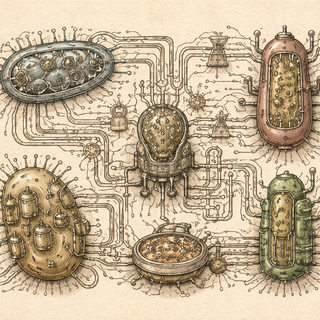
The Cleanup Crew, But Make It Genomic
Bioremediation is the idea that living systems can remove or transform pollutants. Bacteria, fungi, plants, and other organisms can sometimes do chemistry that would otherwise require harsh industrial treatment. The catch is that real contamination is messy. Different pollutants need different enzymes, intermediate products can pile up, and a single strain often runs out of metabolic tricks before the job is done.
So the researchers started with diversity. They isolated 2,155 bacterial strains from xenobiotic-enriched cotton detritusphere, which is a very fancy way of saying "a microbe-rich environment trained on weird chemicals." They screened those strains for growth on pollutant-specific media, then sequenced and annotated 45 promising candidates.
From there, GENIA turned genomes into a graph-shaped problem. Graph neural networks are machine-learning models built for things with nodes and edges: molecules, social networks, road maps, protein interactions, or in this case, bacteria connected to enzymes, pathways, pollutants, and metabolic handoffs. If a normal spreadsheet is a seating chart, a graph is the party after everyone starts trading snacks, secrets, and possibly atrazine-degrading enzymes.
GENIA combined graph neural networks, pathway complementarity modeling, and redundancy minimization. Translation: it looked for microbes that bring different useful tools, cooperate metabolically, and do not all redundantly show up carrying the same wrench.
Nine Microbes Walk Into a Polluted Soil Sample
The model selected a nine-member community including Atlantibacter hermannii, several Bacillus species, Micrococcus luteus, Paenibacillus polymyxa, Pantoea dispersa, and two Pseudomonas species. That little bacterial ensemble did something individual strains could not match.
In minimal medium, the consortium removed 91.6% of lignin by day 5, 91.4% of atrazine by day 3, and 93.1% of PFOS within 7 days. Compared with the best individual performers, the community improved degradation by about 2.2-fold for PFOS and about 1.5-fold for atrazine and lignin De la Vega-Camarillo et al., 2026.
That is the cool part. Not "AI magically cleans the planet while we all clap from a safe distance," but something more specific and useful: ML helped pick a community whose combined metabolic abilities beat its solo members. The bacteria were not just tiny janitors. They were tiny janitors with a project manager and a shared enzyme calendar.
Why Graphs Fit the Mess
Recent work has been pushing in this direction. Ruaud and colleagues showed at ICML 2024 that graph neural networks can model microbial communities directly from genomes, aiming to predict how bacteria interact in new community setups Ruaud et al., 2024. Reviews of metabolic modeling for bioremediation have also argued that genome-scale metabolic models can guide the design of microbial communities instead of relying on trial-and-error petri dish roulette Zomorrodi et al.-related review, 2023.
PFAS remediation, meanwhile, is a high-pressure area because the chemistry is brutally durable. The EPA set enforceable drinking-water limits of 4 parts per trillion for PFOA and PFOS in 2024, which tells you these compounds are not background noise EPA PFAS rule. Other recent studies have explored PFAS biodegradation by specific bacteria such as Labrys portucalensis F11 10.1016/j.scitotenv.2024.178348, while machine learning is also being used to understand PFAS removal by membranes 10.1038/s41467-024-55320-9.
This paper slots into that landscape nicely: not just finding one useful microbe, and not just filtering contaminants, but designing a living network for degradation. If you were sketching the idea out, a tool like mapb2.io would actually be handy for mapping which organisms cover which pathways, because microbial teamwork gets complicated fast.
The Part Where We Stay Sober
The results are exciting, but the usual lab-to-field caveats apply. Minimal media are not farms, wetlands, landfills, or stormwater sediments. Real sites have changing temperature, pH, nutrients, competing microbes, oxygen gradients, and regulatory paperwork lurking in the bushes. PFAS degradation claims also need careful metabolite tracking, especially to confirm that the process destroys problematic structures rather than simply transforming them into smaller headaches wearing novelty mustaches.
Still, the idea is strong: use genomes and ML to design communities for function, then test whether the predicted teamwork holds up. If this scales, it could help engineers build more reliable bioremediation systems for mixed pollution sites, pesticide residues, industrial runoff, and contaminated soils where single-organism approaches keep bonking into biological reality.
The best part is that GENIA treats microbes less like mystery sludge and more like programmable ecological collaborators. Not programmable in the simplistic "press button, bacteria obey" way. More like "we finally brought a decent spreadsheet to the potluck, and now everyone knows who is bringing carbon-fluorine bond cleavage."
References
-
De la Vega-Camarillo, E., Arreola-Vargas, J., Antony-Babu, S., Mathur, S. K., Santos, J. A., & Shim, W. B. (2026). Machine Learning-Guided Synthetic Microbial Communities Enable Functional and Sustainable Degradation of Persistent Environmental Pollutants. Environmental Science & Technology, 60(18), 13500-13519. DOI: 10.1021/acs.est.6c01112. PMID: 42036878. PMCID: PMC13173533.
-
Ruaud, A., Sancaktar, C., Bagatella, M., Ratzke, C., & Martius, G. (2024). Modelling Microbial Communities with Graph Neural Networks. Proceedings of the 41st International Conference on Machine Learning. PMLR.
-
Metabolic modeling of synthetic microbial communities for bioremediation. (2023). Critical Reviews in Environmental Science and Technology. DOI: 10.1080/10643389.2023.2212569.
-
M. K. et al. (2024). PFAS biodegradation by Labrys portucalensis F11: Evidence of chain shortening and identification of metabolites of PFOS, 6:2 FTS, and 5:3 FTCA. Science of the Total Environment. DOI: 10.1016/j.scitotenv.2024.178348.
-
Jeong, N., Park, S., Mahajan, S., et al. (2024). Elucidating governing factors of PFAS removal by polyamide membranes using machine learning and molecular simulations. Nature Communications, 15, 10918. DOI: 10.1038/s41467-024-55320-9.
Disclaimer: This blog post is a simplified summary of published research for educational purposes. The accompanying illustration is artistic and does not depict actual model architectures, data, or experimental results. Always refer to the original paper for technical details.