A neural network walks into a highway merge. It needs to be fast, smooth, and not crash. Sounds simple until you realize most AI systems are really bad at wanting more than one thing at a time.
Here's the dirty secret of autonomous driving AI: teaching a car to drive isn't the hard part. Teaching it to drive well - efficiently, safely, and without giving passengers whiplash - turns out to be a surprisingly nasty optimization problem. Researchers at Tongji University just published a paper that tackles this head-on, and their solution is clever enough to warrant attention.
The "Pick Two" Problem
Traditional reinforcement learning for autonomous vehicles works like this: you give the AI a reward function, it learns to maximize that reward, everyone goes home happy. Except driving isn't a single-objective game. You want your car to:
- Get you there quickly (efficiency)
- Not jerk around like a caffeinated squirrel (action consistency)
- Avoid becoming intimately acquainted with other vehicles (safety)
The catch? These goals fight each other constantly. The fastest path through traffic involves aggressive lane changes. The smoothest ride means being patient. The safest option might be crawling at 45 mph while everyone honks. Current RL methods typically smoosh all these objectives into one reward signal - which is like asking a chef to optimize a dish for "deliciousness, cheapness, and speed" using a single score. Something's getting sacrificed.
Enter the Ensemble Critic
Jin et al.'s approach, called Multiobjective Ensemble-Critic (MoEC), does something refreshingly sensible: it gives each objective its own evaluation network [1]. Instead of one critic trying to judge everything at once, you get a team of specialized critics - one obsessing over efficiency, another fixated on smoothness, a third paranoid about collisions. Each maintains its own reward function, and the policy learning integrates all their feedback.
Think of it as replacing one overworked generalist with three focused specialists. The architecture means the AI can actually understand why a particular action is good or bad along multiple dimensions, rather than getting a cryptic thumbs-up-or-down from a single aggregated score.
Hybrid Actions: The Best of Both Worlds
The second clever bit addresses how the car actually does things. Most autonomous driving RL systems use either discrete actions ("change left," "speed up," "maintain lane") or continuous actions (exact steering angle, precise acceleration). Discrete actions are easier to learn but crude. Continuous actions are flexible but can produce twitchy, inconsistent behavior.
MoEC uses parameterized hybrid actions - discrete high-level decisions with continuous parameters attached. The AI might choose "lane change left" (discrete) while also specifying exactly how aggressively to execute it (continuous). It's the difference between telling someone "go left" versus "ease into the left lane over the next 3 seconds at 15 degrees."
This matches how humans actually think about driving. You make categorical decisions ("I'm going to pass this truck") that get translated into smooth continuous control. The hybrid structure naturally supports this two-level reasoning.
Does It Actually Work?
The researchers tested MoEC in both simulated highway environments and scenarios reconstructed from the HighD dataset - real drone footage of German highway traffic [2]. Compared to baseline methods like SAC (Soft Actor-Critic) and PPO (Proximal Policy Optimization), MoEC showed better performance across all three objectives simultaneously rather than trading one off against another.
Particularly interesting: the uncertainty-based exploration mechanism they developed helps the system learn faster by focusing attention on situations where the multiple critics disagree. When your efficiency critic says "great move!" but your safety critic screams "terrible idea!", that's exactly where you need more training data.
The Bigger Picture
This work connects to a broader trend in RL research: moving away from monolithic reward functions toward more structured approaches that respect the inherent multi-objective nature of real tasks [3]. Whether it's robots balancing speed against energy efficiency, or game-playing AI managing resource gathering versus combat, most interesting problems involve competing priorities.
The hybrid action space idea also reflects growing recognition that human-like behavior often operates at multiple levels of abstraction. Tools like mapb2.io use similar hierarchical thinking for visual planning - breaking complex reasoning into discrete structural decisions with continuous refinements.
For autonomous driving specifically, multi-objective compatibility might be essential for public acceptance. Nobody wants a car that's technically "optimal" by some aggregate metric but drives like a aggressive teenager or an overly cautious grandparent. Passengers have intuitions about what good driving feels like, and those intuitions are inherently multi-dimensional.
What's Still Missing
The experiments focused on highway driving - relatively structured environments with clear lane markings and predictable behavior. Urban driving, with its pedestrians, cyclists, and creative interpretations of traffic laws, presents significantly harder challenges. The authors acknowledge this limitation.
There's also the question of how to set the relative importance of different objectives. MoEC can optimize multiple goals, but someone still needs to decide whether safety should be weighted 10x more than efficiency or 100x. That's not a technical question - it's a values question that ultimately requires human input.
References
-
Jin G, Li Z, Leng B, Han W, Xiong L, Sun C. Hybrid Action-Based Reinforcement Learning for Multiobjective Compatible Autonomous Driving. IEEE Trans Neural Netw Learn Syst. 2026. doi: 10.1109/TNNLS.2026.3674573
-
Krajewski R, Bock J, Kloeker L, Eckstein L. The highD Dataset: A Drone Dataset of Naturalistic Vehicle Trajectories on German Highways for Validation of Highly Automated Driving Systems. In: 2018 21st International Conference on Intelligent Transportation Systems (ITSC). IEEE; 2018. doi: 10.1109/ITSC.2018.8569552
-
Hayes CF, Rădulescu R, Bargiacchi E, et al. A practical guide to multi-objective reinforcement learning and planning. Auton Agent Multi-Agent Syst. 2022;36(1):26. doi: 10.1007/s10458-022-09552-y
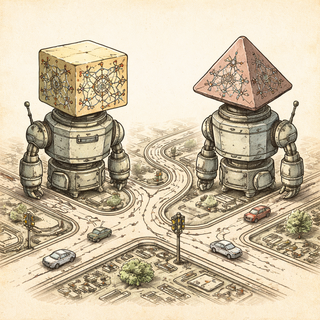
Disclaimer: This blog post is a simplified summary of published research for educational purposes. The accompanying illustration is artistic and does not depict actual model architectures, data, or experimental results. Always refer to the original paper for technical details.