When the Sc2.0 consortium described a redesigned synthetic yeast genome in 2017, it made baker’s yeast look less like pantry dust and more like programmable wetware. Qian and colleagues’ new Nature paper, “Towards the construction of a virtual yeast”, takes the next logical step and then adds a lab coat: what if yeast had a digital double that could reason, simulate, propose experiments, and generally behave like the world’s tiniest research assistant?
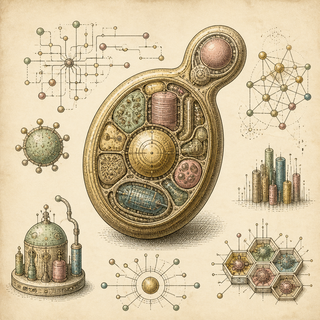
This is not “The Sims: Fermentation Edition.” It is a proposal for an AI-driven virtual cell, built around Saccharomyces cerevisiae, the beloved yeast that gives us bread, beer, wine, and a suspicious number of Nobel-adjacent biology insights. Yeast is useful because it is a eukaryote, meaning its cells have many of the same basic compartments and regulatory headaches as ours, but it is also small, fast-growing, genetically friendly, and much less likely to require an ethics committee when it has a bad Tuesday.
The Cell, But With Tabs Open
The paper’s main idea is to stop pretending a cell can be modeled by one grand equation wearing a crown. Cells are messy. Genes talk to proteins, proteins nudge metabolism, metabolism changes stress responses, structures move around, and then somebody adds glucose and the whole office Slack erupts.
So the authors split virtual yeast into eight function-centered modules spanning genetic, metabolic, and structural systems. Each module acts like a domain-specific AI tool. Above them sits a large language model-based orchestration layer, which is basically the project manager who says, “Mitochondria, you take respiration. Metabolism, please stop eating all the budget. Everyone sync by Friday.”
Under the hood, the system rests on three data pillars: mechanistic knowledge, subcellular architecture, and dynamic states. Translation: what biology already knows, where stuff is inside the cell, and how that stuff changes over time. That matters because static biology is fake biology. A cell is not a diagram. It is a tiny chemical nightclub where every molecule is both dancing and filing taxes.
And Then the Yeast Starts Asking Questions
The spicy part is the closed-loop learning pipeline. The model does not just sit there making predictions like a fortune cookie with a GPU. It uses representation learning and generative modeling to form hypotheses, design experiments, get new results, update itself, and then ask better questions.
And then it predicts which gene edits might improve a biosynthetic pathway. And then it suggests which perturbation to test next. And then the lab result feeds back in. And then, if the system works, researchers spend less time blindly poking cells and more time testing high-value ideas. That is the dream, anyway. Biology has historically treated “simple experiment” as a phrase with strong comedic value.
This connects to a broader push in AI biology. Bunne and colleagues laid out priorities for AI virtual cells in Cell, 2024, while foundation models such as Geneformer and multimodal cell models are trying to learn patterns across huge biological datasets. Meanwhile, community resources like Yeast9, a genome-scale metabolic model of S. cerevisiae, provide the kind of curated scaffolding AI systems desperately need. Without that, a model is just confidently rearranging biology-shaped confetti.
If you are trying to sketch how all these modules connect without turning your whiteboard into spaghetti carbonara, visual tools like mapb2.io are oddly relevant here: virtual cells are partly a mapping problem before they become a prediction problem.
Why This Could Matter
If virtual yeast becomes reliable, the payoff is big. Yeast already helps manufacture enzymes, medicines, flavors, fuels, and specialty chemicals. A good virtual yeast could help researchers optimize biosynthetic pathways before running endless wet-lab trials. Want more of a target molecule and less cellular drama? Ask the model which knobs to turn first.
It could also help prioritize hypotheses in basic biology. Instead of testing every gene, condition, and stressor combination like a very tired wizard, scientists could use the model to rank experiments. That does not eliminate lab work. It makes lab work sharper.
The same blueprint could eventually extend beyond yeast toward other eukaryotic cells. Carefully. Slowly. With many validation experiments and nobody shouting “digital human” after one nice benchmark.
The Reality Check, Served Cold
The hard part is that cells are context machines. A gene’s effect depends on strain, environment, timing, measurement method, and whatever biological weirdness slipped in wearing a fake mustache. Multimodal data can be noisy, incomplete, biased, or measured at incompatible scales. LLM orchestration also needs guardrails, because hallucinated biology is not charming. It is how you waste six months and a freezer shelf.
So the paper is best read as a serious blueprint, not a victory lap. It says: here is how we might combine mechanistic models, omics data, spatial biology, active learning, and AI agents into a more useful simulation of life. That is ambitious. Also slightly unhinged. Good science often is.
The punchline is that yeast, humanity’s ancient fermentation buddy, may become the testbed for AI systems that learn biology by proposing experiments and then eating the consequences. First bread. Then beer. And then a virtual cell that tells us which experiment is worth doing before the incubator gets involved.
References
-
Qian, L. et al. “Towards the construction of a virtual yeast.” Nature 655, 59-70 (2026). DOI: 10.1038/s41586-026-10574-9. PMID: 42387167.
-
Richardson, S. M. et al. “Design of a synthetic yeast genome.” Science 355, 1040-1044 (2017). DOI: 10.1126/science.aaf4557. PMID: 28280199.
-
Bunne, C. et al. “How to build the virtual cell with artificial intelligence: Priorities and opportunities.” Cell 187, 7045-7063 (2024). DOI: 10.1016/j.cell.2024.11.015. arXiv: 2409.11654.
-
Cui, H. et al. “Towards multimodal foundation models in molecular cell biology.” Nature 640, 623-633 (2025). DOI: 10.1038/s41586-025-08710-y.
-
Theodoris, C. V. et al. “Transfer learning enables predictions in network biology.” Nature 618, 616-624 (2023). DOI: 10.1038/s41586-023-06139-9.
-
Zhang, C. et al. “Yeast9: a consensus genome-scale metabolic model for S. cerevisiae curated by the community.” Molecular Systems Biology 20, 1134-1150 (2024). DOI: 10.1038/s44320-024-00060-7. PMCID: PMC11450192.
Disclaimer: This blog post is a simplified summary of published research for educational purposes. The accompanying illustration is artistic and does not depict actual model architectures, data, or experimental results. Always refer to the original paper for technical details.