Compared with AlphaFold-style structure prediction, classic test-tube refolding experiments, and heroic cryo-EM/NMR snapshots of molecular chaos, Chan and colleagues took the extremely un-chill route: they watched half-born proteins fold while still attached to the ribosome, then used fluorine NMR plus simulations to reconstruct the awkward teenage phases that AI still mostly pretends do not exist.
On one hand, that is beautiful. On the other hand, it means biology has been quietly running a molecular escape room inside every cell, and our best models have mostly been looking at the final group photo.
The Protein Is Still Leaving the Factory
Proteins are chains of amino acids, and for a long time the cartoon version was simple: make the chain, release the chain, let the chain fold into its final shape. Like building IKEA furniture, except the furniture builds itself and occasionally becomes toxic furniture soup.
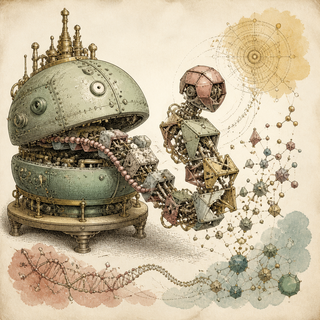
Real cells are messier and more impressive. Proteins often begin folding while the ribosome is still making them. This is called cotranslational folding. The chain emerges from the ribosome exit tunnel bit by bit, so the protein does not get the luxury of seeing its whole body before deciding what to become. Same, honestly.
That matters because folding is not just about the final structure. It is about the route. A protein can head toward the right shape, get trapped in a bad intermediate, aggregate with its neighbors, or need rescue by chaperone proteins. The ribosome may help steer this process, not by making grand executive decisions, but by changing what shapes are physically and energetically available as the chain emerges.
Chan et al. studied FLN5, an immunoglobulin-like domain from a filamin protein. Earlier work had shown that, on the ribosome, FLN5 forms stable folding intermediates that barely show up when the protein is studied off the ribosome. That is already suspicious in the best way. The new paper goes further: it reports structural ensembles for two of those ribosome-bound intermediates, called I1 and I2, in Nature Structural & Molecular Biology Chan et al., 2026.
Fluorine, Because Biology Was Not Weird Enough
The technical trick is ^19F NMR. The team engineered fluorine-containing labels into the nascent protein, then used chemical shifts, paramagnetic relaxation enhancement, protein engineering, and molecular dynamics simulations to infer which parts of the folding protein were near each other.
If normal NMR is like trying to hear one violin in a crowded subway station, ^19F NMR is giving that violin a tiny neon hat. Fluorine is rare in natural proteins, so the signal stands out.
This let the researchers see partially folded states that other labeling schemes missed. Their structures showed native-like folded cores but nonnative termini. Translation: the middle of the protein had already started acting like the grown-up version, while the ends were still making questionable life choices.
Even more interesting, I1 and I2 appeared to interact differently with a molecular chaperone. That suggests the ribosome does not merely slow folding down or hold proteins in place. It may create multiple viable folding routes, each with different opportunities for help, correction, or disaster avoidance.
On one hand, this feels comforting: cells have backup choreography. On the other hand, the choreography involves transient molecular poses so slippery that our instruments needed fluorine breadcrumbs and simulation scaffolding to catch them.
Why AlphaFold Has a Blind Spot Here
This paper also lands in the long shadow of AlphaFold. AlphaFold2 showed that machine learning can predict many mature protein structures with stunning accuracy Jumper et al., 2021, and AlphaFold3 expanded prediction to biomolecular interactions Abramson et al., 2024. Wonderful. Slightly unnerving. Very useful.
But mature structure is not the same as folding history. A wedding photo does not tell you who cried in the parking lot.
Chan et al. explicitly point out that these ribosome-bound intermediates cannot currently be predicted by machine learning methods. A recent computational assessment made the same broader warning: AlphaFold2 does not reliably predict nonnative folding intermediates, especially cotranslational ones, because training on stable final structures does not magically teach a model the whole pathway Duran-Romaña et al., 2026.
That is not a dunk on AlphaFold. It is a boundary marker. The model is excellent at many final forms. This paper asks for the messy middle.
The Ribosome Has Opinions
The wider field has been building toward this. Recent work has shown how chaperones coordinate during cotranslational folding in bacteria Roeselová et al., 2024, how chaperone-assisted folding can be resolved at peptide-level detail Wales et al., 2024, and how codon usage can influence folding by changing translation speed Moss et al., 2024. The message is getting loud: the ribosome is not a neutral conveyor belt. It is more like a bouncer, stage manager, and passive-aggressive life coach in one giant RNA-protein complex.
The real-world impact is not immediate drug design magic. Please keep the confetti in the drawer. But if these findings generalize, they could improve how we understand misfolding diseases, design proteins that fold correctly in cells, engineer expression systems, and train future AI models that care about pathways, not just destinations.
For anyone mapping these pathways visually, this is the kind of problem where a tool like mapb2.io actually makes sense: the science is basically a branching subway map where every station is a molecule having a small identity crisis.
The Awkward Middle Matters
The best part of this paper is also the most humbling: the intermediate is not noise. It is the story.
On one hand, AI has made protein structure feel newly predictable. On the other hand, the ribosome is reminding us that life does not simply compute the answer and print it. It nudges, delays, exposes, hides, recruits helpers, and lets half-made proteins try on shapes before the final act.
That is wonderful. That is terrifying. Possibly both. Definitely both.
References
Chan, S. H. S., Streit, J. O., Włodarski, T., et al. “Structures of protein folding intermediates on the ribosome.” Nature Structural & Molecular Biology 33, 962-972 (2026). https://doi.org/10.1038/s41594-026-01814-7
Jumper, J., Evans, R., Pritzel, A., et al. “Highly accurate protein structure prediction with AlphaFold.” Nature 596, 583-589 (2021). https://doi.org/10.1038/s41586-021-03819-2
Abramson, J., Adler, J., Dunger, J., et al. “Accurate structure prediction of biomolecular interactions with AlphaFold 3.” Nature 630, 493-500 (2024). https://doi.org/10.1038/s41586-024-07487-w
Roeselová, A., Maslen, S. L., Shivakumaraswamy, S., et al. “Mechanism of chaperone coordination during cotranslational protein folding in bacteria.” Molecular Cell 84, 2455-2471.e8 (2024). https://doi.org/10.1016/j.molcel.2024.06.002
Wales, T. E., Pajak, A., Roeselová, A., et al. “Resolving chaperone-assisted protein folding on the ribosome at the peptide level.” Nature Structural & Molecular Biology 31, 1888-1897 (2024). https://doi.org/10.1038/s41594-024-01355-x
Moss, M. J., Chamness, L. M., & Clark, P. L. “The Effects of Codon Usage on Protein Structure and Folding.” Annual Review of Biophysics 53, 87-108 (2024). https://doi.org/10.1146/annurev-biophys-030722-020555
Duran-Romaña, R., et al. “Unavailability of experimental 3D structural data on protein folding intermediates limits evaluation of computational predictions.” Bioinformatics 42, btag020 (2026). https://doi.org/10.1093/bioinformatics/btag020
Disclaimer: This blog post is a simplified summary of published research for educational purposes. The accompanying illustration is artistic and does not depict actual model architectures, data, or experimental results. Always refer to the original paper for technical details.