A flexible health sensor can now be judged by a tougher standard: not just whether it bends like skin, but whether its data survives the sweaty, noisy, wireless obstacle course between your body and a clinician's screen.
That is the story inside Huang and colleagues' review, Polymer-Based Flexible Wireless Sensors for Health Monitoring (DOI: 10.1007/s40820-026-02233-5). The headline version sounds familiar: soft polymer sensors, wireless health monitoring, continuous data. Nice. Very future-of-medicine. But according to the paper's abstract, the authors are after a less glamorous suspect: the communication and processing pipeline where signals fade, noise piles up, and data gets bent out of shape like a cheap phone charger in a backpack.
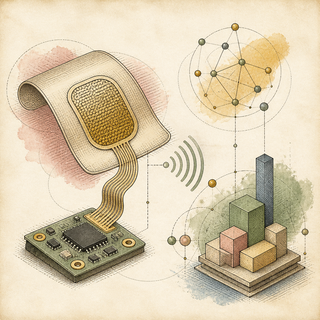
The Patch Is Not the Whole Case
For years, wearable sensor research has loved materials. Hydrogels! Elastomers! Conductive polymers! Tiny flexible circuits doing yoga on your wrist! And to be fair, the materials are genuinely impressive. Recent reviews describe polymer platforms that can capture electrophysiological, biochemical, mechanical, and thermal signals while staying soft enough to live on skin or even near tissue (Xu et al., 2026).
But Huang's review asks the awkward follow-up question: what happens after the sensor senses?
A heart signal, sweat biomarker, respiration pattern, or muscle movement does not teleport cleanly into a medical dashboard. It travels through electrodes, analog front ends, wireless links, compression, filtering, model inference, and power constraints. Every step can add static, latency, missing packets, or distortion. If the raw signal is a witness, the wireless link is the hallway where somebody keeps turning off the lights.
That matters because clinical monitoring needs stability, not just novelty. A wearable that works beautifully in a controlled demo but gets confused by motion, sweat, body position, or weak transmission is less "personalized healthcare" and more "expensive sticker with trust issues."
The Numbers Tell a Different Story
The broader field already knows that wearables are moving toward multi-signal monitoring. Mahato and colleagues reviewed hybrid multimodal wearable sensors that combine biophysical and biochemical measurements, with AI proposed as a way to assess health status in real time (Nature Electronics, 2024). Liu and Lorenzelli also argued that next-generation wearables need flexible circuits, on-device processing, and edge computing, not just soft sensors (Wearable Electronics, 2024).
Huang's contribution fits that shift. The review frames the system as three connected problems: sensing, wireless transmission, and intelligent processing. That sounds tidy, but in practice it is a bar fight between physics, biology, and battery life.
Wireless signals weaken. Motion creates artifacts. Physiological signals are small and moody. The body is full of conductive fluids, moving tissue, and inconvenient geometry. Meanwhile, the battery sits there like a tiny accountant whispering, "You cannot afford that neural network."
So the authors focus on the unsexy tools that make the whole thing plausible: channel compensation, noise suppression, feature extraction, lightweight AI, and edge computing.
Edge AI: The Tiny Bouncer at the Door
Edge computing means doing more work near the sensor, phone, or gateway instead of shipping everything to a distant cloud. In plain English: stop mailing every sneeze to a data center before deciding whether it matters.
That has two advantages. First, it can reduce latency, which matters if a device monitors arrhythmia, respiratory distress, falls, or neurological events. Second, it can save energy by filtering, compressing, or summarizing data before transmission. Wikipedia's edge computing overview describes this general idea as moving computation closer to devices and network gateways, which is exactly the kind of trick wearables need when they are small, wireless, and allergic to big batteries.
But edge AI has to stay lean. These are not giant language models with a billion-dollar electricity bill. They are compact classifiers, filters, and feature extractors that need to run on hardware with the computational confidence of a hotel room thermostat.
When pressed, the technical challenge becomes clear: how do you preserve the medically meaningful part of a signal while throwing away noise, redundancy, and wireless chaos?
Filtering the Gossip From the Evidence
Signal processing has a long toolbox for this job. Filters can suppress known noise bands. Sensor fusion can combine multiple weak clues into one better estimate. Kalman filtering, widely used in sensor fusion, estimates hidden states from noisy measurements over time. Translation: it tries to figure out what is probably happening when the data arrives wearing a fake mustache.
For flexible wireless sensors, these methods may help separate body movement from genuine physiology, compensate for unstable channels, and extract useful features before a lightweight AI model makes a call. The review does not claim that algorithms magically fix bad hardware. Instead, it points toward co-design: materials, antennas, power supply, wireless protocols, and AI all tuned together.
That is the grown-up version of wearable health tech. Not "look, a stretchy sensor!" but "can this system keep producing trustworthy data at 2 a.m. while the wearer sleeps badly, sweats, rolls over, and lives an actual human life?"
What This Could Change
If this direction holds up across real-world trials, flexible wireless sensors could become more than wellness gadgets. They could support continuous monitoring for chronic disease, rehabilitation, elder care, post-surgical recovery, and in vivo measurements where wired systems are impractical.
The catch is reproducibility. Reviews can map the road, but clinical adoption needs validation across people, skin types, movement patterns, environments, and failure modes. The field also has to answer privacy, calibration, durability, and regulatory questions. A health patch that quietly learns from your body is useful; a health patch that quietly leaks, drifts, or hallucinates a diagnosis is a lawsuit in adhesive form.
Huang and colleagues are not selling a single miracle device. They are pointing at the missing infrastructure: robust links, cleaner signals, smarter local processing, and power-aware AI. The sensor is only the first witness. The case depends on whether the whole chain can tell the truth.
References
-
Huang, H., Xue, G., Zhan, J., Yang, Y., Jia, B., Dong, Z., Deng, Z., & Zhao, X. Polymer-Based Flexible Wireless Sensors for Health Monitoring. Nano-Micro Letters. https://doi.org/10.1007/s40820-026-02233-5
-
Xu, D., Yang, Y., Numata, K., & Pang, B. Flexible Polymer-Based Electronics for Human Health Monitoring: A Safety-Level-Oriented Review of Materials and Applications. Nano-Micro Letters 18, 213 (2026). https://doi.org/10.1007/s40820-025-02059-7
-
Mahato, K., Saha, T., Ding, S., Sandhu, S. S., Chang, A.-Y., et al. Hybrid Multimodal Wearable Sensors for Comprehensive Health Monitoring. Nature Electronics 7, 735-750 (2024). https://doi.org/10.1038/s41928-024-01247-4
-
Liu, F., & Lorenzelli, L. Toward All Flexible Sensing Systems for Next-Generation Wearables. Wearable Electronics 1, 137-149 (2024). https://doi.org/10.1016/j.wees.2024.07.003
-
Chen, S., Qiao, Z., Niu, Y., Yeo, J. C., Liu, Y., Qi, J., Fan, S., Liu, X., Lee, J. Y., & Lim, C. T. Wearable Flexible Microfluidic Sensing Technologies. Nature Reviews Bioengineering 1, 950-971 (2023). https://doi.org/10.1038/s44222-023-00094-w
Disclaimer: This blog post is a simplified summary of published research for educational purposes. The accompanying illustration is artistic and does not depict actual model architectures, data, or experimental results. Always refer to the original paper for technical details.