The breakthrough here starts with quiet, unglamorous work: sorting hundreds of thousands of plant proteins into better little boxes, checking their shapes, updating their tags, and generally doing the database equivalent of changing bandages at 2 a.m. No fireworks. No robot violin solo. Just patient biological rescue work, one receptor-like kinase at a time.
And honestly, these proteins needed the help.
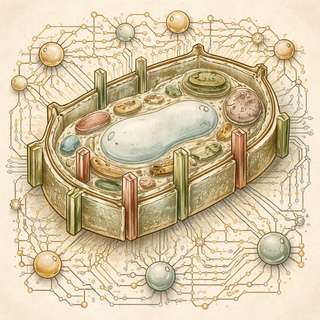
Plant receptor-like kinases, or RLKs, are tiny molecular sentries sitting in or near plant cell membranes. Think of them as the plant's neighborhood watch, except the neighborhood includes drought, fungi, bacteria, growth signals, cell wall stress, and whatever fresh nonsense the environment brought today. A typical RLK has an outside-facing region that senses signals, a membrane-spanning bit, and an inside kinase domain that passes the message along by phosphorylation, which is biology's favorite way of saying, "Please act weird now."
The new paper, metaRLK 2.0, updates a major database for these proteins using structure-based annotation and deep learning-assisted functional classification. The old metaRLK database already housed 311,581 RLKs from 508 plant species, which is not a database so much as a botanical protein boarding school. But about 13% of those RLKs lacked clear domain or family assignments. They were the shy injured rescues in the back crate: probably meaningful, definitely under-described, and not thriving under the old paperwork.
The Problem With Naming Mystery Proteins
For years, scientists often classified proteins by sequence similarity. If two proteins have similar amino-acid strings, they may share ancestry or function. This works pretty well until evolution gets creative, which evolution does constantly, like a raccoon with grant funding.
Protein sequences can drift while their 3D structures stay useful. Two RLKs may look unimpressive on paper but fold into similar shapes that hint at related jobs. That matters because RLKs often use their extracellular domains to recognize ligands: peptides, carbohydrates, cell wall fragments, pathogen-associated molecules, and other molecular "hello, are we under attack?" signals.
Recent RLK reviews have emphasized just how much of plant development, immunity, and stress response runs through these receptor systems. Arabidopsis has hundreds of RLK-related proteins, rice has more than a thousand, and different RLK families specialize in growth, defense, reproduction, cell wall monitoring, and environmental adaptation Frontiers in Plant Science, 2024. Plants may look calm, but at the molecular level they are answering approximately 900 group chats at once.
What metaRLK 2.0 Adds
Zhang and colleagues gave metaRLK a structural checkup. Instead of relying only on old domain labels, they integrated predicted structures, fold classification, network analysis, and semantic functional inference. That is a fancy way of saying: they looked at what the proteins might actually fold into, who they resemble, and what biological work those shapes suggest.
The payoff is substantial. Structural reannotation found 677 distinct domain types, increasing recognized domain types by 62.7%. CATH-based fold classification suggested RLK domains are enriched in rigid beta-fold architectures. The team also built a structural similarity network and identified 70 newly defined RLK families. Even better, 50 of those new families were predicted to connect to plant cell wall-related processes.
That cell wall angle is not a decorative fern in the corner. Plant cell walls are living infrastructure: strength, shape, defense, growth control, all wrapped into one fibrous security system. Wall-associated kinases and related RLK groups can help plants sense damage or changing wall conditions, like a building that can feel when its bricks are sulking. A 2023 review of RLKs in abiotic stress argues that these receptors are key players in how plants respond to harsh environments such as salinity, drought, and temperature stress International Journal of Molecular Sciences, 2023.
Deep Learning as a Protein Rehab Tool
Deep learning did not magically "understand plants." Let's not give the GPU a tiny lab coat just yet. But modern structure prediction has become good enough to help researchers extract biological clues from enormous protein catalogs. AlphaFold showed how neural networks could predict protein structures with impressive accuracy, especially when paired with evolutionary and geometric constraints Nature, 2021. Tools like CATH then help classify structural domains into fold families, giving researchers a more organized map of protein shape space.
In metaRLK 2.0, that matters because some unclassified RLKs were not hopeless cases. They were under-examined cases. The paper reports that 8% of previously unclassified RLKs could now be assigned to known or newly defined families. Is 8% everything? No. But in database rescue work, 8% is the moment a protein eats from the spoon on its own. We celebrate that.
Other recent work shows why this kind of large-scale annotation is useful. A 2024 BMC Plant Biology study analyzed 510,233 N-terminal regulatory element sequences across RLKs from 528 plant species, finding conserved motifs and regulatory features that may act like kinase switches BMC Plant Biology, 2024. That kind of pattern hunting gets much stronger when researchers can combine sequence, structure, domain architecture, and family context instead of squinting at one data type in isolation.
If you are trying to sketch these relationships for yourself, this is exactly the kind of tangled biology where a visual map helps. A tool like mapb2.io would not classify the proteins for you, but it could help you keep track of families, domains, folds, and functions without turning your notes into compost.
Why This Matters Beyond Protein Neatness
Better RLK annotation could help crop scientists identify receptors involved in stress tolerance, disease resistance, growth regulation, or cell wall remodeling. That does not mean metaRLK 2.0 instantly gives us drought-proof wheat or tomatoes that file their own taxes. It gives researchers a better triage board.
The limitations are real. Predicted structures are still predictions. Functional inference is not the same as wet-lab validation. Newly defined families need experimental follow-up: expression data, mutant analysis, ligand testing, structural confirmation, and all the slow careful work that keeps biology honest.
But this paper makes the search space less feral. It turns a pile of mystery RLKs into a more navigable rescue center, with clearer intake forms, better family rooms, and a few newly discovered patients wagging their little beta-fold tails.
That is not hype. That is infrastructure. And in science, infrastructure is often where the real healing starts.
References
Zhang, Z., Li, X., Li, J., Liu, Q., Li, W., Liu, J., Liu, D., Wang, L., Yan, Z., Fu, P., & Yu, F. (2026). metaRLK 2.0: An updated database of plant receptor-like kinases developed with structure- and deep learning-based functional annotation and classification. Plant Communications. DOI: 10.1016/j.xplc.2026.101781. PMID: 41742654
Yadav, B., et al. (2024). An update on evolutionary, structural, and functional studies of receptor-like kinases in plants. Frontiers in Plant Science. DOI: 10.3389/fpls.2024.1305599
Fu, Q., Liu, Q., Zhang, R., Chen, J., Guo, H., Ming, Z., Yu, F., et al. (2024). Large-scale analysis of the N-terminal regulatory elements of the kinase domain in plant receptor-like kinase family. BMC Plant Biology, 24, 174. DOI: 10.1186/s12870-024-04846-7
Rehman, S. U., et al. (2023). Emerging roles of receptor-like protein kinases in plant response to abiotic stresses. International Journal of Molecular Sciences, 24(19), 14762. DOI: 10.3390/ijms241914762
Jumper, J., Evans, R., Pritzel, A., et al. (2021). Highly accurate protein structure prediction with AlphaFold. Nature, 596, 583-589. DOI: 10.1038/s41586-021-03819-2
Disclaimer: This blog post is a simplified summary of published research for educational purposes. The accompanying illustration is artistic and does not depict actual model architectures, data, or experimental results. Always refer to the original paper for technical details.