The paper is titled "Manganese (Hydr)oxides record the dynamic evolution of a million-year Hesperian Ocean in Utopia Planitia, Mars," which is the sort of phrase that makes your coffee file for workers' comp. In plain English: researchers think a deep-learning system found mineral clues on Mars that look a lot like the chemical watermark of a long-lived ancient ocean.
The clue is not water. It's the stain water leaves behind.
According to Hou and colleagues, the key signal is manganese (hydr)oxides - minerals that can form where water chemistry and oxidation conditions line up just right (Hou et al., 2026). The team used short-wave infrared data from China's Zhurong rover, plus ESA and NASA orbital data, and asked a neural network called SCANet to identify where those minerals show up.
Why does that matter? Because the pattern is weirdly tidy. The authors report an altitude-dependent enrichment that forms a mineralogical "bathtub ring" around parts of Utopia Planitia. That is not proof by itself, but it is exactly the sort of pattern that makes planetary geologists stop scrolling and sit up straighter. If you find minerals clustering along a consistent elevation boundary, you start asking the obvious question: was there once a standing body of water here, hanging around long enough to leave a shoreline-like chemical halo?
That question has been simmering for years. Zhurong has already supplied in situ evidence for marine sedimentary rocks in Utopia Planitia, which strengthened the case for a northern Martian ocean (Xiao et al., 2023; PMCID: PMC10411667). A 2025 PNAS paper then reported radar-imaged coastal deposits buried below the surface, again in the same broad region (Li et al., 2025). This new paper tries to go one step further and put a clock on that water.
The AI did not "discover an ocean." It helped sort spectral spaghetti.
This is where the machine learning enters, wearing a lab coat two sizes too big. Hyperspectral imaging measures how materials reflect light across many wavelengths, so instead of a normal picture you get something more like a barcode for rocks. Helpful in theory, messy in practice. Martian dust, mixed minerals, atmospheric effects, and instrument noise all love to jump into the soup.
SCANet was trained on 13,742 spectra, but here is the part worth reading twice: 13,500 were simulated and 242 came from laboratory spectra of Martian soil simulants (Hou et al., 2026). The model reportedly kept classification accuracy above 0.91 in reduced-data tests and cross-validation, and the authors say they validated the spectral interpretations against LIBS-based manganese estimates. They also released code and supporting data through GitHub, which is refreshing. Reproducibility is still not free, but at least the door is unlocked.
If you want the plain-English version of contrastive-style spectral learning, think of it as teaching the model to stop confusing "these two rocks look vaguely alike" with "these two rocks are chemically the same." Like training a sommelier, except the sommelier lives inside a GPU and only drinks infrared.
The headline is bold. The caveats are doing real work.
The paper estimates stable aqueous conditions lasted about 0.8 to 1.5 million years. That is the eye-catching number, and yes, it is a lot longer than a splashy one-weekend flood. But when pressed, the methods reveal a chain of inference, not a direct time machine. The lifespan comes from depositional modeling built on inferred manganese distributions, estimated oxidation-zone depths, and assumptions about how those mineral boundaries formed.
The numbers tell a more careful story than the headline. This is a strong case, not a final verdict. The authors themselves note that their inferred paleoshorelines are constrained mainly at regional to basin scales, not fine-grained local stratigraphy. Also, Mars is rude enough to reuse landscapes. Lava, burial, erosion, periglacial activity, and later flooding all keep trying to rewrite the page after geology thinks it's finished.
That broader debate is active right now. A 2024 Nature Astronomy perspective reviewed the northern-ocean hypothesis and argued Zhurong has pushed it from speculative to increasingly testable (Wang and Huang, 2024). In April 2026, a Nature paper argued that on Mars, the better fingerprint may be a coastal shelf zone rather than a neat shoreline line, which fits the idea that ancient oceans leave broad topographic signatures instead of cartoon beach edges (Nature, 2026).
Why this matters beyond Mars nerds and rover fans
If this result holds up, it means Mars may have hosted not just water, but water with staying power. And that changes the habitability conversation. Chemistry gets more interesting when environments persist. So does the search strategy for future missions.
It also says something about AI in science that is more useful than the usual robot-prophet nonsense. This model did not replace geologists. It helped them read a gigantic spectral haystack without going cross-eyed. Similar hyperspectral and contrastive-learning methods are already being refined for Earth observation and material mapping (Gissibl et al., 2026; Storch et al., 2024). Mars just happens to be the coolest possible stress test, because the ground truth is far away, expensive, and not accepting walk-in appointments.
References
Hou, B., Sun, H., Hu, Z., et al. (2026). Manganese (Hydr)oxides record the dynamic evolution of a million-year Hesperian Ocean in Utopia Planitia, Mars. Nature Communications. https://doi.org/10.1038/s41467-026-72858-y
Xiao, L., Huang, J., Kusky, T., et al. (2023). Evidence for marine sedimentary rocks in Utopia Planitia: Zhurong rover observations. National Science Review, 10(9), nwad137. https://doi.org/10.1093/nsr/nwad137 ; PMCID: PMC10411667
Wang, L., & Huang, J. (2024). Hypothesis of an ancient northern ocean on Mars and insights from the Zhurong rover. Nature Astronomy, 8, 1220-1229. https://doi.org/10.1038/s41550-024-02343-3
Li, J., et al. (2025). Ancient ocean coastal deposits imaged on Mars. Proceedings of the National Academy of Sciences, 122(9), e2422213122. https://doi.org/10.1073/pnas.2422213122
Liu, Y., et al. (2025). Multipolarized radar reveals shallow subsurface structure and middle-late Amazonian aqueous activity in Utopia Planitia, Mars. National Science Review. https://doi.org/10.1093/nsr/nwaf505
Moreland, K., et al. (2022). Formation of manganese oxides on early Mars due to active halogen cycling. Nature Geoscience, 16, 44-49. https://doi.org/10.1038/s41561-022-01094-y
Gissibl, A., et al. (2026). Hyperspectral imaging. Nature Reviews Methods Primers, 6. https://doi.org/10.1038/s43586-026-00470-x
Storch, T., et al. (2024). HyperKon: A Self-Supervised Contrastive Network for Hyperspectral Image Analysis. Remote Sensing, 16(18), 3399. https://doi.org/10.3390/rs16183399
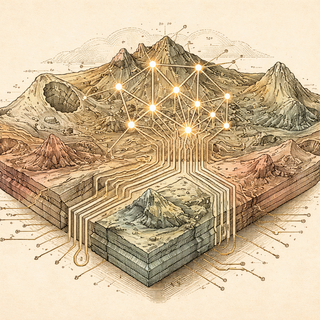
Disclaimer: This blog post is a simplified summary of published research for educational purposes. The accompanying illustration is artistic and does not depict actual model architectures, data, or experimental results. Always refer to the original paper for technical details.