There's a fundamental absurdity in how large language models work. You train them on hundreds of billions of words, freeze their knowledge at a cutoff date, and then ask them questions about the world as if they're an encyclopedia that stopped updating in 2024. "What's the latest treatment guideline for type 2 diabetes?" "Let me tell you about the 2023 standards, because I have no idea what happened after that. But I'll sound very confident about it."
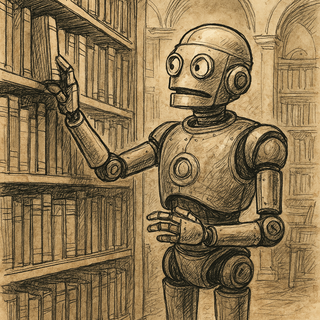
Retrieval-Augmented Generation - everyone calls it RAG - fixes this by doing something shockingly obvious: letting the AI look things up before it answers.
The Library Analogy That Actually Works
Imagine two students taking an open-book exam. Student A memorized the entire textbook last semester and is now working from memory. Student B has the textbook open on their desk and flips to the relevant chapter before writing each answer.
Student A (the standard LLM) knows a lot, but their memory is imperfect, sometimes outdated, and occasionally just wrong in ways they can't detect. Student B (the RAG system) might know less off the top of their head, but their answers cite actual sources and reflect the most current information available.
RAG is about turning closed-book AI into open-book AI.
How It Actually Works
A RAG system has two main components:
The retriever. When a query comes in, the retriever searches through a knowledge base - which could be a collection of documents, a database, a set of web pages, whatever - and pulls out the most relevant chunks of text. This typically uses vector similarity search: the query and all documents are converted into numerical vectors (embeddings), and the retriever finds documents whose vectors are closest to the query's vector.
The generator. The retrieved documents are stuffed into the LLM's context window along with the original query. The prompt basically says "here's what the user asked, and here's some relevant information - now generate a response." The LLM synthesizes the retrieved information into a coherent answer.
That's it. The genius is in the simplicity. You don't need to retrain the model when information changes - you just update the knowledge base. You don't need to worry (as much) about hallucinations on factual questions, because the model is working from actual source material rather than fuzzy memory.
The Chunk Size Problem and Other Headaches
If you've ever tried to build a RAG system, you know it sounds simple on paper and turns into an engineering nightmare in practice. Here are the pain points:
Chunking. You have to split documents into pieces that fit the context window, but how you split them matters enormously. Cut mid-sentence? Bad. Cut between two paragraphs that answer the question together? Bad. There's an entire sub-field dedicated to chunking strategies, and none of them work perfectly.
Retrieval quality. The system is only as good as its retriever. Embedding models have blind spots - they sometimes rank semantically similar but factually irrelevant documents higher than the one that actually answers the question.
The "lost in the middle" problem. LLMs pay more attention to information at the beginning and end of their context window and ignore stuff in the middle. If the key fact is in document #4 out of 7, the model might skip it.
Contradictory sources. When your knowledge base contains documents that disagree, the model often just picks whichever appeared most recently in the context. Especially problematic in medical and legal domains.
Where RAG Actually Shines
RAG is genuinely useful in specific scenarios: enterprise search (ask questions in natural language, get answers citing actual company documents), up-to-date information (connect to a regularly updated knowledge base instead of retraining), domain-specific applications (medical databases, legal case law, technical documentation where accuracy beats creativity), and auditable responses (cite sources so users can verify, which matters when "the AI said so" isn't acceptable).
The Future: Beyond Basic RAG
The field is moving toward multi-step RAG (break complex questions into sub-questions), agentic RAG (the model decides when and what to search for), and graph RAG (knowledge graphs instead of flat document stores, preserving entity relationships).
For anyone building the knowledge bases that feed RAG systems, clean source material matters. If your PDFs are a mess of scanned images and broken formatting, your RAG system inherits that mess. pdfb2.io handles PDF processing - splitting, merging, annotations - making it easier to prepare clean documents for any retrieval system.
The bottom line: RAG doesn't make AI smarter. It makes AI less likely to guess when it could just look. - ## References
- Lewis P, et al. Retrieval-Augmented Generation for Knowledge-Intensive NLP Tasks. NeurIPS. 2020. arXiv: 2005.11401
- Gao Y, et al. Retrieval-Augmented Generation for Large Language Models: A Survey. arXiv: 2312.10997. 2024.
- Liu NF, et al. Lost in the Middle: How Language Models Use Long Contexts. TACL. 2024. arXiv: 2307.03172