Fourteen years of assuming graphene is see-through to water? Done.
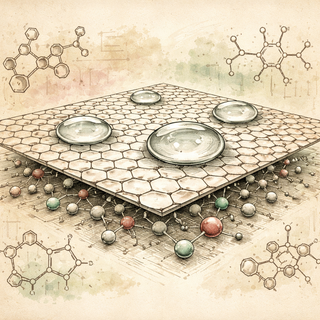
Since 2012, a tidy idea has dominated the graphene world: that this atom-thick sheet of carbon is so impossibly thin that water droplets sitting on top of it can "feel" whatever surface lies beneath. Put graphene on copper, and water thinks it's touching copper. Lay it on glass, and water acts like it's on glass. Researchers called it "wetting transparency," and it was elegant, intuitive, and - according to a new machine-learning-powered study in Nature Communications - wrong at the molecular level.
The Plot Twist Nobody Expected
A team led by Dianwei Hou, Stefan Ringe, and Minhaeng Cho at Korea University and the Institute for Basic Science ran molecular dynamics simulations using a machine-learning interatomic potential trained on quantum-mechanical calculations. Think of it as teaching a neural network to mimic the expensive quantum math, then letting it loose on systems large enough and long enough to actually reveal what water does near graphene (Hou et al., 2026).
Their verdict: pristine graphene is hydrophobic. It repels water. Full stop.
But here's where it gets weird. When they simulated the spectroscopy experiments that had previously suggested graphene was letting substrate wettability shine through, they found the "hydrophilic" signal wasn't coming from transparency at all. It was coming from water molecules that had snuck underneath the graphene, wedging themselves between the carbon sheet and the substrate like uninvited guests crashing a molecular house party.
Water: The Ultimate Gatecrasher
The technique they simulated is called vibrational sum-frequency generation (VSFG) spectroscopy - a laser-based method that's exquisitely sensitive to how water molecules orient themselves at surfaces. Previous VSFG experiments on monolayer graphene sitting on hydrophilic substrates showed signatures that screamed "this surface likes water." Naturally, everyone assumed the substrate's friendliness was leaking through.
Nope. The simulations show those signals come from intercalated water - molecules trapped in the angstrom-scale gap between graphene and substrate - whose orientations partially cancel out the signal from water on top. The resulting spectrum looks like wetting transparency but has a completely different physical origin. It's the molecular equivalent of two people shouting opposite things and you hearing a third message entirely.
Why Machine Learning Cracked This
Classical molecular dynamics simulations use pre-built force fields that approximate how atoms interact. They're fast but often miss subtle quantum effects. Pure quantum calculations (density functional theory) capture those effects but choke on anything bigger than a few hundred atoms. Machine learning interatomic potentials - specifically the Atomic Cluster Expansion framework used here - split the difference: quantum-level accuracy at a fraction of the computational cost (Batatia et al., 2022).
This let the team simulate thousands of water molecules interacting with graphene over nanosecond timescales, then compute spectroscopic observables directly comparable to experiments. It's like upgrading from a blurry security camera to 4K footage of the crime scene.
The Thickness Effect (Or: Why More Layers = More Honest)
Here's an elegant finding: water intercalation is thermodynamically favorable for monolayer graphene on hydrophilic substrates but becomes unfavorable for multilayer graphene. More layers mean a stiffer barrier that water can't slip under. This neatly explains a long-standing experimental puzzle - why graphene's apparent wettability changes with thickness. It's not that thicker graphene blocks the substrate's influence (the wetting transparency story). It's that thicker graphene keeps the gatecrasher water molecules out from below.
Recent work by Lim and colleagues using similar ML potentials found a contact angle of about 72 degrees for free-standing graphene (Lim et al., 2026), firmly in hydrophobic territory and consistent with this paper's conclusions. Meanwhile, Wang et al. showed that while macroscopic contact angles might suggest transparency, the nanoscopic water structure tells a different story (Wang et al., 2025). The consensus is shifting fast.
Why Should You Care About Wet Carbon?
Graphene membranes are a leading candidate for next-generation water desalination and filtration. If you're designing a membrane and you think the surface loves water when it actually repels it, your design assumptions are fundamentally off. Same goes for graphene-based biosensors, anti-corrosion coatings, and nanofluidic devices. Getting the wettability right isn't academic trivia - it's the difference between a filter that works and one that clogs.
And the broader lesson? Sometimes when experiments give confusing, contradictory results for over a decade, the answer isn't that the measurements are bad. It's that there's a hidden variable - in this case, sneaky intercalated water - that nobody accounted for. Machine learning didn't just speed up the simulations. It made the invisible visible.
References
-
Hou, D., Horbatenko, Y., Ringe, S., & Cho, M. (2026). Machine-learning enhanced simulations predict graphene is hydrophobic and microscopically not wetting transparent. Nature Communications. DOI: 10.1038/s41467-026-71053-3. PMID: 41922339.
-
Rafiee, J., Mi, X., Gullapalli, H., et al. (2012). Wetting transparency of graphene. Nature Materials, 11, 217-222. DOI: 10.1038/nmat3228.
-
Lim, H., Advincula, X. R., Witt, W. C., et al. (2026). Revealing strain effects on the graphene-water contact angle using a machine learning potential. arXiv:2601.20134.
-
Wang, Y., Litman, Y., Cho, M., Cox, S. J., & Bonn, M. (2025). Wetting transparency of graphene: A macroscopic window but nanoscopic mirror. arXiv:2511.04930.
-
Batatia, I., Kovacs, D. P., Simm, G. N. C., Ortner, C., & Csanyi, G. (2022). MACE: Higher order equivariant message passing neural networks for fast and accurate force fields. NeurIPS 2022. arXiv:2206.07697.
-
Li, Z., Naik, A. A., et al. (2015). Solving the controversy on the wetting transparency of graphene. Scientific Reports, 5, 15526. DOI: 10.1038/srep15526.
Disclaimer: This blog post is a simplified summary of published research for educational purposes. The accompanying illustration is artistic and does not depict actual model architectures, data, or experimental results. Always refer to the original paper for technical details.