Backpropagation has a dirty secret that neuroscientists have been side-eyeing for decades: it's biologically ridiculous. The algorithm that powers everything from ChatGPT to your phone's photo filters requires neurons to send error signals backward through the exact same pathways they use going forward - something real neurons absolutely do not do. It's like expecting your postal carrier to also be your return-mail service, using the same truck, at the same time, traveling in both directions simultaneously.
A new study from Alessandro Galloni and colleagues at Rutgers-Newark just demonstrated that you can build neural networks that actually respect how brains work - and they still learn to classify images just fine, thank you very much.
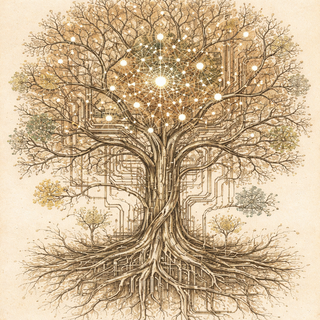
Your Neurons Have Apartments, Not Studio Units
Here's something wild about your brain cells: they're not simple on-off switches. Each neuron has elaborate tree-like branches called dendrites that receive thousands of inputs, and different parts of these branches operate under completely different learning rules. Recent research in Science showed that the upper branches (apical dendrites) strengthen connections based on what their neighbors are doing, while the lower branches (basal dendrites) care more about whether the whole neuron actually fired.
It's like having roommates who each have their own lease agreements within the same apartment.
The Rutgers team built artificial neural networks that mimic this compartmentalized structure. Instead of treating each artificial neuron as a single point that sums inputs and spits out an output, they gave their neurons separate dendritic compartments that process information differently - just like the real thing.
Dale's Law: The Rule Everyone Ignored
There's another biological constraint that most AI researchers pretend doesn't exist: Dale's principle. In your brain, a neuron is either excitatory (it encourages other neurons to fire) or inhibitory (it tells them to calm down). It can't be both. This is like having dedicated cheerleaders and dedicated referees - nobody's doing both jobs.
Standard neural networks? They completely ignore this. Any connection can be positive or negative, flipping based on whatever gradient descent feels like that day. The Rutgers team enforced strict separation between excitatory and inhibitory units, creating what researchers call "Daleian" networks.
Target Propagation: The Anti-Backprop
The real star of this research is an algorithm called dendritic target propagation. Instead of sending error gradients backward (which requires those biologically impossible symmetric weight connections), this approach sends target activations - essentially telling each layer "here's what you should have produced" rather than "here's how wrong you were."
Think of it like coaching a basketball team. Backpropagation is the coach who watches you miss a shot and calculates exactly how many degrees off your elbow angle was, then somehow transmits that mathematical critique backward through every muscle you used. Target propagation is the coach who just shows you a video of the correct form and says "do it more like this."
The math works out differently, but critically, it can all happen using local information - each neuron only needs to know about its immediate inputs and its assigned target, not some mystical global error signal beamed in from the output layer.
Why Should Anyone Care?
This isn't just an academic exercise in biological navel-gazing. By adhering to how brains actually compute, this model makes testable predictions about what specific cell types should be doing during learning. That's the kind of thing neuroscientists can actually go verify with electrodes and microscopes.
There's also a practical angle: biologically plausible algorithms tend to be more robust and parameter-efficient. When you're not fighting against architectural constraints, you need fewer neurons to get the job done. Recent work on Dendritic Localized Learning shows these approaches can match backpropagation's performance while using significantly fewer trainable parameters.
The Punchline
For thirty years, AI researchers essentially told neuroscientists "your wiring diagram is cute, but we've got gradient descent and GPUs." Now the biologists are showing that maybe, just maybe, evolution spent 500 million years figuring out some tricks worth paying attention to.
The brain doesn't do backpropagation. It does something weirder, more local, and apparently just as effective. The Rutgers team proved you can build that weirdness into silicon - and it works.
Next time someone tells you AI is "inspired by the brain," you can now ask: "Which part? The part we made up, or the part that actually exists?"
References:
-
Galloni AR, Peddada A, Chennawar Y, Milstein AD. Cellular and subcellular specialization enables biology-constrained deep learning. Cell Reports. 2026. DOI: 10.1016/j.celrep.2026.117159
-
Lv Z, et al. Dendritic Localized Learning: Toward Biologically Plausible Algorithm. ICML 2025. arXiv:2501.09976
-
Dendrites endow artificial neural networks with accurate, robust and parameter-efficient learning. Nature Communications. 2025. DOI: 10.1038/s41467-025-56297-9
-
Cornford J, et al. Learning to live with Dale's principle: ANNs with separate excitatory and inhibitory units. ICLR 2021. OpenReview
-
Bhattacharya S, et al. Distinct synaptic plasticity rules operate across dendritic compartments in vivo during learning. Science. 2025. DOI: 10.1126/science.ads4706
Disclaimer: This blog post is a simplified summary of published research for educational purposes. The accompanying illustration is artistic and does not depict actual model architectures, data, or experimental results. Always refer to the original paper for technical details.