Bacteria are clever little jerks. They mutate, they hide, they team up against our best antibiotics like a microscopic Ocean's Eleven. And our traditional methods for catching them? About as fast as dial-up internet. Culture-based testing can take days. ELISA tests need expensive equipment. Microscopy requires someone who actually knows what they're looking at. Meanwhile, the pathogens are out there, multiplying and laughing at us.
Enter nanosensors: the molecular equivalent of giving a bloodhound a chemistry degree and a really, really good magnifying glass.
A comprehensive new review in ACS Nano by Zargul and colleagues maps out how three converging technologies are turning pathogen detection from a waiting game into something approaching real-time surveillance. Think of it as the diagnostic holy trinity: smart biorecognition elements that grab onto pathogens with near-obsessive specificity, signal amplification systems that can spot a single bacterium in a crowd, and integrated platforms that put CRISPR, AI, and microfluidics together on devices small enough to fit in your pocket.
The Biorecognition Buffet
The first challenge in finding pathogens is grabbing onto them specifically without false alarms. Traditionally, we've used antibodies - nature's highly specific sticky notes. But antibodies are expensive, finicky about temperature, and take months to produce.
The new generation of nanosensors has options. Aptamers are short DNA or RNA sequences that fold into 3D shapes capable of binding targets with antibody-like precision, except they're cheaper to synthesize and more stable. Bacteriophages - viruses that specifically infect bacteria - bring millions of years of evolutionary target practice to the table. Molecularly imprinted polymers are essentially plastic antibodies with custom-shaped cavities that fit specific pathogens like molecular puzzle pieces. Some researchers are even using antimicrobial peptides and lectins as biorecognition elements, each with their own advantages for specific detection scenarios.
Signal Amplification: From Whisper to Shout
Finding a handful of bacteria in a blood sample is like trying to spot a specific grain of sand on a beach. The signal they produce is vanishingly small. This is where nanosensors really earn their keep.
Nanomaterials like gold nanoparticles and quantum dots act as signal amplifiers, converting tiny binding events into measurable optical or electronic signals. Enzymatic cascades can multiply these signals further. But the real stars are isothermal nucleic acid amplification techniques that can detect down to femtomolar concentrations and single-cell levels.
CRISPR-based diagnostics like SHERLOCK and DETECTR have added another amplification trick: Cas proteins that, once they find their target, go on a nucleic acid chopping spree that generates easily detectable signals. DETECTR was the first CRISPR diagnostic to get FDA Emergency Use Authorization during COVID-19, achieving 95% sensitivity and 100% specificity while compressing detection time to under 40 minutes.
The Platform Party
Having great biorecognition elements and signal amplifiers is nice, but you need somewhere to put them. Microfluidic lab-on-chip devices shrink entire diagnostic workflows onto devices the size of a credit card, moving tiny fluid volumes through channels narrower than a human hair. This means less sample needed, faster reactions, and portable deployment.
Add AI to the mix, and things get interesting. Machine learning algorithms are being trained to interpret complex sensor outputs, classify pathogens with over 95% accuracy, and even help design better biorecognition elements for emerging threats. One nanosensor array using AI-enhanced analysis discriminated eight foodborne pathogens with up to 100% accuracy within an hour.
Why This Matters Beyond the Lab
Antimicrobial resistance is projected to cause 10 million deaths annually by 2050. A massive contributor to this crisis is the inappropriate use of antibiotics - often prescribed because doctors don't have time to wait for culture results. If you could identify the specific pathogen and its resistance profile at the bedside, in the field, or at the local clinic rather than sending samples away and waiting days, treatment could be targeted from the start.
The World Health Organization has ASSURED criteria for point-of-care tests: affordable, sensitive, specific, user-friendly, rapid, robust, equipment-free, and deliverable to end users. Nanosensor platforms are checking off these boxes one by one.
Of course, challenges remain. Manufacturing these devices at scale with consistent quality isn't trivial. Regulatory approval for novel diagnostic technologies takes time. And interpreting complex AI-assisted outputs in clinical settings requires trust and transparency that are still being built.
But the trajectory is clear. The same convergence of computing, biology, and materials science that gave us smartphones and gene editing is now being aimed at one of medicine's oldest problems: figuring out what's making you sick, fast enough to actually do something about it.
The pathogens had a good run. Time to even the odds.
References
-
Zargul, A., Liu, H., Zhang, W., Wang, H., Liu, J., & Chen, C. (2025). Advances in Pathogen Detection by Nanosensors: Biorecognition Strategies, Signal Amplification, and Platform Engineering. ACS Nano. DOI: 10.1021/acsnano.5c22148
-
Artificial Intelligence-Assisted Nanosensors for Clinical Diagnostics: Current Advances and Future Prospects. (2024). Biosensors. PMC12564406
-
Integration of Artificial Intelligence in Biosensors for Enhanced Detection of Foodborne Pathogens. (2024). Biosensors. PMC12564411
-
Recent developments and future directions in point-of-care next-generation CRISPR-based rapid diagnosis. (2024). Clinical and Experimental Medicine. PMC11717804
-
Recent Advances in Aptamer-Based Biosensors for Bacterial Detection. (2024). Biosensors. MDPI
-
A review of new emerging biosensors based on bacteria-imprinted polymers towards pathogenic bacteria. (2024). Microchemical Journal. ScienceDirect
-
The Global Challenge of Antimicrobial Resistance: Mechanisms, Case Studies, and Mitigation Approaches. (2024). PMC. PMC12284435
-
Microfluidic systems for infectious disease diagnostics. (2024). Lab on a Chip. RSC Publishing
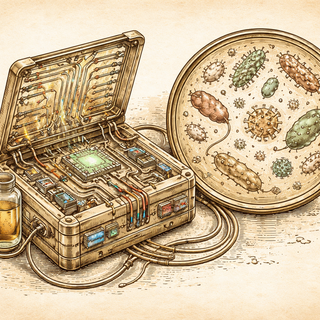
Disclaimer: This blog post is a simplified summary of published research for educational purposes. The accompanying illustration is artistic and does not depict actual model architectures, data, or experimental results. Always refer to the original paper for technical details.