A chip that trains itself using light instead of electricity just landed in Nature, and it might be the most important thing to happen to AI hardware since someone decided to strap thousands of GPUs together and pray the cooling system held up.
The Problem with Teaching Light New Tricks
Neural networks are hungry. Not "skipped lunch" hungry - more like "devouring the energy output of a small nation" hungry. Training GPT-scale models on electronic hardware generates enough heat to make data center engineers weep into their server racks. Photonic neural networks - chips that compute with light instead of electrons - have been the tantalizing alternative for years: faster, cooler, and potentially thousands of times more energy efficient (Bandyopadhyay et al., 2024).
But here's the catch that kept photonic computing in the "promising but not quite there" category: you could run a trained network on a photonic chip, but training it? That still required a regular digital computer sitting next to it, doing all the calculus homework. It's like buying a sports car but needing a donkey to push-start it every morning.
The core issue is backpropagation - the algorithm that lets neural networks learn from their mistakes by sending error signals backward through the network. On electronic chips, backprop is straightforward. On photonic chips, where your "wires" are beams of light bouncing through interferometers, it's been a nightmare. Previous attempts either relied on off-chip digital processors to calculate gradients (Hughes et al., 2023) or used gradient-free training methods that are about as efficient as trying to tune a guitar by randomly turning pegs.
Light, Camera, Backpropagation
Researchers at Nokia Bell Labs - Farshid Ashtiani, Mohamad Hossein Idjadi, and Kwangwoong Kim - just solved this problem in a way that's almost offensively elegant. They built a photonic chip that performs backpropagation entirely in the optical domain. No digital babysitter required (Ashtiani et al., 2026).
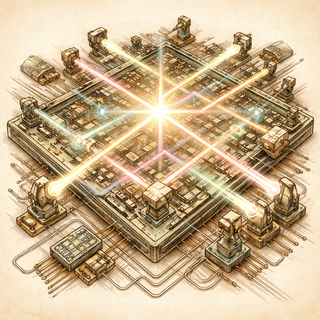
The chip includes both forward and backward optical paths with multiple layers of photonic neurons. Each layer uses tunable optical elements for linear weights (think of tiny adjustable mirrors steering light) and opto-electronic components for nonlinear activation functions (the mathematical squishing that makes neural networks actually useful). The backward path interferes forward-propagating and backward-propagating light to measure gradients directly - the optical equivalent of a network saying "here's exactly how wrong I was, and here's how to fix it."
The whole thing was fabricated in a standard silicon photonic foundry. Not a custom, one-off lab curiosity - a standard foundry. That's the manufacturing equivalent of saying "yeah, we could mass-produce these."
The Results That Matter
On two nonlinear classification benchmarks, the chip hit over 90% accuracy - matching the performance of an equivalent ideal digital model. But the really interesting part isn't the accuracy number itself. It's that the chip maintained stable training despite the manufacturing imperfections that plague silicon photonics. Every chip comes off the fabrication line slightly different, and previous photonic networks would choke on these variations. This one just... adapted. Because it was training itself, on itself, it automatically compensated for its own quirks.
This is the difference between a musician who memorized a piece in a studio and one who can improvise through a broken string.
Why Your Future GPU Might Be Made of Glass
The energy math here is staggering. Photonic processors have demonstrated energy-per-bit improvements of over 4,000x compared to GPUs (Pai et al., 2023), and recent large-scale photonic accelerators with 16,000+ integrated components already show ultralow latency compared to commercial GPUs (Nature, 2025). Companies like Lightmatter and Q.ANT are shipping photonic processors that can run models like ResNet and BERT out of the box.
But all of those systems still train elsewhere and run inference on the photonic chip. Nokia Bell Labs' contribution is the missing piece: a photonic chip that can learn on its own. If you can train and run on the same optical hardware, you unlock real-time adaptation at the edge - self-driving cars that retrain on the fly, telecom systems that optimize themselves, signal processors that get smarter without phoning home to a data center.
If you're trying to wrap your head around how optical neural architectures differ from traditional ones, visual tools like mapb2.io can help you map out these multi-layer network topologies side by side - sometimes seeing the structure makes the light-versus-electron distinction click.
What's Still in the Way
Let's not get carried away. The demonstrated chip solves classification tasks, not trillion-parameter language models. Scaling photonic neural networks to the size of modern AI systems remains an open engineering challenge. The nonlinear activations are opto-electronic (part optical, part electrical), not purely optical, which adds complexity. And while the chip was fabricated in a standard foundry, "standard" in silicon photonics still means relatively low production volumes compared to mainstream electronics.
Still, this paper represents a genuine inflection point. The team behind it includes Ashtiani, who previously demonstrated a photonic deep neural network for sub-nanosecond image classification in Nature back in 2022 (Ashtiani et al., 2022). That chip could classify handwritten letters in under 570 picoseconds - but it couldn't train itself. Now it can.
The trajectory is clear: photonic computing is no longer just fast inference hardware waiting for someone else to do the teaching. It's starting to think for itself. And it's doing it at the speed of light, which - let's be honest - is a pretty solid flex.
References
-
Ashtiani, F., Idjadi, M.H. & Kim, K. Integrated photonic neural network with on-chip backpropagation training. Nature (2026). DOI: 10.1038/s41586-026-10262-8
-
Ashtiani, F., Geers, A.J. & Aflatouni, F. An on-chip photonic deep neural network for image classification. Nature 606, 501 - 506 (2022). DOI: 10.1038/s41586-022-04714-0
-
Hughes, T.W. et al. Experimentally realized in situ backpropagation for deep learning in photonic neural networks. Science 380, 6647 (2023). DOI: 10.1126/science.ade8450
-
Bandyopadhyay, S. et al. Single-chip photonic deep neural network with forward-only training. Nature Photonics 18, 1335 - 1343 (2024). DOI: 10.1038/s41566-024-01567-z
-
Chen, H. et al. An integrated large-scale photonic accelerator with ultralow latency. Nature (2025). DOI: 10.1038/s41586-025-08786-6
Disclaimer: This blog post is a simplified summary of published research for educational purposes. The accompanying illustration is artistic and does not depict actual model architectures, data, or experimental results. Always refer to the original paper for technical details.