A 17th-century painting just spilled its secrets to a laser beam, and the results are kind of wild.
Researchers at the Metropolitan Museum of Art and the University of Bordeaux have essentially turned an analytical chemistry technique - the kind usually reserved for identifying proteins in biological samples - into an art history detective tool. Their target? The Marriage of the Virgin, a painting from around 1690 by José Sánchez. Their method? Zapping tiny paint samples with lasers and letting machine learning sort through the molecular chaos.
The Problem With Peeling Back the Layers
Old paintings are basically geological formations made of organic goo. You've got your canvas, your sizing layer (historically made from rabbit skin glue, because of course it was), ground layers, multiple paint applications, possibly some gold leaf thrown in for good measure, and a varnish top coat that's been slowly yellowing for centuries.
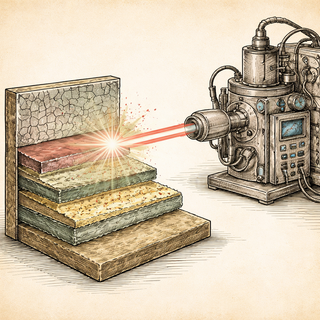
Understanding this layer cake matters enormously for conservation. How was the artwork originally created? What's degraded? What's a later "restoration" that a well-meaning conservator added in 1847? Traditional analysis methods often require dissolving samples - which destroys the very spatial information you're trying to preserve. It's like grinding up a sedimentary rock and then asking where each grain of sand came from.
Enter the Laser (and the Learning Algorithm)
The technique in question is MALDI mass spectrometry imaging, which stands for matrix-assisted laser desorption/ionization. Here's the basic idea: you coat your sample in a special crystalline matrix, hit it with a pulsed laser, and the matrix absorbs the energy while gently lifting molecules off the surface and giving them an electrical charge. These charged molecules then get sorted by mass in a spectrometer. Do this across an entire cross-section of paint, pixel by pixel, and you build a chemical map showing exactly where each compound lives.
The team had to solve some genuinely tricky problems. Paint samples are brittle and don't slice cleanly. The existing databases for interpreting mass spectra were built for biological tissues, not 17th-century oil paints full of degradation products nobody had catalogued. So they extended the spectral libraries to include what paint actually becomes after three centuries of slow chemical transformation.
Then came the machine learning piece. They trained a model on paint samples that had been prepared fifteen years earlier - essentially creating reference standards with known compositions. The algorithm learned to recognize patterns in the mass spectra and automatically assign layer compositions without requiring a human expert to manually interpret every peak.
What They Actually Found
Six distinct layers in the painting cross-section, each with its own molecular fingerprint. The results included animal glue binders, various pigments, and - here's the cool part - a super-thin gold leaf layer that traditional analytical methods would likely have missed entirely. When you dissolve a sample for bulk analysis, a whisper-thin layer of gold just... disappears into the noise.
The technique also revealed how varnish compounds had penetrated through underlying paint layers over time. This kind of information is gold (pun intended) for conservators trying to understand how materials interact and degrade.
Why This Actually Matters
This isn't just "cool science trick applied to old stuff." Understanding the molecular reality of how paintings age helps conservators make smarter decisions about storage conditions, lighting, and treatment approaches. If you know that a particular binding medium forms problematic compounds when exposed to certain wavelengths of light, you can adjust the gallery environment accordingly.
The researchers also suggest the technique could help authenticate artworks that lack documentation. Every artist's choice of materials - the specific oils, pigments, and preparation methods - leaves a molecular signature. That signature is now readable at a resolution that wasn't previously possible.
The broader trend here is significant: machine learning is increasingly transforming art conservation. From using convolutional neural networks to identify pigments in hyperspectral images to deep learning approaches for analyzing X-ray fluorescence data, algorithms are becoming essential partners in understanding cultural heritage.
The Future: Portable Molecular Analysis?
Looking ahead, researchers envision bringing mass spectrometry directly into museums rather than extracting samples and shipping them to labs. The dream is non-destructive, in-situ analysis - point a device at a suspicious area of a painting and get a molecular readout without touching the surface.
We're not there yet. But this study represents a significant step toward making high-resolution chemical imaging a standard tool in the conservator's toolkit. The paintings hanging in museums around the world have stories written in their molecular structure. We're finally developing the vocabulary to read them.
References
Krupička, V., Grélard, F., Blanc, L., Popowich, A., Lazarte Luna, J.L., Desbenoit, N., Arslanoglu, J., & Tokarski, C. (2026). Layer-by-layer decoding of contemporary and historic painting composition using MALDI mass spectrometry imaging and machine learning. Science Advances. DOI: 10.1126/sciadv.adz4427
Smoluch, M., et al. (2023). Mass spectrometry in art conservation - With focus on paintings. Mass Spectrometry Reviews. Available at Wiley Online Library
Ngai, K.H., et al. (2025). Mini Review: Highlight of Recent Advances and Applications of MALDI Mass Spectrometry Imaging in 2024. Analytical Science Advances. PMID: 40352425
Disclaimer: This blog post is a simplified summary of published research for educational purposes. The accompanying illustration is artistic and does not depict actual model architectures, data, or experimental results. Always refer to the original paper for technical details.