A quadcopter the size of your palm just flew through dense fog, total darkness, and falling snow - without a camera, without LIDAR, without GPS. Its secret? Sonar, the same trick bats figured out about 50 million years ago.
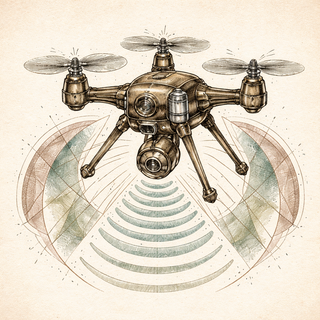
Researchers at Worcester Polytechnic Institute and Chirp Microsystems built Saranga, a 72-gram aerial robot that uses ultrasound to dodge obstacles when every other sensor would be flying blind. And the whole perception system sips just 1.9 milliwatts of power. That's less than your phone uses to display a single notification.
The Problem with Seeing
Here's the thing about cameras and LIDAR on tiny drones: they're great until they're not. Dust storms, fog banks, smoke from wildfires, the inside of a collapsed building - these are exactly the places you'd want to send a small, cheap, expendable robot, and exactly the places where optical sensors become very expensive paperweights.
RADAR can punch through visual clutter, but it's power-hungry. Millimeter-wave radar modules drink watts like they're going out of style. When your entire robot weighs less than a deck of cards and runs on a battery the size of your thumbnail, that's a non-starter.
Ultrasound, though? Ultrasound is cheap, low-power, and couldn't care less whether there's light in the room. The catch is that sonar signals on a tiny drone get absolutely demolished by propeller noise. The spinning blades create ultrasonic interference that drowns out the faint echoes bouncing back from obstacles. Previous attempts at drone sonar worked only while hovering - the moment you started moving, the signal-to-noise ratio cratered.
Fighting Physics with Physics (and Neural Networks)
The Saranga team attacked the noise problem from two angles. First, they built physical baffles - essentially tiny shields around the ultrasound transducers that block the direct acoustic path from the propellers. Think of it like putting your hands around your ears at a loud concert, except engineered to nanometer precision.
But mechanical isolation only gets you so far. The remaining signal still looked like static to classical detection algorithms. So the researchers trained a neural network on synthetic ultrasound data - millions of simulated echoes with various noise patterns - then fine-tuned it with real-world recordings. The network learned to spot the subtle temporal patterns in legitimate echoes that random noise doesn't have.
The result? Reliable obstacle detection at a signal-to-noise ratio of negative 4.9 decibels. For context, that means the noise is more than three times louder than the signal you're trying to find. It's like picking out a whispered conversation at a metal concert.
What the Little Robot Actually Did
In testing, Saranga navigated cluttered environments containing thin poles, transparent acrylic sheets, and hanging obstacles - the kinds of things that give even good cameras trouble. It did this in complete darkness. It did this in artificially generated fog thick enough to reduce visibility to under two meters. It did this while researchers pelted it with fake snow.
The drone's dual sonar array (one transducer pointing forward, one angled down) created a 3D understanding of nearby obstacles sufficient for real-time avoidance. All processing happened onboard using a Google Coral Edge TPU, keeping the robot fully autonomous with no ground station required.
Flight speeds reached 1.6 meters per second - not breaking any records, but respectable for a sensor suite that draws less power than an LED indicator light.
Why This Matters Beyond Cool Robot Videos
Search and rescue in smoke-filled buildings. Infrastructure inspection inside steam tunnels. Agricultural monitoring in dusty conditions. Environmental sampling in fog-prone coastal areas. There's a long list of applications where small drones would be useful but current sensors fail.
The Saranga approach also opens interesting possibilities for sensor fusion. Cameras remain excellent when visibility is good; ultrasound fills in when it isn't. A hybrid system could switch modalities based on conditions, maintaining situational awareness across a much wider range of environments.
The researchers released their synthetic data generation pipeline, meaning other teams can train their own models without needing to collect thousands of hours of real ultrasound recordings. That's the kind of infrastructure contribution that accelerates an entire subfield.
The Broader Picture
This work sits at an interesting intersection of bio-inspired robotics, deep learning, and practical engineering. Bats solved the "navigate in the dark with terrible eyesight" problem through millions of years of evolution. Replicating their solution in silicon required understanding not just what bats do, but why it works under physical constraints - and then adapting those principles to a platform weighing less than a small apple.
The 1.9-milliwatt power budget is particularly striking. As edge computing improves and neural network inference gets more efficient, we'll likely see more examples of sophisticated perception running on genuinely tiny power budgets. The combination of better algorithms and better hardware is making previously impossible things merely difficult.
For now, Saranga demonstrates that when one sensing modality fails, there are often others waiting to be exploited. Sometimes the oldest tricks really are the best.
References
-
Velmurugan M, Brush P, Balfour C, Przybyla RJ, Sanket NJ. Milliwatt ultrasound for navigation in visually degraded environments on palm-sized aerial robots. Science Robotics. 2025. DOI: 10.1126/scirobotics.adz9609
-
Eliakim I, Cohen Z, Kosa G, Yovel Y. A fully autonomous terrestrial bat-like acoustic robot. PLOS Computational Biology. 2018;14(9):e1006406. DOI: 10.1371/journal.pcbi.1006406
-
Zhou H, Xiong H, Liu Y, Tan N, Chen L. Trajectory planning algorithm of UAV based on system positioning accuracy constraints. Electronics. 2020;9(2):250. DOI: 10.3390/electronics9020250
-
Gao M, Huber MF, Möllenhoff T, Cremers D. Gradient-based trajectory optimization for real-time autonomous racing. IEEE Robotics and Automation Letters. 2022;7(4):9661-9668. DOI: 10.1109/LRA.2022.3191940
Disclaimer: This blog post is a simplified summary of published research for educational purposes. The accompanying illustration is artistic and does not depict actual model architectures, data, or experimental results. Always refer to the original paper for technical details.