Your brain is basically 60% fat by dry weight - and not in the "I ate too much cheese" way, but in the "this is structurally necessary for you to think" way. Turns out, when that fatty machinery starts gumming up, Alzheimer's disease often follows. A new review in Translational Neurodegeneration makes a compelling case that exercise might be the WD-40 your neural lipids need.
The Greasy Truth About Your Brain
Here's something neuroscience textbooks don't emphasize enough: your brain runs on lipids the way a vintage car runs on motor oil. Cholesterol, sphingolipids, and glycerophospholipids make up the triple threat of brain fats, each present in roughly equal proportions. They're not just padding - they're maintaining your neuronal membranes, enabling signal transmission, and keeping the whole operation from seizing up.
The problem? In Alzheimer's disease, this lipid logistics operation goes spectacularly wrong. Elevated cholesterol in neuronal membranes increases the cleavage of amyloid precursor protein (APP) by enzymes called secretases, basically turning your brain's cholesterol-rich zones into amyloid-beta production facilities. Meanwhile, sphingomyelin - one of those structural fats - gets depleted, which promotes abnormal APP processing. It's like your brain's quality control department quit, and the assembly line started churning out defective products.
Exercise: The Unlikely Lipid Regulator
Pharmaceutical companies have spent billions trying to fix brain lipid problems with drugs. The results? "Limited effectiveness" and "often accompanied by side effects," according to the review authors. Statins, PPAR agonists, metformin - they've all had their moment in clinical trials, with mixed results at best.
Exercise, on the other hand, operates like a systems-wide software update rather than a single bug fix. When you work out, you're not just burning calories - you're triggering a cascade of molecular events across multiple organs that all converge on lipid metabolism.
The magic happens through something researchers call the "brain-muscle-liver axis." Your muscles activate AMPK/PGC-1α signaling, which enhances mitochondrial biogenesis and fatty acid oxidation. Your liver kicks in with SIRT1 activation, promoting lipid metabolism. And your brain? It receives myokines like BDNF and IL-6 that promote neuronal survival and synaptic plasticity. All from a morning run.
The EXERT Study: Finally, Some Hard Evidence
"EXERT is the largest rigorous clinical trial of exercise ever conducted in adults with mild cognitive impairment," according to Wake Forest University researchers. The findings? People who exercised - at either low or moderate-high intensity - showed less cognitive decline compared to usual care. Cognitive function remained stable over 12 months for both exercise groups.
The takeaway isn't that you need to become a marathon runner. Even light exercise appears to slow cognitive decline. Though if you want the full metabolic reprogramming effect, multimodal exercise programs combining aerobic, resistance, and balance training for at least 150 minutes per week seem to be the sweet spot.
Plot Twist: Your Genes Might Make Exercise Work Better
About 25% of people carry a copy of the APOE4 gene - the biggest genetic risk factor for Alzheimer's. Conventional wisdom might suggest these folks are destined for cognitive decline. But here's where it gets interesting: research indicates that APOE4 carriers might actually benefit more from exercise than non-carriers.
APOE4 carriers who exercise show preserved cognitive performance and improved physical measures. Exercise upregulates neprilysin and insulin-degrading enzyme (IDE), which break down amyloid-beta - and APOE4 carriers typically have reduced expression of these enzymes. Translation: exercise may be compensating for a genetic deficit.
The Peripheral-Central Crosstalk Hypothesis
The review proposes something genuinely intriguing: lipids might serve as the messenger molecules enabling "peripheral-central crosstalk" between exercise and brain health. When you exercise, you're not just affecting your muscles and cardiovascular system. You're modulating fatty acids, triglycerides, glycerophospholipids, sphingolipids, and cholesterol levels throughout your body - and those changes eventually reach your brain.
This isn't just mechanistic hand-waving. The authors compiled evidence from genome-wide association studies, lipidomic analyses, mass spectrometry data, and machine learning approaches, all pointing toward lipids as key mediators of exercise's neuroprotective effects.
What This Means for You
The research suggests that 45% of dementia cases could be prevented by addressing modifiable risk factors - and physical inactivity ranks among the key middle-age contributors alongside diabetes, smoking, and hypertension. Unlike pharmaceutical interventions that target single pathways, exercise simultaneously modulates multiple lipid classes while minimizing side effects.
Your brain's lipid homeostasis matters. And unlike genetic factors you can't change, physical activity is entirely within your control. The molecular machinery connecting your morning jog to your afternoon mental clarity is becoming clearer - and it runs on fat.
References:
-
Zhou J, Zhang X, Yin S, et al. Molecular mechanisms of exercise-induced improvements in Alzheimer's disease: a focus on lipid homeostasis. Translational Neurodegeneration. 2026. DOI: 10.1186/s40035-026-00537-5
-
Cao Y, Zhao LW, Chen ZX, Li SH. New insights in lipid metabolism: potential therapeutic targets for the treatment of Alzheimer's disease. Frontiers in Neuroscience. 2024;18:1430465. DOI: 10.3389/fnins.2024.1430465
-
Baker LD, et al. Effects of exercise on cognition and Alzheimer's biomarkers in a randomized controlled trial of adults with mild cognitive impairment: The EXERT study. Alzheimer's & Dementia. 2025. DOI: 10.1002/alz.14586
-
Yin F. Lipid metabolism and Alzheimer's disease: clinical evidence, mechanisms, and therapeutic opportunities. Aging Research. 2025. Link
-
Jia R, et al. Patients with Alzheimer's disease who carry the APOE ε4 allele benefit more from physical exercise. Brain Plasticity. 2019. PMCID: PMC6461575
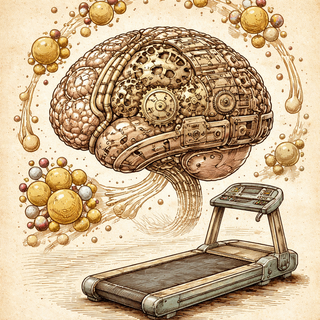
Disclaimer: This blog post is a simplified summary of published research for educational purposes. The accompanying illustration is artistic and does not depict actual model architectures, data, or experimental results. Always refer to the original paper for technical details.