Most chemistry papers feel like careful roadwork. This one shows up with a transit map and says, actually, what if the soup could run a recurrent neural network. Very normal week in science.
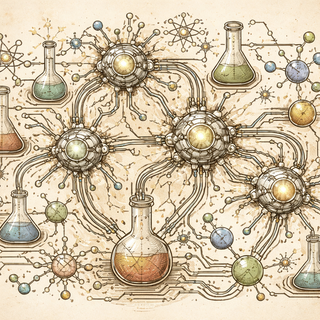
A new paper in Cell Systems by Alexander Dack, Benjamin Qureshi, Thomas E. Ouldridge, and Tomislav Plesa proposes something called a recurrent neural chemical reaction network, or RNCRN. The short version: the authors take the logic of a recurrent neural network - the kind of model built for feedback, memory, oscillations, and other time-based shenanigans - and express it as a system of chemical reactions. Then they prove that, given enough chemical "neurons" and the right reaction speeds, the system can approximate essentially any dynamical behavior they want (Dack et al., 2026; arXiv:2406.03456).
That sounds abstract until you remember biology already runs on this stuff. Cells do not carry around tiny spreadsheets. They live by feedback loops, switches, oscillators, and occasional biochemical drama.
The basic trick: make chemistry do the remembering
A recurrent neural network works because its current state depends not just on the input now, but on what happened a moment ago. It has memory. Not memoir-level memory. More like "I vaguely recall the last few seconds and that matters."
Chemical reaction networks can also have memory-like behavior, because concentrations change over time and feed back into later reactions. Under the right conditions, they can settle into multiple stable states, oscillate, or even behave chaotically. In dynamical systems language, this is the good stuff: attractors, feedback, and trajectories wandering around phase space like they pay rent there.
The paper’s move is to build a modular chemical architecture where each "chemical neuron" contributes to a larger dynamical system. Instead of training weights in silicon and then calling it a day, the training defines reaction parameters. In effect, the math says: if you want a chemical system that wiggles, switches, remembers, or spirals in a particular way, here is a principled route.
That matters because designing rich molecular dynamics by hand is hard. Very hard. "Just tune a hundred interacting reactions until they produce controlled oscillations" is the sort of sentence that ruins a postdoc’s weekend.
Why this is more interesting than "neural network, but make it wet"
There has been a broader shift toward treating chemistry as a computational medium rather than just the thing happening inside beakers while computers watch. A 2023 review in Nature Computational Science laid out the growing overlap between chemical reaction networks and machine learning, arguing that chemistry is not just a target for ML but a substrate that can itself compute (Wen et al., 2023).
Other recent work points in the same direction. Mordvintsev and colleagues showed that abstract chemical reaction networks can be trained with differentiable optimization to discover oscillators and other computing devices (arXiv:2302.02714). Braccini and co-authors discussed recurrent neural networks inside synthetic cells as a route toward autonomous molecular agents, which is either inspiring or mildly threatening depending on how much coffee you have had (PMCID: PMC10284608). Kriukov, Huskens, and Wong explored how autocatalytic reaction networks can be made more programmable, which is useful when your medium of computation is made of molecules that enjoy improvising (Kriukov et al., 2024). And in 2024, Baltussen and colleagues showed a self-organizing chemical reaction network could do reservoir computing, including nonlinear classification and chaotic time-series forecasting (Baltussen et al., 2024).
Put differently, this paper is not a random science side quest. It lands in a research area that has started asking, with a straight face, whether chemistry can be trained to process information the way neural systems do.
What could this actually be good for?
If the framework holds up experimentally, the appeal is obvious. Synthetic biology and molecular nanotechnology would get a more systematic recipe for building dynamical behavior instead of hunting it by intuition and prayer.
That could matter for:
- smart biochemical controllers that switch states based on context
- DNA-based molecular circuits that sense and respond over time
- artificial cells with richer internal regulation
- chemical simulators for biological rhythms, toggles, and feedback-heavy pathways
The authors also argue the RNCRN designs can be implemented using DNA strand displacement, a well-established molecular programming technique where one DNA strand nudges another out of a binding arrangement. It is one of the cleaner ways to make molecules act like logic components without pretending they are tiny laptops. If you want to sketch these feedback tangles without sacrificing a notebook page to chaos, something like mapb2.io is probably kinder than drawing 40 arrows by hand.
The catch, because there is always a catch
The paper proves an impressive universality result, but theory and wet-lab reality are still different neighborhoods. Reaction rates must stay within usable ranges. Noise matters. Scaling matters. DNA implementations are promising, not magic. Chemistry is excellent at parallelism and terrible at reading your intentions.
So no, this does not mean your future chatbot will live in a test tube and brood in a drawer. It does mean researchers are getting better at designing molecular systems that behave less like passive mixtures and more like trainable dynamical machines.
That is a weird sentence. It is also, apparently, a scientific one.
References
Dack A, Qureshi B, Ouldridge TE, Plesa T. Recurrent neural chemical reaction networks that approximate arbitrary dynamics. Cell Systems. 2026. DOI: 10.1016/j.cels.2026.101572. PubMed: 42025162. arXiv: 2406.03456
Wen M, Spotte-Smith EWC, Blau SM, et al. Chemical reaction networks and opportunities for machine learning. Nature Computational Science. 2023;3:12-24. DOI: 10.1038/s43588-022-00369-z
Mordvintsev A, Randazzo E, Niklasson E. Differentiable Programming of Chemical Reaction Networks. arXiv, 2023. DOI: 10.48550/arXiv.2302.02714
Braccini M, Collinson E, Roli A, Fellermann H, Stano P. Recurrent neural networks in synthetic cells: a route to autonomous molecular agents? Frontiers in Bioengineering and Biotechnology. 2023;11:1210334. DOI: 10.3389/fbioe.2023.1210334. PMCID: PMC10284608
Kriukov DV, Huskens J, Wong ASY. Exploring the programmability of autocatalytic chemical reaction networks. Nature Communications. 2024;15:8289. DOI: 10.1038/s41467-024-52649-z
Baltussen MG, de Jong TJ, Duez Q, Robinson WE, Huck WTS, et al. Chemical reservoir computation in a self-organizing reaction network. Nature. 2024;631:549-555. DOI: 10.1038/s41586-024-07567-x
Disclaimer: This blog post is a simplified summary of published research for educational purposes. The accompanying illustration is artistic and does not depict actual model architectures, data, or experimental results. Always refer to the original paper for technical details.