Evolution usually behaves like an ant colony: millions of tiny moves, most of them useless, a few of them weirdly brilliant, and somehow the whole mess still builds something impressive. This paper asks a fun question: what if we let AI act less like a fortune teller and more like a very caffeinated trail guide, pointing protein engineers toward the mutation combos that might actually work before the lab budget catches fire?
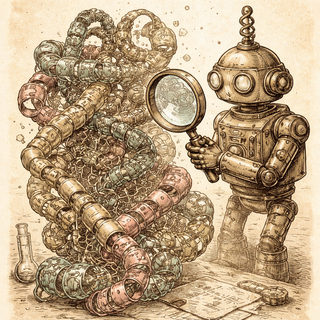
Proteins are tiny molecular machines, and tweaking them is a lot like renovating a house where every wall is load-bearing and the plumbing is emotional. Change one amino acid and maybe the protein gets better. Change two and maybe it gets much better. Or maybe it folds like a wet napkin. That is the joy of protein engineering.
Traditional directed evolution works by making lots of variants, testing them, keeping the winners, and repeating. It is basically dog breeding for molecules, except the dogs are invisible and each round costs real money. The trouble is that protein sequence space is absurdly huge, and useful mutations do not always stack neatly. A mutation that helps on its own can become a disaster when paired with the wrong neighbor. That effect is called epistasis, which is a fancy biology word for "these mutations have office politics" [2].
Autocomplete for Proteins, But With Better Career Prospects
Tran and colleagues built a framework called MULTI-evolve to hunt for powerful combinations of mutations in a single round of machine learning-guided directed evolution [1]. The core trick is combining two ideas:
-
Protein language models
These are like the autocomplete engines of molecular biology. Instead of predicting the next word in your text message, they learn patterns in amino acid sequences across evolution and can guess which mutations look plausible or promising [3,4]. -
Epistatic modeling
This part tries to predict when mutations will cooperate instead of sabotage each other like a doomed group project [1,2].
The authors also introduce MULTI-assembly, a mutagenesis method designed to efficiently build multi-mutation protein variants across long sequences. That matters because prediction is cute, but eventually someone has to actually make the thing in a tube.
The headline result is strong: across three proteins, the system reportedly produced up to 10-fold improvements using a single round of AI-guided directed evolution [1]. That is the kind of result that makes wet-lab scientists raise one eyebrow and computational scientists immediately open twelve tabs.
Why This Is More Interesting Than Yet Another "AI Helps Biology" Headline
A lot of AI-for-biology stories boil down to "the model suggested some candidates." Useful, sure, but vague. What makes this paper more interesting is that it goes straight at a real bottleneck: useful protein improvements often live in combinations of mutations, not just one-at-a-time edits. Stepwise mutation stacking can miss those combinations because evolution, both natural and lab-made, loves local optima. You climb one hill and miss the mountain next door.
This paper tries to skip the scenic route. Instead of asking, "Which single mutation looks nice?" it asks, "Which bundle of mutations might work together?" That is closer to how proteins actually behave in the wild, where context is everything and the sequence-function relationship is less a straight road than a haunted corn maze.
The broader field has been moving this way fast. A 2024 Science paper showed that structure-informed protein language models can guide evolution across diverse proteins and antibody complexes without task-specific retraining [3]. Another study in Nature Biotechnology showed that general protein language models could improve antibody binding with surprisingly few lab-tested variants [5]. Reviews published in 2024 make the same point from 30,000 feet: machine learning is getting much better at proposing useful proteins, but epistasis, benchmarking, and experimental validation are still the dragons guarding the treasure [2,4,6].
What This Could Mean in the Real World
If results like this hold up across more proteins, the payoff is obvious. Better enzymes for manufacturing. Better genome editors. Better therapeutic proteins. Faster optimization cycles for drug discovery and industrial biotech. In plain English: fewer rounds of blind trial-and-error, more shots on goal that are actually aimed at the net.
That said, nobody should start declaring victory and replacing half the lab with a GPU rack wearing safety goggles. This study covers three proteins, not all of biology. Protein language models are powerful pattern matchers, but biology still has a habit of answering elegant theories with "that’s adorable" before doing something messy. Generalization matters. So do synthesis constraints, assay quality, and whether the predicted wins survive outside the exact setup used in the paper.
Still, the direction is hard to ignore. Directed evolution used to feel like rummaging through a planetary-size junk drawer hoping the right wrench would somehow jump into your hand. MULTI-evolve suggests a smarter workflow: let the AI narrow the drawer, let epistasis modeling flag the combinations that play nicely together, and let the lab settle the argument. That is a much saner division of labor.
References
-
Tran VQ, Nemeth M, Bartie LJ, Chandrasekaran SS, Fanton A, Moon HC, Hie B, Konermann S, Hsu PD. Rapid directed evolution guided by protein language models and epistatic interactions. Science. DOI: 10.1126/science.aea1820. PubMed: PMID 41712694.
-
Lipsh-Sokolik R, Fleishman SJ. Addressing epistasis in the design of protein function. PNAS. 2024;121(34):e2314999121. DOI: 10.1073/pnas.2314999121. PMCID: PMC11348311.
-
Shanker VR, Bruun TUJ, Hie B, Kim PS. Unsupervised evolution of protein and antibody complexes with a structure-informed language model. Science. 2024;385(6704):46-53. DOI: 10.1126/science.adk8946. PMCID: PMC11616794.
-
Notin P, Rollins N, Gal Y, Sander C, Marks D. Machine learning for functional protein design. Nature Biotechnology. 2024;42:216-228. DOI: 10.1038/s41587-024-02127-0.
-
Hie B, et al. Efficient evolution of human antibodies from general protein language models. Nature Biotechnology. 2024;42:275-283. DOI: 10.1038/s41587-023-01763-2.
-
Listov D, Goverde CA, Correia BE, Fleishman SJ. Opportunities and challenges in design and optimization of protein function. Nature Reviews Molecular Cell Biology. 2024;25:639-653. DOI: 10.1038/s41580-024-00718-y.
Disclaimer: This blog post is a simplified summary of published research for educational purposes. The accompanying illustration is artistic and does not depict actual model architectures, data, or experimental results. Always refer to the original paper for technical details.