"Another weird protein knot? Cute. Wake me when it's not a database glitch." Fair criticism, honestly. Structural biology has produced enough exotic shapes to make you suspect the molecules are showing off. This paper answers that suspicion the old-fashioned way - with crystal structures - and argues that the oddity is real: a previously unrecognized Knotted Solenoid fold, created by a sly little rearrangement in a repeating protein coil that leads to a genuine 3_1 trefoil knot.[^1]
A spiral staircase that misses one step on purpose
Most solenoid proteins are repeat machines. One structural unit follows the next, like a spiral staircase assembled by someone who loves symmetry and has never once freelanced. Here, the authors describe something close to a familiar beta-solenoid architecture, but not quite. One coil does a "skip-and-backtrack" move: it jumps ahead a turn, and the next coil realigns the pattern. That small change sounds innocent. It is not innocent.
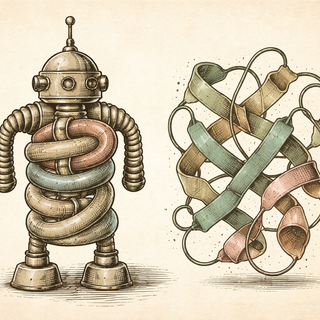
That order shift changes the topology of the whole protein chain. Instead of winding into a standard repeated fold, the backbone crosses itself in a way that produces a nontrivial knot. Not a decorative knot. A mathematically meaningful one.[^2] Protein knots are rare - roughly 1% of structures in the Protein Data Bank, depending on how you count them - which is part of why people study them with the energy of detectives who have found a shoeprint in wet cement.[^2][^3]
Why this is more than molecular origami cosplay
Protein shape is not cosmetic. Shape determines what a protein binds, how stable it is, and whether it behaves like a useful enzyme or a tiny biochemical disaster. So when researchers find a fold that seems absent from current structural databases, the interesting question is not "neat, I guess?" The question is whether biology has discovered another stable way to pack a chain into function.
This paper suggests the answer may be yes. The beauty here is a little wabi-sabi: not perfect repetition, but purposeful imperfection. The fold keeps the repeating solenoid logic, then breaks it just enough to create new topology. In Japanese aesthetics, ma is the meaningful gap - the space that gives the whole arrangement its force. This protein seems to use a structural version of that trick. One skipped turn, one recovery step, and suddenly the chain ties itself into something the usual templates missed.
That matters because protein folding is already hard enough to make Levinthal's paradox feel like nature trolling us gently.[^4] A knotted fold raises the difficulty setting. A chain now has to arrive not just at the right local contacts, but at the right global entanglement. It is like assembling IKEA furniture while also braiding a pretzel. Blindfolded. In water.
The timing is excellent, because the field is finally ready for weirdness
Over the past few years, researchers have pushed hard on exactly this territory: how knots form, what they do, and whether we can predict or even design them. A 2023 review summarizes the picture neatly - knotted proteins are rare, stubborn, and extremely informative about folding pathways and function.[^3] Also in 2023, AlphaFold-based analysis suggested that human proteins may contain more knots than we had experimentally confirmed, which is either thrilling or a reminder that AI can sometimes hand biologists a treasure map with a few dragons still penciled in.[^5]
Then came de novo design. In 2023, researchers reported knotted tandem repeat proteins designed from scratch, showing that nontrivial topology is not just a natural curiosity but something protein engineers can deliberately build.[^6] And in 2024, another group characterized an especially complex 7_1 knotted protein, underscoring that exotic topology is not merely possible - it can be stable and mechanically tough.[^7]
Placed in that context, this new Knotted Solenoid fold feels less like an isolated stunt and more like a sign that protein structure space still has unopened drawers.
What could this lead to?
If these results hold up and similar folds are found or engineered more broadly, the long-term impact could be substantial. Knotted or topologically unusual proteins may offer new routes to stability, mechanical resilience, and precise control of function. That is catnip for protein engineering, where people want scaffolds that survive stress, hold complex shapes, and perform useful chemistry without collapsing like a camping chair from a discount store.
It also sharpens evolutionary questions. Did this fold arise because the topology itself helps function? Or did evolution back into the knot because a small coil rearrangement solved some other structural problem first? Biology loves these side-door solutions.
The caveat is important: a new fold is not automatically a new function, and one structural paper does not settle every folding mechanism or evolutionary pathway. But it does give the field a concrete object to test. Not a rumor. Not a prediction. A structure.
And that, in protein science, is often where the really good arguments begin.
References
[^1]: Sikora M, Mozajew M, Sikorska JA, da Silva FB, Perlinska AP, Kluza A, et al. Novel Knotted Solenoid fold with order-shifted coil arrangement leads to nontrivial 3_1 topology. Proceedings of the National Academy of Sciences of the United States of America. 2025/2026. DOI: 10.1073/pnas.2525920123. PubMed: 42018416
[^2]: Wikipedia contributors. Knotted protein. Wikipedia. https://en.wikipedia.org/wiki/Knotted_protein
[^3]: Jackson SE, Sulkowska JI. Folding and functions of knotted proteins. Current Opinion in Structural Biology. 2023;83:102709. DOI: 10.1016/j.sbi.2023.102709
[^4]: Wikipedia contributors. Protein folding. Wikipedia. https://en.wikipedia.org/wiki/Protein_folding
[^5]: Perlinska AP, Niemyska WH, Gren BA, Bukowicki M, Nowakowski S, Rubach P, Sulkowska JI. AlphaFold predicts novel human proteins with knots. Protein Science. 2023;32(5):e4631. DOI: 10.1002/pro.4631. PMCID: PMC10108431
[^6]: Doyle LA, Takushi B, Kibler RD, et al. De novo design of knotted tandem repeat proteins. Nature Communications. 2023;14:6746. DOI: 10.1038/s41467-023-42388-y
[^7]: Zhao Y, Lou J, Wang J, et al. Structure, dynamics, and stability of the smallest and most complex 7_1 protein knot. Journal of Biological Chemistry. 2024;300(1):105553. DOI: 10.1016/j.jbc.2023.105553
Disclaimer: This blog post is a simplified summary of published research for educational purposes. The accompanying illustration is artistic and does not depict actual model architectures, data, or experimental results. Always refer to the original paper for technical details.