The human eyeball is a weird flex. It's basically a squishy orb of jelly that somehow processes 80% of everything your brain knows about the world, and it does this while sipping power like a hummingbird at a flower. Meanwhile, the camera in your phone is over there chugging electricity like a teenager discovering energy drinks, shipping raw pixel data to a processor that has to make sense of it all.
Researchers at Tsinghua University looked at this situation and thought: what if cameras just... figured more stuff out before bothering the main processor?
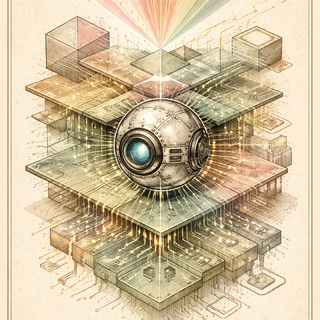
The Problem With Being a Data Firehose
Traditional image sensors are basically very fancy light buckets. They collect photons, convert them to electrical signals, and dump everything - every single pixel, every single frame - onto a processor's desk like an intern who doesn't know how to summarize. This works fine until you need to do it fast, constantly, and without melting your battery.
Machine vision systems (think self-driving cars, drones, robots that fold laundry) are drowning in data. A high-resolution camera shooting at 60 frames per second generates gigabytes of information that mostly contains... walls. Floors. The same tree as the last frame. All that redundant data gets transferred, stored, and processed anyway, burning energy like it's going out of style.
Your retina, on the other hand, is basically running a preprocessing co-op. It doesn't just detect light - it does edge detection, motion sensing, and noise filtering right there in your eyeball before sending a curated highlight reel to your visual cortex. Evolution spent millions of years optimizing this system, and it runs on about 10 milliwatts[^1].
NEOSTI: The Eye-Sized Overachiever
The new sensor, called NEOSTI (Neuromorphic Electronic-Opto Spatial-Temporal Imager, because acronyms must always spell something cool), takes the "compute at the sensor" idea and runs with it. Hard.
Here's the clever bit: NEOSTI processes information in three different places, using three different approaches, all before the data leaves the sensor chip.
Processing-pre-sensor happens in the optical domain - basically manipulating light before it even hits the detector. Processing-in-sensor occurs during the conversion from photons to electrons, using the nonlinear characteristics of the conversion process itself to do computation. Processing-near-sensor handles the rest in traditional electronic circuits, but right next to the sensing elements to minimize data movement[^2].
The result? A vision system roughly the size of an actual eyeball (the paper specifically mentions this, which is either impressive or slightly unsettling) that can work under normal indoor and outdoor lighting - no special laser sources or controlled conditions required.
The Neural Network Lives Where?
NEOSTI also packs a Binary Neural Network directly onto the sensor. Binary neural networks are the minimalists of the deep learning world - instead of using precise floating-point numbers, they use 1s and 0s[^3]. This makes them dramatically smaller and faster, though they sacrifice some accuracy.
By integrating this network at the sensor level, NEOSTI can extract semantic information - understanding what it's looking at, not just recording pixels - without shipping raw data anywhere. The camera doesn't just see; it comprehends, at least a little.
This approach connects to broader trends in edge AI, where computation happens on devices rather than in distant data centers. Tools like scoutb2.io for web auditing similarly push AI processing to the browser, keeping data local and response times snappy.
Why This Matters Beyond Cool Engineering
Neuromorphic sensors like NEOSTI aren't just academic exercises in biomimicry. They're potential solutions to real bottlenecks in:
- Autonomous vehicles: Processing visual data faster with less power could extend range and improve safety
- Wearable devices: Smart glasses that don't die after two hours of use
- IoT sensors: Battery-powered cameras that last years instead of months
- Robotics: Faster visual reaction times without bigger processors
The paper reports competitive performance across several visual processing benchmarks, though "competitive" in academic papers sometimes means "we're in the same ballpark as the state of the art" rather than "we crushed it."[^2]
The Catch (There's Always a Catch)
Neuromorphic hardware is notoriously tricky to manufacture at scale. Traditional CMOS processes don't play nice with all the exotic materials and structures these designs require. And while binary neural networks are efficient, they can't match the accuracy of their full-precision cousins for complex tasks.
Still, NEOSTI represents a genuine step toward cameras that think - or at least pre-think - so that processors can focus on harder problems than "is this pixel slightly different from the last frame?"
Your eyeball figured this out eons ago. Nice of engineering to finally catch up.
References
-
Wong-Riley, M. (2010). Energy metabolism of the visual system. Eye and Brain, 2, 99-116. https://doi.org/10.2147/EB.S9078
-
Liu, T., Huang, Z., Wang, X., Shi, W., Chen, H., & Zhang, M. (2026). NEOSTI - a neuromorphic electronic-opto spatial-temporal hybrid image sensor. Nature Communications. https://doi.org/10.1038/s41467-026-71091-x (PMID: 41888519)
-
Qin, H., Gong, R., Liu, X., Bai, X., Song, J., & Sebe, N. (2020). Binary neural networks: A survey. Pattern Recognition, 105, 107281. https://doi.org/10.1016/j.patcog.2020.107281
Disclaimer: This blog post is a simplified summary of published research for educational purposes. The accompanying illustration is artistic and does not depict actual model architectures, data, or experimental results. Always refer to the original paper for technical details.