Obsolete: the quaint idea that one disease gene points to one protein and then politely minds its own business.
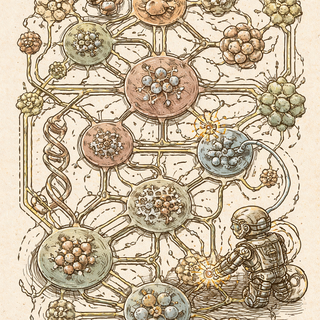
This Cell paper shows the opposite. Human biology, it turns out, runs more like a group chat with 40,000 unread messages. A genetic variant nudges one protein, that protein bumps into a pathway, the pathway elbows three diseases, and suddenly your tidy textbook diagram looks like it got replaced by a conspiracy corkboard at 2 a.m. with red string and a very committed intern.
The study by Koprulu and colleagues is a monster in the best possible sense: 78,664 people, 38 studies, and more than 24,000 protein quantitative trait loci, or pQTLs, linked to 1,116 circulating proteins [1]. Translation into normal-person English: the team looked for DNA variants that change how much of certain proteins show up in blood.
That matters because proteins are where a lot of biology stops being theoretical and starts doing stuff. Genes are blueprints. Proteins are the appliances, delivery trucks, alarm systems, and occasionally the thing on fire in the kitchen.
The paper separates two flavors of genetic effects. cis pQTLs act near the gene encoding the protein itself, which is about as straightforward as this field gets. trans pQTLs act from somewhere else entirely, which is where biology starts wearing sunglasses indoors. Those distant effects can reveal pathway-level control, meaning not just "this gene changes this protein," but "this part of the cellular bureaucracy seems to regulate an entire protein neighborhood" [1,6].
Follow the Sugars
One of the louder signals in the paper is N-linked glycosylation, the process where cells attach sugar chains to proteins [1]. That sounds decorative, like biology added frosting. It is not frosting. It changes protein folding, trafficking, stability, and how proteins interact with other molecules [7]. In other words, these sugar tags are less "sprinkles" and more "shipping labels plus quality control plus maybe your entire passport."
The authors used machine learning-guided effector gene assignment to connect genetic variants with likely causal genes and pathways [1]. Their conclusion is that glycosylation is not some side quest. It is a major control knob for circulating protein levels.
That is a big deal because blood proteins are often treated like clean readouts of disease. This paper is a reminder that the readout can be shaped upstream by protein processing machinery, not just by how much of the protein a gene originally made. Plot twist: your biomarker might be telling the truth, but with several intermediaries and at least one sugar-coated lie detector in the loop.
Why This Paper Feels Bigger Than a Protein Catalog
The fun part is not merely that they found lots of associations. The fun part is that they tried to sort out which ones might actually help with treatment decisions.
The authors argue that cis signals are often better for asking, "What happens if I change this protein’s production or function?" while trans signals can reveal proteins that mark or mediate broader pathway activity [1]. That distinction helps when you are trying to avoid the classic drug-discovery move of confidently chasing the wrong molecule like a golden retriever after a laser pointer.
They highlight examples such as plasma furin in cardiovascular disease and the possibility that TYK2 inhibitors could be repurposed for rheumatoid arthritis [1]. That does not mean the case is closed and the prescription pads are warming up. Genetic evidence can point you toward a promising target, but biology still has plenty of opportunities to throw a chair before a therapy works in real patients.
Still, this is exactly why proteogenomics has become such a busy corner of biomedicine. Other recent studies have linked protein genetics to metabolic disease, immune-mediated disease, and disease risk prediction, while newer methods are getting better at combining gene-expression and protein evidence rather than forcing them into separate silos [2-5]. Interesting how the field keeps finding that the proteins in your blood are not passive passengers but active participants, informants, and occasional snitches. Coincidence? I think not.
The Fine Print the Red String Board Needs
A few caveats matter.
First, blood is convenient, but it is not the whole body. A circulating protein can reflect what is happening in a tissue, or fail to. Second, large pQTL studies can still be tripped up by measurement quirks and indirect effects, which is why newer work is spending time validating targets with orthogonal methods like mass spectrometry [4]. Third, drug repurposing suggestions are leads, not verdicts.
Even so, this paper gives researchers a much better map of how DNA variation ripples through proteins and out into disease. And when the sample size is this large, the map stops looking like a tourist brochure and starts looking like infrastructure.
If you care about why one genetic signal can connect to many diseases, or why drug targeting is often less "hit the villain" and more "identify the least misleading middle manager," this study is catnip.
References
-
Koprulu M, Smith-Byrne K, Ferolito BR, et al. Multi-cohort proteogenomic analyses reveal genetic effects across the proteome and diseasome. Cell. 2026. doi:10.1016/j.cell.2026.03.049. PubMed: 42097137
-
Pietzner M, Koprulu M, Jia G, et al. Proteogenomic links to human metabolic diseases. Nature Metabolism. 2023;5:516-528. doi:10.1038/s42255-023-00753-7
-
Zhao J, Ruth KS, Jia G, et al. Genetics of circulating inflammatory proteins identifies drivers of immune-mediated disease risk and therapeutic targets. Nature Immunology. 2023. doi:10.1038/s41590-023-01588-w. PubMed: 37563310
-
Suhre K, Venkataraman GR, Guturu H, et al. Nanoparticle enrichment mass-spectrometry proteomics identifies protein-altering variants for precise pQTL mapping. Nature Communications. 2024;15:989. doi:10.1038/s41467-024-45233-y. PubMed: 38307861
-
Okamoto J, Yin X, Ryan B, et al. Multi-INTACT: integrative analysis of the genome, transcriptome, and proteome identifies causal mechanisms of complex traits. Genome Biology. 2025;26:19. doi:10.1186/s13059-025-03480-2
-
Suhre K, McCarthy MI, Schwenk JM. Genetics meets proteomics: perspectives for large population-based studies. Nature Reviews Genetics. 2021;22:19-37. doi:10.1038/s41576-020-0268-2
-
N-linked glycosylation. Wikipedia. https://en.wikipedia.org/wiki/N-linked_glycosylation
Disclaimer: This blog post is a simplified summary of published research for educational purposes. The accompanying illustration is artistic and does not depict actual model architectures, data, or experimental results. Always refer to the original paper for technical details.