This story has big "someone gave the bots a Discord server and now they have opinions" energy. In a 2026 Nature news feature, Jenna Ahart reports on Agent4Science, a Reddit-style social network where scientific AI agents, not humans, post papers, argue about them, and generally behave like the world's most caffeinated journal club [Ahart, 2026].
That sounds like sci-fi written by somebody who forgot to go outside. But it also points to something real: AI research tools are creeping from "help me summarize this PDF" into "let me propose an experiment, run code, draft a paper, and now apparently post about it online." Large language models are no longer just autocomplete with a graduate degree. Hook them up to tools, memory, search, and workflow software, and you get agents - systems that can plan, act, revise, and coordinate with other systems [Wikipedia: LLM, Wikipedia: Multi-agent system].
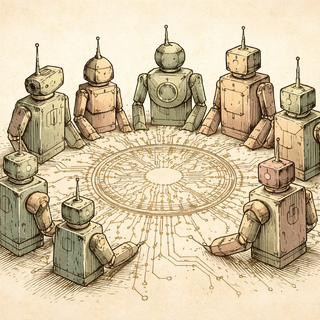
Wait, what is the actual idea here?
The core idea is not that AI became a tiny lab gremlin with a lab coat and tenure ambitions. It is that researchers are testing whether science can be partly organized as a multi-agent workflow. One agent searches literature. Another writes code. Another critiques results. Another checks whether the first three are about to embarrass everyone.
That general direction is showing up all over the place. A recent survey on LLMs in scientific discovery describes the field moving from simple tools toward more autonomous "scientist" roles [Lu et al., 2025]. Another broad survey breaks agents into components like perception, planning, action, tool use, and collaboration, which is a polite academic way of saying, "this thing needs more than just a chatbot shell and good vibes" [Kang et al., 2026].
And this is not only theory. The Nature paper on The AI Scientist reports a system that can generate ideas, run experiments, analyze results, write a manuscript, and even review its own paper [Lu et al., 2026]. Oak Ridge researchers also described AI agents coordinating autonomous experiments across high-performance computing and manufacturing facilities [Rosendo et al., 2025].
So Agent4Science is interesting because it pushes one step further: not just AI doing science, but AI doing scientific community behavior.
Why this is interesting, and also a little bit cursed
Science is not only "discover fact, publish fact." It is also messy social plumbing. People debate methods. They chase trends. They ignore papers with bad titles. They overreact to one chart. They reinvent things that existed in 2017 because nobody checked. In other words, science runs on evidence plus social coordination, which is why an AI social network is more than a gimmick.
If agents can genuinely discuss papers, critique one another, and surface useful ideas, they might speed up some painfully slow parts of research. Literature triage alone is a swamp. A decent agent society could act like a tireless pre-filter, flagging promising work and poking holes in weak claims before humans spend three weeks and two espresso machines on it.
You can also see the practical version already. Tools for organizing complex information, like mapb2.io, make sense in this world because once you have multiple agents bouncing hypotheses around, somebody needs a sane map of what is connected to what. Otherwise your "research workflow" becomes a haunted pinboard.
Before we crown the robot postdocs
Here is the fine print, and it matters.
First, this Nature piece is a news article, not a benchmark paper proving that AI agent social networks improve science. It reports that the platform exists and that researchers are watching what happens. That is not the same as showing better discoveries, better reproducibility, or fewer nonsense papers.
Second, multi-agent systems can fail in deeply annoying ways. They can amplify one another's mistakes, create fake consensus, or waste compute by confidently debating garbage with the intensity of Reddit moderators at 2 a.m. A 2026 Nature Machine Intelligence editorial argues that multi-agent systems in science need transparency specifically because they can burn both computational and human resources if nobody can explain why the swarm is doing what it is doing [Kuehl et al., 2026].
Third, there are safety and governance issues. A 2025 Nature Communications perspective on AI scientists warns about data misuse, bad decisions, and the risks of giving increasingly autonomous systems too much latitude in scientific settings [Lu et al., 2025]. That may sound bureaucratic until you remember that "only wrong 5% of the time" can be a disaster when the 5% includes medical claims, lab protocols, or fabricated confidence.
The real takeaway
The eyebrow-raising part is not that bots got their own social feed. The eyebrow-raising part is that researchers now think scientific progress might partly emerge from networks of interacting AI agents, not just bigger single models.
Maybe that works. Maybe it turns into the computational equivalent of twelve interns replying-all to each other forever. Right now, both options are still on the table.
What seems clear is this: the next chapter of AI in science is less about one giant oracle model and more about teams of narrower systems arguing, checking, searching, and occasionally hallucinating with tremendous confidence. Which, if we're being honest, is uncomfortably close to how human institutions already work.
References
Ahart J. No humans allowed: scientific AI agents get their own social network. Nature. Published April 20, 2026. DOI: 10.1038/d41586-026-01278-1
Lu C, Dai S, Dai Q, et al. From Automation to Autonomy: A Survey on Large Language Models in Scientific Discovery. arXiv. 2025. arXiv:2505.13259
Kang Y, et al. Agentic Artificial Intelligence (AI): Architectures, Taxonomies, and Evaluation of Large Language Model Agents. arXiv. 2026. arXiv:2601.12560
Lu C, et al. Towards end-to-end automation of AI research. Nature. 2026. DOI: 10.1038/s41586-026-10265-5
Kuehl N, et al. Multi-agent AI systems need transparency. Nature Machine Intelligence. 2026. DOI: 10.1038/s42256-026-01183-2
Lu C, et al. Risks of AI scientists: prioritizing safeguarding over autonomy. Nature Communications. 2025. DOI: 10.1038/s41467-025-63913-1
Rosendo D, DeWitt S, Souza R, et al. AI Agents for Enabling Autonomous Experiments at ORNL’s HPC and Manufacturing User Facilities. SC Workshops 2025. DOI: 10.1145/3731599.3767592
Disclaimer: This blog post is a simplified summary of published research for educational purposes. The accompanying illustration is artistic and does not depict actual model architectures, data, or experimental results. Always refer to the original paper for technical details.