What if AI does not actually need a taller GPU skyscraper, but a less ridiculous floor plan? A lot of modern machine learning still lives in a building where the math unit and the memory unit occupy opposite ends of the block, then act surprised when traffic gets ugly. That old commute is the von Neumann bottleneck: too much shuttling of data, too much wasted energy, too many expensive electrons basically circling for parking.
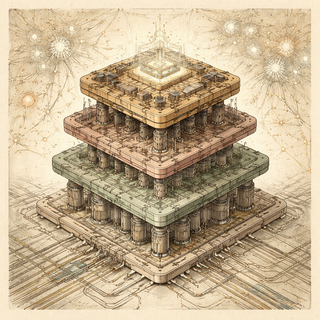
This new paper by Seok, Kim, Son, Choi, and Kim proposes a neater structure. Instead of treating memory and computation like divorced parents who only communicate through logistics, they stack ferroelectric transistors in 3D so storage and calculation can share the same address - or at least the same building lobby (Seok et al., 2026).
A Better Floor Plan for AI
The core move here is monolithic 3D integration. The authors vertically stack IGZO access transistors with HZO-based ferroelectric field-effect transistors, or FeFETs. In plain English: they are building a compact, layered hardware structure where the devices that hold synaptic weights and the devices that control access sit close together, like a well-planned mixed-use development instead of a suburban strip mall.
That matters because AI workloads are brutal on memory traffic. Convolutional neural networks, transformers, and their many overachieving cousins spend an absurd amount of time moving numbers around. The actual multiply-and-accumulate work is often less of a problem than the endless hauling. In hardware terms, the truck route is the problem. In architecture terms, the sight lines are terrible and the corridors are doing emotional damage.
The paper reports both 2-tier and 4-tier stacks with preserved ferroelectric behavior across all tiers, which is the structural miracle here. Getting one shiny lab device to behave is one thing. Getting multiple vertically stacked analog devices to stay uniform and reliable is where many elegant facades turn into damp basements.
Does the Building Stand Up?
Mostly, yes.
The devices showed reproducible switching, retention beyond 10 years, endurance up to 10^11 cycles, and stable multilevel conductance states suited for synaptic computing (Seok et al., 2026). That combination is the hardware equivalent of finding a modernist glass house that is also waterproof. Rare. Suspiciously rare.
The authors then mapped the measured device characteristics onto a CNN for CIFAR-10 image classification. The 2-tier version reached 95.0% accuracy, and the 4-tier version hit 95.5%, compared with a 96.1% software baseline. That is not perfect parity, but it is close enough to get interesting. Close enough, at least, that you stop treating the hardware as a sculpture and start treating it as a candidate occupant.
They also demonstrated analog-domain convolution for edge-aware image processing by programming kernel weights directly into conductance states. If that sounds abstract, think of it as the chip doing a small piece of image filtering in place, without sending every little arithmetic errand out to memory and back. Tools like combb2.io, which sharpen and enhance images in the browser, live in the same broad neighborhood of "make pictures cleaner with clever computation," though this paper is aimed at the hardware foundations rather than end-user polish.
The Façade Looks Great. The Plumbing Is Still Hard.
This work sits inside a larger push toward compute-in-memory and neuromorphic hardware, where data storage and computation move closer together. Recent work has shown how serious that effort has become. Kim and colleagues demonstrated BEOL-compatible ferroelectric FETs for 3D integration in Nature Nanotechnology (Kim et al., 2023). Another team built a 3D ferroelectric NAND array for neural-network hardware in Nature Communications (Lee et al., 2023). MIT-led researchers also showed a six-layer monolithic 3D AI nanosystem using 2D materials and memristors in Nature Materials (Xie et al., 2023).
The field is clearly sketching the same blueprint from different angles: go vertical, reduce data motion, and stop paying a mansion-sized energy bill for hallway travel.
But there are still awkward load-bearing questions. Analog devices drift. Variability sneaks in. Manufacturing yield does not magically improve because the cross-sectional TEM image looked gorgeous in the paper. Commercialization is also not just a materials problem. It is a software stack problem, a tooling problem, and a "can anyone actually program this thing without developing a thousand-yard stare?" problem. A 2025 Nature Communications perspective makes exactly that point: neuromorphic hardware needs an ecosystem, not just a clever chip (Furber et al., 2025).
Why This One Feels Worth Watching
What I like about this paper is that it does not merely wave at brain-inspired computing from across the street. It shows a believable structural grammar: stacked devices, decent reliability, near-baseline inference accuracy, and a small but concrete image-processing demo. The encoder has clean lines, the materials stack has decent load distribution, and the overall composition avoids the usual "beautiful device, impossible system" trap.
No, this does not mean your next laptop will run on ferroelectric whimsy and architectural purity. But it does suggest that future AI hardware may look less like a giant furnace with memory attached and more like a compact building where the rooms are finally arranged by someone who has met a hallway before.
Disclaimer: This blog post is a simplified summary of published research for educational purposes. The accompanying illustration is artistic and does not depict actual model architectures, data, or experimental results. Always refer to the original paper for technical details.
References
Seok H, Kim G, Son S, Choi H, Kim T. Towards Artificial Intelligence Hardware With 3D Integrated Ferroelectric Transistors. Small. 2026:e73295. DOI: https://doi.org/10.1002/smll.73295
Kim KH, et al. Scalable CMOS back-end-of-line-compatible AlScN/two-dimensional channel ferroelectric field-effect transistors. Nature Nanotechnology. 2023. DOI: https://doi.org/10.1038/s41565-023-01399-y
Lee S, et al. Highly-scaled and fully-integrated 3-dimensional ferroelectric transistor array for hardware implementation of neural networks. Nature Communications. 2023;14:504. DOI: https://doi.org/10.1038/s41467-023-36270-0
Xie C, et al. Monolithic 3D integration of 2D materials-based electronics towards ultimate edge computing solutions. Nature Materials. 2023. DOI: https://doi.org/10.1038/s41563-023-01704-z
Wu L. Ferroelectric memory for back-end-of-line 3D integration. Nature Reviews Materials. 2023;8:421. DOI: https://doi.org/10.1038/s41578-023-00578-6
Furber S, et al. The road to commercial success for neuromorphic technologies. Nature Communications. 2025. DOI: https://doi.org/10.1038/s41467-025-57352-1