Tiny bug brain, silicon edition
Most cameras are basically overeager tourists. They take full snapshots over and over, whether anything interesting happened or not. That works, but it is wasteful. Nature solved this a long time ago. Insects do not lug around a cinema camera in their heads. Their visual systems are fast, cheap, and weirdly efficient.
This paper describes a CMOS-integrated synaptic photoreceptor chip inspired by insect visual processing. In plain English: the sensing and some of the “thinking” happen much closer together on the hardware itself. Instead of capturing raw visual data first and punting all the hard work downstream, the chip tries to preprocess information in a more brain-ish, retina-ish way. The authors report a complete optoelectronic, insect-inspired visual sensor aimed at handling both static feature recognition and dynamic trajectory tracking, plus depth perception tasks.
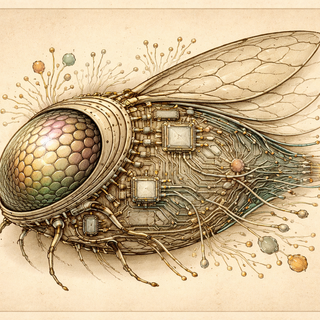
That matters because normal AI vision stacks are kind of spoiled. They expect lots of frames, lots of memory, lots of power, and usually one very sweaty GPU doing algebra in the back room like an overworked intern. A compact chip that can sense and preprocess motion-rich scenes directly could be useful in places where size, speed, and power matter more than leaderboard glory.
Why people keep copying eyeballs
This sits in the broader world of neuromorphic vision. That is the family of sensors and chips that borrow ideas from biology, especially the retina and nervous system, to process visual information more efficiently. If standard cameras are “take everything, sort it out later,” neuromorphic sensors are more “only yell when something changes.” Which, to be fair, is also how many group chats operate.
Recent reviews show why researchers keep coming back to this area: neuromorphic vision promises low latency, sparse data, and lower power use, especially for robotics, autonomous systems, and edge devices where every milliwatt counts (Hardware, Algorithms, and Applications of the Neuromorphic Vision Sensor: A Review; Devices, Functions, and Applications of Artificial Neuromorphic Visual Systems).
This paper’s twist is the hardware integration. A lot of bio-inspired vision work still lives at the level of single devices, small arrays, or demos that are scientifically valid but not exactly ready to babysit a drone. The authors are aiming at a fuller chip-level implementation, which is the difference between “cool lab component” and “maybe this can survive outside the PowerPoint.”
What the chip is trying to do
The paper uses a Si QDs/ReS2 synaptic photoreceptor setup integrated with CMOS. You do not need to memorize the materials science alphabet soup here. The key point is that the device is meant to respond to light in a way that also carries memory-like or synaptic behavior, so the chip can encode useful temporal information right where the photons arrive.
That makes it a natural fit for jobs like:
- tracking moving objects
- recognizing static patterns
- estimating depth from visual cues
Why is that interesting? Because movement is where ordinary frame-based cameras start acting like someone trying to photograph a hummingbird with a potato. Fast scenes produce blur, redundancy, and big compute loads. Bio-inspired hardware can, in principle, react faster and ignore useless repetition.
That idea lines up with other recent results. A perovskite retinomorphic image sensor published in Science Advances in 2024 showed hardware-level sensing, visual processing, and decision support in one system (DOI: 10.1126/sciadv.ads2834). A 2024 Nature paper on low-latency automotive vision with event cameras pushed similar arguments for fast machine perception in driving scenarios (DOI: 10.1038/s41586-024-07409-w). Another 2024 Nature Communications study used insect-inspired motion vision for navigation in cluttered spaces, which is about as close as science gets to saying “the bugs were onto something” (DOI: 10.1038/s41467-024-45063-y).
The part where we do not oversell it
This is promising hardware research, not a declaration that your next phone will contain a cyber-moth retina.
The big challenges are still the usual suspects:
- scaling from impressive prototypes to robust manufacturing
- benchmarking against standard camera pipelines in messy real-world settings
- handling noise, variability, and changing lighting
- proving the efficiency gains survive outside carefully chosen demos
That last one matters a lot. Neuromorphic papers often sound amazing because the setup is so well matched to the method. Fast motion? Sparse events? Tight power budget? Great. But if the world gets uglier, darker, noisier, or more boring, the hardware still has to earn its keep.
Still, the direction makes sense. If AI is going to live in tiny robots, sensors, wearables, and edge devices, we probably cannot keep shoveling every photon into giant downstream models and pretending electricity is free. Chips like this are a bet that smarter sensing beats brute-force hoarding.
And honestly? A bug-inspired vision chip that tracks motion, recognizes features, and estimates depth while staying compact sounds a lot more useful than half the AI products currently trying to “optimize synergy” or whatever.
References
-
Chai J, Xu X, Wang Y, et al. CMOS-Integrated Synaptic Photoreceptor Chip Inspired by Insect Visual Processing. Advanced Science. 2025/2026. PubMed | DOI: 10.1002/advs.75388
-
Hardware, Algorithms, and Applications of the Neuromorphic Vision Sensor: A Review. 2024. PMC
-
Devices, Functions, and Applications of Artificial Neuromorphic Visual Systems. 2025. PMC
-
Perovskite retinomorphic image sensor for embodied intelligent vision. Science Advances. 2024. DOI: 10.1126/sciadv.ads2834
-
Low-latency automotive vision with event cameras. Nature. 2024. DOI: 10.1038/s41586-024-07409-w
-
Finding the gap: neuromorphic motion-vision in dense environments. Nature Communications. 2024. DOI: 10.1038/s41467-024-45063-y
-
Zhou Y, et al. Optical Bio-Inspired Synaptic Devices. Nanomaterials. 2024. DOI: 10.3390/nano14191573
Disclaimer: This blog post is a simplified summary of published research for educational purposes. The accompanying illustration is artistic and does not depict actual model architectures, data, or experimental results. Always refer to the original paper for technical details.