The single design choice that makes WRTDS work where fifteen years of predecessors flopped: it lets every relationship in the data change over time. That's it. That's the whole trick. And somehow it took until 2010 for someone to actually do it right.
Here's the problem. You want to know if a river is getting cleaner or dirtier. Simple question, right? Except rivers are liars. A rainy year flushes tons of nitrogen downstream, making it look like pollution got worse. A drought year makes everything look great - congratulations, your cleanup program "worked" because it didn't rain. Traditional statistical methods treated flow-concentration relationships as fixed constants across decades, which is like assuming your coffee order hasn't changed since 2010. (Mine definitely has. Oat milk wasn't even a thing.)
The Method That Learned to Forget
Robert Hirsch - a USGS hydrologist who once served as acting director of the entire U.S. Geological Survey - introduced Weighted Regressions on Time, Discharge, and Season (WRTDS) with a beautifully simple premise (Hirsch et al., 2010). Instead of fitting one rigid model to thirty years of data, WRTDS weights nearby observations more heavily and distant ones less. "Nearby" means close in three dimensions: time (~10-year window), season (~6-month window), and streamflow (~2 log-units). A tricube weighting function gently tapers observation influence as distance increases.
Translation: the model pays the most attention to data points that actually resemble the moment you're trying to estimate. Data from 1985 doesn't get equal vote on what nitrogen concentrations looked like in 2020. Revolutionary? No. Overdue? Absolutely.
Flow Normalization: Separating Weather from Work
The real magic is flow normalization. WRTDS integrates each estimated concentration across the historical probability distribution of daily flow for that calendar day. This strips out the noise of wet and dry years, leaving behind the signal: are human actions actually improving water quality?
The original application on nine Chesapeake Bay tributaries told dramatically different stories. The Patuxent River showed an 89% drop in total phosphorus at low flows between 1980 and 2007 - a genuine wastewater treatment success story. Meanwhile, the Choptank River's nitrate crept up 59% over the same period, a slow-motion groundwater contamination nobody would have caught without separating flow effects from the trend.
From One Bay to Six Continents
Zhang and colleagues' new review (Zhang et al., 2026) documents what happened next: WRTDS went everywhere. The bibliography now lists 275+ publications spanning the Mississippi River Basin, Great Lakes tributaries, the Loire and Seine in France, Arctic rivers, Australian watersheds, and monsoon-driven systems in India. The Chesapeake Bay Program's 123-station monitoring network uses it as the standard analytical method for annual nutrient reporting.
The software is free and open-source - an R package called EGRET (Exploration and Graphics for RivEr Trends), maintained by USGS and available on CRAN. Its companion package EGRETci adds bootstrap uncertainty analysis, because knowing your trend estimate is only useful if you know how much to trust it.
Machine Learning Enters the Chat
The review also tackles the inevitable question: can deep learning do this better? Recent studies have pitted LSTM networks against WRTDS for nitrate load estimation (Jung et al., 2020; Fang et al., 2024). The answer is nuanced - LSTMs can outperform WRTDS in data-rich settings, but WRTDS maintains an edge in interpretability and works with the sparse, irregular sampling schedules that most monitoring programs actually produce. When your dataset is 200 grab samples spread across 20 years, a transformer model isn't going to save you.
Murphy & Chanat (2023) took a pragmatic middle road, using machine learning to automate WRTDS model evaluation rather than replace it. If you're the kind of person who enjoys visualizing complex analytical workflows, tools like mapb2.io can help map out how these hybrid approaches connect traditional statistics with modern ML pipelines.
Why You Should Care About River Math
Over 90% of sampled U.S. streams have nutrient concentrations above natural background levels. Agricultural streams run roughly six times the nitrogen of undeveloped watersheds. The top 10% of flow events carry more than half the annual nutrient load. Every dead zone, algal bloom, and drinking water advisory traces back to these numbers.
WRTDS doesn't fix any of that. But it tells us - honestly, with the weather stripped out - whether the billions we spend on cleanup are working. After fifteen years and six continents, that's not a bad run for one weighted regression.
References
- Hirsch, R.M., Moyer, D.L., & Archfield, S.A. (2010). Weighted Regressions on Time, Discharge, and Season (WRTDS), with an Application to Chesapeake Bay River Inputs. JAWRA, 46(5), 857-880. DOI: 10.1111/j.1752-1688.2010.00482.x. PMC3307614.
- Zhang, Q., Hirsch, R.M., DeCicco, L.A., & Murphy, J.C. (2026). Fifteen Years of WRTDS for Advancing Water-Quality Science: A Review. Environmental Science & Technology. DOI: 10.1021/acs.est.5c12895. PMID: 41945636.
- Jung, K., Um, M.-J., Markus, M., & Park, D. (2020). Comparison of LSTM and WRTDS Models for Nitrate-N Load Estimation. Sustainability, 12(15), 5942. DOI: 10.3390/su12155942.
- Murphy, J.C. & Chanat, J. (2023). Leveraging Machine Learning to Automate Regression Model Evaluations. Environmental Modelling & Software, 170, 105864. DOI: 10.1016/j.envsoft.2023.105864.
- Fang, K., Caers, J., & Maher, K. (2024). Modeling Continental US Stream Water Quality Using LSTM and WRTDS. Frontiers in Water, 6, 1456647. DOI: 10.3389/frwa.2024.1456647.
- Oelsner, G.P., Sprague, L.A., Murphy, J.C., et al. (2017). Water-Quality Trends in the Nation's Rivers and Streams, 1972-2012. USGS Scientific Investigations Report 2017-5006. https://pubs.usgs.gov/sir/2017/5006/.
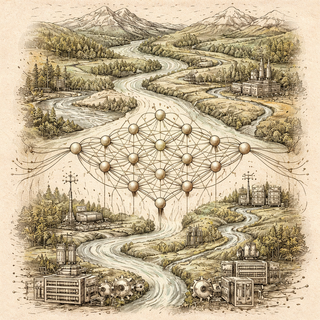
Disclaimer: This blog post is a simplified summary of published research for educational purposes. The accompanying illustration is artistic and does not depict actual model architectures, data, or experimental results. Always refer to the original paper for technical details.