Somewhere in a lab, scientists just built the world's most sophisticated dating app - but instead of matching humans, it pairs cancer-killing T cells with the tiny protein flags waving on tumor surfaces. The stakes? Helping patients survive glioblastoma, one of the nastiest brain cancers around.
The Problem: Finding Needles in a Molecular Haystack
Glioblastoma (GBM) is the villain of brain tumors. Median survival sits at a brutal 16-20 months, and the tumor has more tricks up its sleeve than a magician at a kids' party. One promising approach involves neoantigen vaccines - training a patient's own immune system to recognize and attack cancer cells by targeting unique protein fragments that only appear on tumors.
Here's the catch: tumors produce thousands of these potential "wanted posters" called neoantigens, but only a handful actually trigger T cells to spring into action. Current prediction tools are basically playing darts blindfolded. They're pretty good at guessing which neoantigens will get presented on cell surfaces (the HLA binding part), but predicting whether T cells will actually care about them? That's where things fall apart.
Enter TCRscore: The Algorithm That Actually Listens to T Cells
The secret sauce? They trained the model on publicly available datasets that include both HLA binding information AND T cell receptor (TCR) recognition features. Think of HLA binding as getting your resume past the automated screening - necessary but not sufficient. TCR recognition is like impressing the actual hiring manager. You need both.
When the researchers benchmarked TCRscore against six existing prediction tools, it consistently outperformed them at identifying neoantigens that could actually provoke an immune response. Not by a little - by enough to matter clinically.
Mini-Brains in a Dish: The Organoid Advantage
But here's where this study really gets interesting. Predictions are great, but how do you actually test whether your algorithm works before trying it in patients?
Traditional methods like ELISpot assays (basically seeing if T cells secrete certain molecules when exposed to potential targets) have a problem: they happen in artificial conditions that don't mimic the complex, immunosuppressive environment inside actual brain tumors. Testing T cell activity in a petri dish is like evaluating a basketball player by watching them shoot hoops alone in an empty gym.
The solution? Patient-derived organoids - tiny 3D tumor models grown from actual patient tissue. The team established 21 glioblastoma organoid models, and these mini-tumors retained the key histological and genetic features of the original cancers. They're not perfect replicas (no blood vessels or naturally infiltrating immune cells), but they're close enough to be useful.
The researchers then ran co-culture experiments, mixing neoantigen-primed T cells with organoids and watching what happened. Spoiler: the T cells trained on TCRscore-predicted neoantigens actually killed the tumor organoids. That's the kind of validation that matters.
A Shared Target Emerges
One particularly exciting finding: the analysis flagged a recurrent mutation called PIK3R1G376R as a potential "shared neoantigen." Most neoantigens are unique to individual patients (which is why personalized vaccines are so expensive and time-consuming to make). But shared neoantigens appearing across multiple patients could enable off-the-shelf treatments.
PIK3R1 mutations show up in about 7% of glioblastomas, and the G376R variant sits in a region important for regulating the PI3K signaling pathway - a frequent troublemaker in brain cancer. Finding a common target that triggers immune recognition could speed up vaccine development significantly.
What This Means for the Future
This research represents a methodological upgrade on two fronts. First, TCRscore adds T cell recognition features to neoantigen prediction, moving beyond the "will it bind?" question to "will it work?" Second, the organoid-based validation provides a more physiologically relevant testing platform than standard assays.
The combination creates what the authors call a "high-fidelity, high-quality GBM neoantigen database" - essentially a curated list of targets more likely to actually trigger immune responses.
Current RNA-based cancer vaccines are already in clinical trials, and AI is revolutionizing how we select targets. Manufacturing timelines have dropped from nine weeks to under four for personalized vaccines, though costs remain eye-watering at over $100,000 per patient.
Tools like TCRscore could help make those expensive vaccines more effective by improving target selection. And if shared neoantigens like PIK3R1G376R prove broadly immunogenic, they might eventually enable cheaper, faster treatments that work across patient populations.
The immune system has always been capable of fighting cancer. Sometimes it just needs better intelligence.
References
-
Wang, C., Sun, T., He, Y., et al. (2025). A Deep Learning-Driven Framework Integrating Organoid-Based Functional Validation Identifies Universal Neoantigens from Recurrent Glioma Mutations. Cancer Research. DOI: 10.1158/0008-5472.CAN-25-2679
-
Weber, L.M., et al. (2023). Can we predict T cell specificity with digital biology and machine learning? Nature Reviews Immunology. https://www.nature.com/articles/s41577-023-00835-3
-
Lu, T., et al. (2021). Deep learning-based prediction of the T cell receptor - antigen binding specificity. Nature Machine Intelligence. https://www.nature.com/articles/s42256-021-00383-2
-
Quail, D.F., et al. (2022). Patient-Derived Tumor Organoids for Guidance of Personalized Drug Therapies in Recurrent Glioblastoma. International Journal of Molecular Sciences. https://www.mdpi.com/1422-0067/23/12/6572
-
Ueki, K., et al. (2012). Somatic Mutations of PIK3R1 Promote Gliomagenesis. Cancer Research. https://pmc.ncbi.nlm.nih.gov/articles/PMC3498106/
-
Ogino, H., et al. (2024). A real-world observation of patients with glioblastoma treated with a personalized peptide vaccine. Nature Communications. https://www.nature.com/articles/s41467-024-51315-8
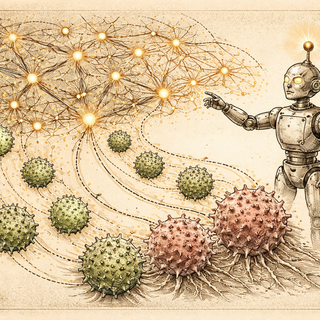
Disclaimer: This blog post is a simplified summary of published research for educational purposes. The accompanying illustration is artistic and does not depict actual model architectures, data, or experimental results. Always refer to the original paper for technical details.