"Feature point detection on textureless surfaces remains a fundamental challenge in computer vision due to the absence of discernible color and brightness gradients." Cool, cool - so basically every algorithm we've trusted for two decades just... gives up? Stares at a white plastic part and says "I see nothing here"? Yeah. That tracks.
The Problem Nobody's Favorite Algorithm Can Solve
Here's what's going on. SIFT, ORB, SURF - the greatest hits of computer vision feature detection - all work the same fundamental way. They hunt for intensity gradients. Bright spots next to dark spots. Corners where edges collide. Patterns that repeat at different scales. These detectors are brilliant at finding keypoints on, say, a richly textured book cover or a brick wall.
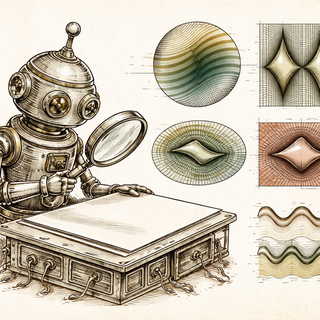
Now hand them a white plastic engine housing. A brushed aluminum panel. A ceramic tile. They return approximately... nothing. Zero. The visual equivalent of asking someone to find landmarks in a salt flat.
This isn't a minor inconvenience. Textureless objects are everywhere in manufacturing, warehouse automation, and robotics. That bin-picking robot trying to grab identical white plastic parts from a pile? It's basically working blindfolded. Even deep learning detectors like SuperPoint (DeTone et al., 2018) struggle when the training distribution doesn't include enough bland, featureless surfaces. And let's be honest - "bland and featureless" describes about 80% of industrial components.
Turns Out, "Textureless" Is a Lie
This is the wild part. Yanxing Liang and colleagues at IEEE TPAMI just published a method that essentially calls our bluff (Liang et al., 2026). Their argument? Those "textureless" surfaces aren't actually textureless. They have micro-geometry - tiny bumps, scratches, grain patterns, and height variations invisible to gradient-based detectors but absolutely real in terms of physics. Light hits these micro-structures and undergoes subtle phase modulation in its reflection. You can't see it. SIFT can't see it. But the math can.
Their framework reconstructs these invisible surface structures from a single standard RGB image. No depth sensor. No structured light projector. No LiDAR. Just a regular camera and some extremely clever physics.
Gabor Kernels: The Unsung Hero
The reconstruction engine runs on Gabor kernel-based spectral analysis - filters that decompose an image into frequency and orientation components. Gabor filters are inspired by how the human visual cortex processes information, which is ironic because they're being used here to detect things human vision literally cannot perceive. They tease out the phase information embedded in reflected light, mapping it to actual surface height variations.
From that height map, the team computes what they call the Concave-Convex Index (CCI) - a geometric descriptor that identifies stable feature points based on whether the local micro-surface curves inward or outward. Think of it like reading braille on a surface that feels perfectly smooth to your fingertips. The CCI doesn't care about color or brightness. It cares about shape, and shape doesn't change when you swap the lighting or repaint the object.
No Neural Network Required (Seriously)
In an era where the default answer to every computer vision problem is "throw a transformer at it," this paper takes the refreshingly contrarian route of not using deep learning. The entire pipeline is physics-based. No training data. No GPU clusters burning through megawatts. No worrying about domain shift when your factory changes suppliers and the new parts are slightly different shade of beige.
They tested across TUM, T-LESS (Hodan et al., 2017), and Shape2.5D (Khan et al., 2024) datasets - plus self-collected images - and demonstrated "superior capability in extracting stably distributed and highly repeatable feature points" even when visible texture or brightness gradients vanish entirely. The feature points stay consistent across different lighting conditions and viewing angles, which is exactly the kind of reliability that makes robotics engineers tear up a little.
Why This Actually Matters
Robots in factories drop things. Augmented reality overlays jitter and drift on plain surfaces. Automated quality inspection systems miss defects on uniform parts. These are real, expensive problems - and they trace back to the same root cause: our feature detectors are texture junkies that fall apart when the visual sugar runs out.
If you've ever used tools like combb2.io to enhance image details, you know that subtle visual information often hides in plain sight. This paper takes that idea to its logical extreme - finding structure in surfaces that appear to have none at all.
The potential applications stretch across manufacturing bin-picking, markerless AR on featureless walls, medical surface reconstruction, and any scenario where a robot needs to understand the geometry of something that looks aggressively boring. Which, if you've ever walked through a factory floor, is basically everything.
References
-
Liang, Y., Wang, Y., Yan, T., Yang, J., Li, W., Huang, L., Ning, X., & Kuchkorov, T. (2026). Textureless Surface Feature Point Detection via Micro-Geometry Reconstruction. IEEE Transactions on Pattern Analysis and Machine Intelligence. DOI: 10.1109/TPAMI.2026.3681931
-
DeTone, D., Malisiewicz, T., & Rabinovich, A. (2018). SuperPoint: Self-Supervised Interest Point Detection and Description. CVPR Workshop. arXiv: 1712.07629
-
Hodan, T., Haluza, P., Obdrzalek, S., Matas, J., Lourakis, M., & Zabulis, X. (2017). T-LESS: An RGB-D Dataset for 6D Pose Estimation of Texture-less Objects. IEEE WACV. arXiv: 1701.05498
-
Khan, M. Z., et al. (2024). Shape2.5D: A Dataset of Texture-less Surfaces for Depth and Normals Estimation. IEEE Access. arXiv: 2406.15831
-
Hinterstoisser, S., et al. (2012). Gradient Response Maps for Real-Time Detection of Textureless Objects. IEEE Transactions on Pattern Analysis and Machine Intelligence. DOI: 10.1109/TPAMI.2011.206
Disclaimer: This blog post is a simplified summary of published research for educational purposes. The accompanying illustration is artistic and does not depict actual model architectures, data, or experimental results. Always refer to the original paper for technical details.