Star Trek sold us a future where machines quietly fix reality in the background, and honestly, this new optics paper has that exact energy. Instead of asking a camera system to squint at several measurements and do a bunch of iterative soul-searching afterward, the researchers built a setup that can look at one image, figure out how the light got messed up, and correct it in one shot [1].
So here is the thing: a lot of optical systems are walking around with bad vision. Microscopes, telescopes, phone cameras, lidar, optical communication links - they all suffer when light waves get warped by imperfect lenses, turbulence, noise, or general real-world chaos. In optics, that distortion is called a wavefront aberration. If you can measure it fast, you can fix it fast. If you cannot, your fancy hardware becomes an expensive blur machine.
The Basic Trick: Train the Glass and the Brain Together
Most wavefront sensing methods make you work for it. They often need multiple intensity images, extra defocused measurements, or iterative phase retrieval algorithms that behave a bit like a GPS recalculating itself in a tunnel [1]. They can also struggle when aberrations are weak or the signal is noisy, which is rude, because real systems are noisy basically as a hobby.
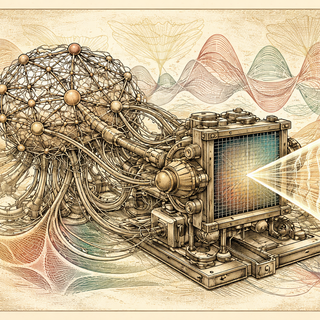
This paper tackles that by using a hybrid deep-learning design. The key move is not just a neural network. It is a learned optical phase mask placed in the physical system itself, plus a neural-network decoder trained jointly with it [1]. Let me unpack that.
The phase mask acts like a custom optical translator. Incoming distorted light passes through this engineered mask, which deliberately reshapes the information before it hits the sensor. Then the neural network reads that encoded intensity image and directly estimates the aberration in terms of Zernike modes, which are the standard math shorthand for common optical distortions like defocus, astigmatism, and coma [1,6].
That means the optics are no longer passive glass waiting to be judged later by software. The hardware and the model are co-designed end to end. It is less "take a messy picture and hope for the best" and more "set the exam so the answer key is easier to grade."
Why That Matters Outside a Lab Full of Lasers
This is where it gets interesting. The authors report single-shot retrieval from one focal-plane intensity image, without needing defocus measurements or iterative reconstruction, and they say the method is broadband, noise-robust, and able to generalize across structured light fields [1]. That combination matters because speed and reliability are the whole ballgame in adaptive optics.
In astronomy, wavefront correction can mean the difference between seeing a crisp object and seeing atmospheric soup [7]. In microscopy, it can help recover detail from tissue or other messy samples. In optical communications, better wavefront sensing can keep a free-space link from turning into an interpretive dance of lost photons [3,5].
There is also a broader trend here. Other recent papers have pushed wavefront sensing toward faster, smarter, and more integrated designs: deep-learning single-shot sensing for high-power lasers in 2023 [2], optical differentiation plus neural decoding in 2024 [3], transformer-based control for pyramid wavefront sensors in adaptive optics in 2024 [4], and metasurface-based single-shot sensing for deep turbulence in 2025 [5]. A 2025 review makes the same point more dryly than I will: the field is moving toward data-driven sensing that is faster and more tightly coupled to the physics of the system [8].
The Real Plot Twist
The clever part is not merely "AI was used." That sentence has been stretched thinner than conference coffee. The clever part is that the researchers used AI to redesign what the measurement itself should look like. That is a deeper shift. Instead of treating optics as fixed and computation as the cleanup crew, they optimize both together.
You can already see the family resemblance in browser tools that sharpen or clean up images after capture, like combb2.io. But this paper goes earlier in the pipeline. It tries to make the raw optical signal more informative before the software ever gets its turn. That is a stronger move.
Of course, the usual caveats still apply. Real-world deployment will depend on calibration, fabrication tolerances, generalization outside the training distribution, and whether the system stays stable when the environment gets weird in new ways. Neural networks remain enthusiastic pattern matchers, which is useful right up until they meet a scenario their training set never warned them about [8].
Still, if you like the idea of cameras, microscopes, and communication systems getting faster at correcting their own bad eyesight, this paper is a very solid signpost. It is optics learning a new trick: not just seeing light, but setting up the light so the answer comes back cleaner the first time.
References
[1] Moayed Baharlou S, Khalid MW, Gulinihali G, et al. An end-to-end hybrid deep-learning approach for single-shot wavefront sensing and correction. Nature Communications. 2026. DOI: 10.1038/s41467-026-72364-1. PubMed: 42120408
[2] Zhuang Y, Wang D, Deng X, et al. High robustness single-shot wavefront sensing method using a near-field profile image and fully-connected retrieval neural network for a high power laser facility. Optics Express. 2023;31(16):26990-27005. DOI: 10.1364/OE.496020. PubMed: 37710547
[3] Swain BR, Qadeer MA, Dorrer C, Narayanan RM, Rolland JP, Qiao J. Wavefront sensing with optical differentiation powered by deep learning. Optics Letters. 2024;49(18):5216-5219. DOI: 10.1364/OL.530559. PubMed: 39270269
[4] Weinberger C, Tapia J, Neichel B, Vera E. Transformer neural networks for closed-loop adaptive optics using nonmodulated pyramid wavefront sensors. Astronomy & Astrophysics. 2024;687:A202. DOI: 10.1051/0004-6361/202349118
[5] Martin Jimenez A, Baltes M, Cornelius J, et al. Single-shot phase diversity wavefront sensing in deep turbulence via metasurface optics. Nature Photonics. 2025;19:1315-1321. DOI: 10.1038/s41566-025-01772-4. arXiv: 2410.18789
[6] Zernike polynomials. Wikipedia. https://en.wikipedia.org/wiki/Zernike_polynomials
[7] Adaptive optics. Wikipedia. https://en.wikipedia.org/wiki/Adaptive_optics
[8] Zhang Y, An Q, Yang M, Ma L, Wang L. A Review of Wavefront Sensing and Control Based on Data-Driven Methods. Aerospace. 2025;12(5):399. DOI: 10.3390/aerospace12050399
Disclaimer: This blog post is a simplified summary of published research for educational purposes. The accompanying illustration is artistic and does not depict actual model architectures, data, or experimental results. Always refer to the original paper for technical details.