If we do not solve this problem, chemists keep burning absurd amounts of compute just to watch a few atoms bump into each other, panic, rearrange, and call it a reaction. That means slower work on batteries, catalysts, semiconductors, and all the other gear in the engine room of modern technology. The paper by Kim, Cho, Jeon, Jung, and Han is basically a salty old map of how to stop doing chemistry by dead reckoning and start doing it with better machine learning charts [1].
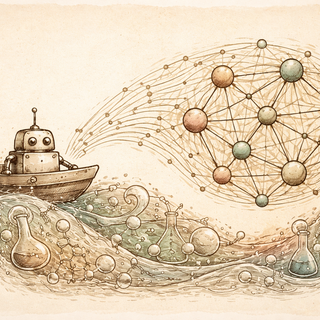
Why Atoms Need Better Navigators
At the heart of this story is the interatomic potential, which sounds like a pub argument between two physicists but is really just a rulebook for how atoms push, pull, and generally ruin each other's day. Traditional versions are fast, but they are often too stiff and too specialized. Quantum methods like density functional theory, or DFT, are much more accurate, but they move with the speed of a barnacle-covered galleon. Fine for tiny systems. Not fine when you want to simulate a messy chemical reaction over useful timescales.
Machine learning interatomic potentials, or MLIPs, promise a better vessel. You train a model on many examples from quantum calculations, and it learns the energy landscape well enough to run much larger simulations at much lower cost. Same ocean, far less seasickness. This review focuses on the reactive kind - the models meant to handle bond breaking and bond making, which is where chemistry stops being polite and starts throwing chairs [1].
The review says two things matter most: the ship itself and the charts. In plain English, that means model architecture and training data. A fancy neural network with lousy data is still a fancy way to be wrong. And a mountain of data with a weak model is like handing an intern a sextant and wishing them luck.
The Good Ship Equivariance
One big theme in the paper is the rise from old hand-crafted descriptors to graph neural networks, especially equivariant ones [1]. Translation: newer models are better at respecting the geometry of the atomic world. If you rotate a molecule, physics does not change. A decent model should know that without needing a dramatic intervention.
That is why newer architectures such as CHGNet and related universal MLIPs have attracted so much attention. They treat atoms like nodes in a graph and pass messages between neighbors, which is delightfully close to how gossip works on a small ship. CHGNet, for example, also bakes in charge-related information, which helps with materials where electronic state matters and not just who is standing next to whom [2].
Recent work is pushing even further toward "foundation models" for atomistic simulation. The dream is a broadly pretrained model you can fine-tune for a new material or reaction instead of rebuilding the whole vessel from timber every time. A 2024 study showed meta-learning can help pretrain MLIPs across datasets with different quantum levels of theory, which is a neat trick and a very good sign that the fleet is getting smarter [3].
Reactions Happen in Rough Water
Here is the real problem, and the review is admirably honest about it. Most data live near calm conditions - stable structures, low-energy configurations, the nice weather parts of the map. Real reactions do not. Reactions go through transition states, strained bonds, weird intermediates, and other places where atoms behave like sailors after three days without sleep.
So reactive MLIPs need training data that cover the dangerous waters, not just the harbor. That is where active learning comes in. Instead of blindly collecting more data, the model flags where it is uncertain and asks for expensive quantum calculations there. In captain terms, you send scouts toward the fog bank instead of drawing the rest of the map from imagination [1].
That matters because recent benchmarks show universal models still wobble when pushed off the safe route. One 2024-2025 line of work found that popular universal MLIPs struggle on surfaces and can systematically "soften" the potential energy surface, which is a polite way of saying the model underestimates how steep or punishing some parts of chemistry really are [4,5]. Another 2025 benchmark found that some models do well on phonons while others stumble, even when they look strong on basic energy and force metrics [6]. Plot twist: passing the easy exam does not mean you can steer through a storm.
Why This Review Actually Matters
What makes this paper worth your time is that it does not just cheer for bigger models and call it a day. It lays out a practical framework for choosing or building reactive MLIPs based on the chemistry you care about, the data you can afford, and the failure modes you cannot ignore [1]. That is useful if you study catalysis, battery interfaces, semiconductor etching, or any other setting where atoms are constantly making regrettable life choices.
If these methods keep improving, the payoff is obvious. Researchers could simulate reaction pathways at scales that were previously too expensive, screen materials faster, and design experiments with fewer blind alleys. Not magic. Not robot alchemy. Just better charts, faster ships, and fewer expensive voyages into the computational abyss.
And that, matey, is the whole game. Chemistry does not need an AI that "thinks." It needs one that knows where the rocks are.
References
[1] Kim J, Cho H, Jeon H, Jung J, Han S. Reactive Machine Learning Interatomic Potentials for Chemistry and Materials Science. Chemical Reviews (2025). DOI: 10.1021/acs.chemrev.5c00728. PubMed: 41950416
[2] Deng B, Zhong P, Jun K, et al. CHGNet as a pretrained universal neural network potential for charge-informed atomistic modelling. Nature Machine Intelligence 5, 1031-1041 (2023). DOI: 10.1038/s42256-023-00716-3
[3] Allen AEA, Lubbers N, Matin S, et al. Learning together: Towards foundation models for machine learning interatomic potentials with meta-learning. npj Computational Materials 10, 154 (2024). DOI: 10.1038/s41524-024-01339-x
[4] Focassio B, Freitas LPM, Schleder GR. Performance Assessment of Universal Machine Learning Interatomic Potentials: Challenges and Directions for Materials' Surfaces. ACS Applied Materials & Interfaces 17(9), 13111-13121 (2025). DOI: 10.1021/acsami.4c03815
[5] Deng B, Choi Y, Zhong P, et al. Systematic softening in universal machine learning interatomic potentials. npj Computational Materials 11, 9 (2025). DOI: 10.1038/s41524-024-01500-6
[6] Loew A, Sun D, Wang HC, et al. Universal machine learning interatomic potentials are ready for phonons. npj Computational Materials 11, 178 (2025). DOI: 10.1038/s41524-025-01650-1
Disclaimer: This blog post is a simplified summary of published research for educational purposes. The accompanying illustration is artistic and does not depict actual model architectures, data, or experimental results. Always refer to the original paper for technical details.