Somewhere right now, a supercomputer is watching billions of atoms jostle around like a mosh pit in slow motion. The problem? Even with all that computational muscle, the interesting stuff - a protein folding, a drug binding to its target, crystals forming from solution - happens on timescales that would make geological time look impatient. So how do scientists make sense of molecular chaos without waiting until the heat death of the universe?
Enter free-energy surfaces: the topographical maps of the molecular world.
The Landscape Metaphor That Actually Works
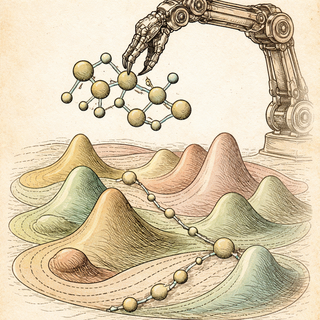
Think of molecules as hikers navigating terrain. They naturally settle into valleys (stable states) and occasionally muster the energy to climb over mountain passes (transition states) to reach new valleys. A free-energy surface, or FES, is essentially Google Maps for this molecular hiking trip - except instead of roads and elevation, you're plotting energy against the positions and configurations of atoms.
Marcello Sega and Matteo Salvalaglio's recent review in the Annual Review of Chemical and Biomolecular Engineering surveys how scientists construct these maps, from the foundational statistical mechanics to the machine learning methods that are reshaping the field. It's the kind of comprehensive guide that makes you realize how far computational chemistry has come - and how many clever hacks researchers have invented to speed things up.
The Sampling Problem: Why Your Simulation is Stuck in a Rut
Here's the catch: molecules don't explore their landscape democratically. They spend most of their time lounging in comfortable energy valleys, occasionally peeking over ridges but rarely making the trek across. Standard molecular dynamics simulations capture this all too faithfully, producing terabytes of data showing a molecule wiggling in place like someone who walked into a party and immediately found the snack table.
This is the sampling problem. Rare events - the transitions that actually matter for biology and materials science - are called "rare" for a reason. A protein might flip between two functional states once every millisecond, but simulating a millisecond of molecular motion would take years of supercomputer time.
The solution? Cheating, essentially. But elegant, mathematically justified cheating.
Enhanced sampling methods like metadynamics add artificial biases that push molecules out of their comfort zones. Imagine adding sand to each valley as the molecule visits it, gradually filling up the comfortable spots until the system is forced to explore elsewhere. The Nature Reviews Physics summary by Bussi and Laio describes how metadynamics builds a history-dependent potential that eventually flattens the landscape, allowing free exploration and - crucially - enabling reconstruction of the original unbiased free energy surface.
Collective Variables: The Art of Knowing What to Ignore
You can't map a landscape you can't describe. A protein with thousands of atoms exists in a space with tens of thousands of dimensions. Nobody is visualizing that, and no algorithm is sampling it efficiently.
The trick is finding collective variables (CVs) - a small set of coordinates that capture the essential physics. Maybe it's the distance between two amino acids, an angle describing a molecular twist, or some more abstract mathematical construct. Choose well, and your free energy surface becomes interpretable. Choose poorly, and your simulations produce qualitatively wrong mechanisms.
Traditionally, CV selection required chemical intuition and domain expertise. A researcher studying protein folding might track backbone dihedral angles; someone simulating crystal nucleation might focus on coordination numbers. It worked, but it relied heavily on already knowing what mattered.
Machine Learning Enters the Chat
This is where things get interesting. The explosion of machine learning in molecular simulation isn't just about faster force calculations - it's fundamentally changing how scientists discover and represent the important coordinates.
Time-lagged independent component analysis (TICA) automatically identifies slow modes from simulation data - the directions along which the system evolves most sluggishly, which usually correspond to the functionally relevant motions. Diffusion maps and related techniques find nonlinear coordinates that group kinetically similar states together.
More recently, neural networks have entered the picture. Variational approaches (VAMPnets) can learn eigenfunctions of the molecular dynamics operator directly from data. Autoencoders compress high-dimensional molecular configurations into low-dimensional bottlenecks, and researchers are figuring out how to interpret what they've learned.
Salvalaglio's own recent work on reproducibility in machine-learned collective variable spaces tackles a practical concern: different training runs can produce different CV representations. Without standardization, comparing results between studies becomes problematic.
From Landscapes to Understanding
Why does any of this matter outside computational chemistry papers?
Drug discovery relies on understanding protein dynamics - how binding sites open and close, how allosteric signals propagate. Markov state models built from free energy surfaces can predict timescales that experiments struggle to measure directly. AI-based methods are now uncovering hidden intermediate states in protein folding that might be targets for therapeutic intervention.
Materials scientists use similar approaches to understand phase transitions, nucleation, and crystal growth. The same conceptual framework that describes a protein folding describes ice forming or a pharmaceutical compound crystallizing - it's all about navigating free energy landscapes.
The Road Ahead
The field is moving fast. Hybrid machine learning potentials are making simulations both faster and more accurate. New benchmarks like Landscape17 are revealing where current methods succeed and fail. The challenge isn't just computational anymore - it's about developing frameworks that make these high-dimensional landscapes interpretable to human researchers.
Sega and Salvalaglio's review arrives at a moment when the foundations are solid but the frontiers are expanding rapidly. The mountains and valleys of free energy space have always been there. We're just getting better at reading the map.
References
-
Sega, M., & Salvalaglio, M. (2025). Molecular Understanding of Free-Energy Landscapes. Annual Review of Chemical and Biomolecular Engineering. DOI: 10.1146/annurev-chembioeng-100724-082451
-
Bussi, G., & Laio, A. (2020). Using metadynamics to explore complex free-energy landscapes. Nature Reviews Physics. https://www.nature.com/articles/s42254-020-0153-0
-
Wang, Y., et al. (2022). Collective variable discovery in the age of machine learning: reality, hype and everything in between. RSC Advances. https://pubs.rsc.org/en/content/articlehtml/2022/ra/d2ra03660f
-
Husic, B.E., & Pande, V.S. (2018). Markov State Models: From an Art to a Science. Journal of the American Chemical Society. https://pubs.acs.org/doi/10.1021/jacsau.1c00254
-
Mardt, A., et al. (2024). Machine learning heralding a new development phase in molecular dynamics simulations. Artificial Intelligence Review. https://link.springer.com/article/10.1007/s10462-024-10731-4
Disclaimer: This blog post is a simplified summary of published research for educational purposes. The accompanying illustration is artistic and does not depict actual model architectures, data, or experimental results. Always refer to the original paper for technical details.