Neural networks have a focus problem. Not the existential "what is my purpose" kind, but the practical "someone keeps bumping my elbow while I'm doing math" kind.
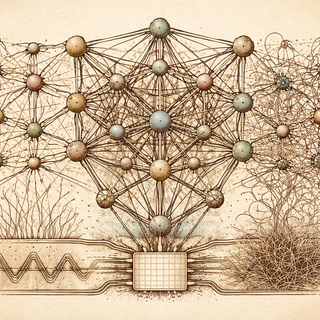
A team of researchers from China just published a paper tackling one of the messier challenges in distributed computing: how do you get a bunch of interconnected systems to share resources fairly when the real world keeps throwing curveballs at them? Their solution involves something called "anti-disturbance proximal neural networks," which sounds like a wellness app for robots but is actually a clever approach to optimization under chaos.
The Problem: Sharing Is Hard When Things Keep Going Wrong
Imagine you're running a smart power grid. You've got solar panels generating unpredictable amounts of energy, wind turbines doing their own thing, and thousands of homes all wanting electricity at the same time. The goal is simple: distribute power efficiently so everyone gets what they need without wasting resources or blowing transformers.
The math for this is a "composite resource allocation problem" - basically, split up limited stuff among competing demands while respecting a bunch of constraints. Classic optimization territory.
Here's where it gets spicy: real systems don't operate in a vacuum. Sensors drift. Communication links hiccup. Random noise creeps into measurements. These disturbances can throw off your carefully calculated solutions like a cat walking across a keyboard during a coding session.
Previous approaches often assumed perfect conditions or required complete knowledge of every disturbance - neither of which exists outside of academic papers and fever dreams.
Two Flavors of Resilience
The researchers, Linhua Luan, Sitian Qin, and Shuai Qi, developed two neural network architectures, each designed for a different type of chaos.
For "structured" disturbances - the predictable troublemakers whose patterns you can model - they built a network using something called the internal model principle. If you know a disturbance follows a sine wave pattern, for instance, you can bake that knowledge into your system and cancel it out. It's like noise-canceling headphones but for optimization algorithms.
For "unstructured" disturbances - the random gremlins with no discernible pattern - they designed an observer-based network that watches what's happening and adapts on the fly. Think of it as giving the neural network its own pair of eyes to spot trouble and compensate in real-time.
Both approaches handle "nonsmooth" objective functions, which is technical speak for optimization landscapes with sharp edges and corners rather than gentle hills. These pop up constantly in practical applications and tend to break traditional gradient-based methods that expect everything to be nicely differentiable.
Why This Actually Matters
Distributed resource allocation isn't just an academic exercise. It shows up everywhere:
- Smart grids balancing renewable energy sources with fluctuating demand
- Multi-robot coordination where autonomous agents need to divide up tasks
- Cloud computing allocating server resources across thousands of requests
- Traffic networks routing vehicles to minimize congestion
In all these cases, disturbances are the rule, not the exception. A neural network that can maintain good performance while the world throws nonsense at it has obvious appeal.
The paper includes simulations showing both networks converging to optimal solutions even under sustained disturbances. The structured-disturbance version handles periodic interference gracefully, while the observer-based version deals with random noise without losing its composure.
The Technical Guts (Briefly)
For the optimization nerds: the networks tackle composite optimization with general inequality and equality constraints across networked agents. The objective functions don't need to be smooth, which means they're using proximal operators to handle subdifferentials - essentially a way to deal with functions that have kinks.
The convergence proofs rely on Lyapunov stability theory, the gold standard for showing that dynamic systems settle down to where you want them instead of spiraling into chaos. The researchers proved asymptotic convergence for both architectures, meaning the networks eventually reach the optimal solution and stay there.
What's particularly neat is that the observer-based version doesn't require prior knowledge of disturbance structure. It estimates and compensates for whatever garbage the environment throws at it, which is far more practical for real deployments where you can't predict every failure mode.
Looking Forward
This work fits into a broader trend of making optimization algorithms robust to real-world messiness. As we push more decision-making to distributed systems - edge computing, IoT networks, autonomous vehicle fleets - the gap between theoretical optimality and practical performance becomes critical.
The proximal approach also connects to recent work on optimization in machine learning itself. Training neural networks involves nonsmooth objectives (hello, ReLU activations), and handling constraints gracefully remains an active research area.
Whether these specific architectures make it into production systems remains to be seen. But the underlying insight - that you can bake disturbance rejection directly into optimization dynamics rather than treating it as an afterthought - feels like the kind of idea that keeps paying dividends.
Sometimes the best solution isn't eliminating noise. It's building systems smart enough to ignore it.
References
-
Luan, L., Qi, S., & Qin, S. (2026). Anti-Disturbance Proximal Neural Networks for Composite Resource Allocation. IEEE Transactions on Neural Networks and Learning Systems. DOI: 10.1109/TNNLS.2026.3675092
-
Yang, S., Liu, Q., & Wang, J. (2017). A multi-agent system with a proportional-integral protocol for distributed constrained optimization. IEEE Transactions on Automatic Control, 62(7), 3461-3467. DOI: 10.1109/TAC.2016.2610945
-
Cherukuri, A., & Cortés, J. (2016). Initialization-free distributed coordination for economic dispatch under varying loads and generator commitment. Automatica, 74, 183-193. DOI: 10.1016/j.automatica.2016.07.003
-
Beck, A. (2017). First-Order Methods in Optimization. Society for Industrial and Applied Mathematics. DOI: 10.1137/1.9781611974997
Disclaimer: This blog post is a simplified summary of published research for educational purposes. The accompanying illustration is artistic and does not depict actual model architectures, data, or experimental results. Always refer to the original paper for technical details.