I’ll admit it: the first time I read this paper, I got stuck on the phrase “distinct inverse mappings” and briefly felt like the authors had hidden the actual plot inside an optics escape room. Then it clicked. They are asking a sneaky question: when a deep network “sees through” a messy scattering medium like fog, tissue, or milk-water chaos, is it really learning the physics, or is it just bluffing until the light gets weird enough to expose it?
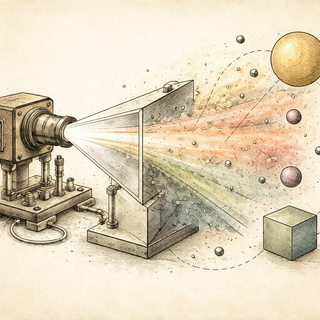
The paper studies deep learning for imaging through scattering media, which is a fancy way of saying: light hits a chaotic material, gets scrambled into speckle soup, and your camera records something that looks less like a picture and more like your TV losing a fight with a snowstorm.
Researchers already knew neural networks can sometimes reconstruct the hidden object from that mess. The annoying part is that these models often work great in the lab and then fall apart when the scattering conditions change. Same object, same camera, slightly different medium, and the model starts improvising like a jazz musician who never learned the song.
Zhang and colleagues argue that this failure is not random bad luck. It comes from physics. In their setup, the scattering medium is described by a transmission matrix, basically the rulebook for how incoming light gets scrambled on the way out. A model trained on one set of rulebooks can only handle so many new ones before its learned inverse mapping runs out of road. Past that point, the network does not gracefully degrade. It hallucinates - meaning it produces non-physical predictions that look confident and can be completely wrong [1].
Interesting timing, by the way. A paper about hallucination in imaging lands in April 2026, after the broader AI world spent two years yelling about hallucinations in language models. Coincidence? Probably. But also: the same vibe. Once the system leaves familiar territory, confidence remains. Truth gets left at the bus stop.
Ballistic photons: the tiny honest witnesses
Here’s the part I liked most. The paper says residual ballistic light can act as a stabilizing anchor. Ballistic photons are the lucky few that pass through the scattering mess without getting bounced around too badly. They are not the loudest signal in the room, but they are the honest one.
That matters because the network seems to generalize better when even a small amount of physically reliable information survives. Earlier work from related authors pointed in the same direction, arguing that ballistic photons help explain why some “scalable” scattering models generalize across diffusers better than they should on paper [2,3].
In plain English: if the model still has a few trustworthy breadcrumbs from reality, it is less likely to wander off into fantasyland.
That is a big deal for biomedical imaging, endoscopy, remote sensing, and any setup where the medium changes over time. A network that can only behave when every optical condition is frozen like a museum exhibit is not much use outside the lab.
Why this matters outside the optics bunker
This is not just a niche optics paper. It is really about AI reliability under shifting physical conditions. The same general headache shows up all over machine learning: train on one world, deploy in a slightly different one, watch the model become a surprisingly eloquent liar.
Recent work in this area has been pushing hard on dynamic scattering. A 2024 Light: Science & Applications paper reported real-time learning-based imaging through changing media, including fog-like conditions and outdoor scenes [4]. Another 2024 study used transfer learning to keep adapting as scattering changed, basically giving the model a quick tune-up instead of pretending the world would stay still forever [5]. On the non-deep-learning side, a 2025 Nature Communications paper showed matrix-based imaging through dynamic scattering, which is another sign the field is chasing robustness, not just prettier demo images [6].
Also, if this all sounds like the lab-coat cousin of image restoration tools, that’s because it is. Consumer tools like combb2.io deal with denoising and sharpening in much friendlier settings. This paper is the same family reunion, except the relatives are photons, disorder, and a neural net trying not to make stuff up.
The authors also released code and data, which is exactly what you want when a paper makes strong claims about generalization instead of just showing one glossy miracle image [1].
The actual takeaway, with fewer smoke machines
My read is that this paper does something refreshingly unsentimental. It says the model’s behavior is constrained by the physics of the problem, not by motivational posters about “better generalization.” If the network cannot represent enough distinct inverse mappings, it will fail. If physical anchors like ballistic light survive, it has a better shot. If not, you may get a reconstruction that looks plausible while being nonsense.
That is useful because it turns “the model hallucinated” from a spooky AI ghost story into a testable engineering problem. Less mysticism. More accounting. Always a good sign.
References
-
Zhang X, Zhong T, Huang H, et al. Physical mechanisms governing generalization and hallucination in deep learning for imaging through scattering media. Nature Communications. Published April 23, 2026. DOI: 10.1038/s41467-026-72304-z. PubMed: PMID 42026070. Code/data noted in article: GitHub repository
-
Zhang X, et al. Roles of scattered and ballistic photons in imaging through scattering media: a deep learning-based study. arXiv: 2207.10263 (2022).
-
Zhang X, et al. The physical origin and boundary of scalable imaging through scattering media: a deep learning-based exploration. Photonics Research. 2023;11(6):1038-1046. DOI: 10.1364/PRJ.490125
-
Liu H, Wang F, Jin Y, et al. Learning-based real-time imaging through dynamic scattering media. Light: Science & Applications. 2024;13:194. DOI: 10.1038/s41377-024-01569-0
-
Fu Z, Wang F, Tang Z, Bian Y, Situ G. Adaptive imaging through dense dynamic scattering media using transfer learning. Optics Express. 2024;32(8):13688-13700. DOI: 10.1364/OE.519771
-
Weinberg S, et al. Matrix-based imaging through dynamic scattering. Nature Communications. 2025;16:9413. DOI: 10.1038/s41467-025-64422-x
-
Ding C, Shao R, He Q, Li LS, Yang J. Wavefront shaping improves the transparency of the scattering media: a review. Journal of Biomedical Optics. 2024;29(S1):S010801. DOI: 10.1117/1.JBO.29.S1.S010801
-
Gigan S, Katz O, de Aguiar HB, et al. Roadmap on wavefront shaping and deep imaging in complex media. Journal of Physics: Photonics. 2022;4(4):042501. DOI: 10.1088/2515-7647/ac76f9
Disclaimer: This blog post is a simplified summary of published research for educational purposes. The accompanying illustration is artistic and does not depict actual model architectures, data, or experimental results. Always refer to the original paper for technical details.