Five years ago, cancer AI often looked like a very confident person trying to solve a murder mystery with exactly one clue. Today, the field is finally admitting that tumors are messy little chaos goblins, and Liu and colleagues argue that if you want to understand them, you need the whole stack - genomics, transcriptomics, proteomics, imaging, clinical records, the lot - stitched together by AI that can survive contact with reality [1].
If I am reading this review right, the main point is almost offensively sensible: cancer does not operate on one biological layer at a time, so our models should stop pretending it does. "Multi-omics" just means combining multiple molecular readouts - DNA changes, RNA activity, protein levels, methylation patterns, sometimes metabolites too - to get a fuller picture of what a tumor is doing. Add clinical notes and medical images, and now you are not just staring at a parts list, you are watching the machine cough, spark, and occasionally explode.
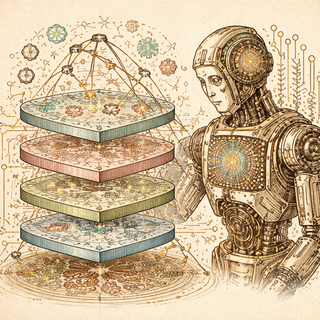
That matters because two patients can have "the same" cancer on paper and still respond to treatment like they were assigned by different screenwriters. One tumor may carry the mutation. Another may actually use it. A third may route around it like a GPS that has decided traffic laws are a suggestion. Single-modality models miss that kind of layered weirdness.
AI as the overcaffeinated translator
AI is useful here because these datasets are enormous, noisy, and not designed by people who wanted to make my life easy. Different omics layers come in different shapes, different scales, and different levels of completeness. Clinical records are messy. Imaging is rich but indirect. Gene expression is detailed but context-poor. Put them together and you get something closer to the truth, plus a much greater chance of computational nonsense if you are careless.
Recent work shows the field moving from "cool demo" to "please standardize something before we all lose our minds." A 2023 Nature Machine Intelligence paper laid out how deep learning can fuse multimodal cancer data for biomarker discovery [2]. A 2024 review in npj Digital Medicine showed how multi-omics machine learning is already helping with immunotherapy questions, where simple biomarkers often flop because the tumor microenvironment is doing twelve things at once [3]. And in 2025, the MLOmics team released a standardized cancer multi-omics database covering 8,314 samples across 32 cancer types, which is the kind of boring infrastructure progress that quietly saves a field from repeatedly benchmarking on whatever CSV happened to be nearest the keyboard [4].
Why this review actually matters
Liu et al. are not pitching magic. They are mapping where AI is already helping: earlier diagnosis, sharper patient stratification, therapy response prediction, and clues about drug resistance [1]. That last one is especially interesting. Resistance is cancer's favorite party trick. You hit one pathway, it finds another. You block the front door, it leaves through a window, steals your wallet, and writes a paper about resilience.
The review also leans hard on explainable AI, which, honestly, thank goodness. In oncology, "the model vibes strongly with this answer" is not a clinical argument. Doctors need to know what signal the system is using, whether it generalizes beyond one hospital, and whether it is rediscovering biology or just memorizing scanner settings and demographic quirks. A model that predicts beautifully and explains nothing is not a medical breakthrough. It is a trust exercise with terrible stakes.
This is where multimodal foundation models and future digital twins enter the chat. Another 2024 perspective described how transformer-based multimodal models could handle text, images, and molecular data together in precision oncology [5]. A 2025 commentary pushed the idea further toward patient-specific digital twins - computational stand-ins that could simulate disease course and treatment response [6]. I say this with appropriate anxiety: that is exciting, but also a phrase that can attract nonsense at high speed. We are not talking about a perfect virtual copy of a person. We are talking about better predictive models, hopefully grounded in biology, not sci-fi mood lighting.
The annoying problems are still the real problems
The review is refreshingly honest about what gets in the way: missing data, incompatible platforms, privacy constraints, small cohorts, batch effects, fairness issues, and the classic "worked on one dataset, collapsed everywhere else" problem [1]. Cancer data integration is less like snapping Lego bricks together and more like trying to merge tax records, MRI scans, and four partially burned cookbooks.
And yet, this is exactly why the paper is worth your attention. It frames AI not as a replacement for cancer biology, but as the thing that might finally help us connect biology, pathology, and clinical care without dropping half the signal on the floor. If you have ever tried to sketch how all these layers relate and ended up with a diagram that looks like a conspiracy board, that is also why visual tools like mapb2.io feel weirdly relevant here.
The cautious takeaway: if these models become reproducible, interpretable, and genuinely portable across hospitals, they could help turn precision oncology from "we sequenced your tumor and found a maybe" into something closer to an evidence-backed plan. I think that is the dream, anyway. I have read this review several times and I am still suspicious of how much sense it makes.
References
-
Liu F, Beck S, Yang L, Luo H, Zhang K. Advancing AI for multi-omics and clinical data integration in basic and translational cancer research. Nature Reviews Cancer. 2026. DOI: 10.1038/s41568-026-00922-2
-
Steyaert S, Pizurica M, Nagaraj D, et al. Multimodal data fusion for cancer biomarker discovery with deep learning. Nature Machine Intelligence. 2023;5:351-362. DOI: 10.1038/s42256-023-00633-5
-
Li Y, Wu X, Fang D, et al. Informing immunotherapy with multi-omics driven machine learning. npj Digital Medicine. 2024;7:67. DOI: 10.1038/s41746-024-01043-6. PubMed: 38486092
-
Yang Z, Kotoge R, Piao X, et al. MLOmics: Cancer Multi-Omics Database for Machine Learning. Scientific Data. 2025;12:913. DOI: 10.1038/s41597-025-05235-x. arXiv: 2409.02143
-
Truhn D, Eckardt JN, Ferber D, et al. Large language models and multimodal foundation models for precision oncology. npj Precision Oncology. 2024;8:72. DOI: 10.1038/s41698-024-00573-2
-
Wen J. Towards a multi-organ, multi-omics medical digital twin. Nature Biomedical Engineering. 2025;9:1386-1389. DOI: 10.1038/s41551-025-01474-w
Disclaimer: This blog post is a simplified summary of published research for educational purposes. The accompanying illustration is artistic and does not depict actual model architectures, data, or experimental results. Always refer to the original paper for technical details.