Somewhere between the third multiple-choice question and the fourth, your teacher just figured out that you've completely forgotten how photosynthesis works but somehow retained everything about the Krebs cycle. They didn't need a 200-question final exam to discover this. They needed five questions and a text embedding model.
Researchers at Dartmouth just published a paper that sounds like science fiction: take a handful of quiz questions, run them through the same kind of AI that powers modern language models, and suddenly you've got a detailed map of everything a student knows - and doesn't know - without subjecting anyone to a three-hour standardized test.
The Problem with Traditional Quizzes
Here's the dirty secret about most educational assessments: they're basically binary. You either got the question right or you didn't. Your score is a number that tells everyone approximately nothing about the landscape of your actual understanding.
Did you miss that question about cellular respiration because you don't understand biology, or because you mixed up mitochondria with chloroplasts? Traditional quizzes shrug. They have no idea. They just mark you wrong and move on.
Jeremy Manning and his team at Dartmouth's Contextual Dynamics Laboratory decided this was unacceptable.
Enter the Embedding Space
The key insight is almost elegant in its simplicity: concepts that are related to each other should live close together in some mathematical space. Gravity and magnetism? Neighbors. Genetics and Renaissance art history? They're in different zip codes entirely.
Text embedding models - the same technology that helps search engines understand that "running shoes" and "athletic footwear" mean basically the same thing - can represent any piece of text as coordinates in a high-dimensional space. The researchers applied this to both Khan Academy video transcripts and multiple-choice quiz questions.
Now here's where it gets interesting. When a student correctly answers a question about, say, Newton's laws, the model doesn't just record "knows Newton's laws." It infers that the student probably also understands nearby concepts in the embedding space - momentum, force, acceleration - even without directly testing those topics.
It's like figuring out someone's entire music taste from five songs. If they love three obscure indie folk albums, you can reasonably guess they're not spending their weekends at EDM festivals.
The Khan Academy Experiment
The team tested this on 50 Dartmouth undergraduates watching educational videos on Khan Academy (yes, the same Khan Academy that's been quietly revolutionizing online education). Students answered short quiz sets before and after watching the videos, and the framework tracked how their "knowledge coordinates" shifted in the embedding space.
The results were striking. Not only could the model capture knowledge changes from before to after watching lectures, but it could reliably predict which specific questions students would answer correctly on future quizzes. A handful of questions revealed what would normally require a comprehensive exam to uncover.
Why This Actually Matters
Traditional knowledge tracing - the field dedicated to modeling what students know - has been around for decades. Bayesian Knowledge Tracing, introduced in the 1990s, treats each skill as either "learned" or "unlearned," which is a bit like describing a sunset as either "happening" or "not happening." Technically accurate, completely missing the point.
Deep learning approaches have improved things, but they typically need massive amounts of student interaction data to work well. This new framework is different: it bootstraps rich knowledge maps from minimal quiz data by leveraging the semantic structure already encoded in language models.
The applications are genuinely exciting. Imagine an AI tutor that doesn't just know you got a question wrong, but understands exactly which prerequisite concept is fuzzy and needs reinforcement. Or a classroom tool that identifies, in real-time, that half the class has a shared misconception about how electric circuits work - before anyone even asks about circuits directly.
For anyone building educational tools or learning analytics platforms, this approach offers a way to create more nuanced understanding of learners without drowning them in assessments. Tools like mapb2.io that focus on visual knowledge mapping could potentially integrate similar embedding-based approaches to help learners see connections between concepts they're studying.
The Catch (There's Always a Catch)
This framework relies on text - specifically, on the assumption that quiz questions and learning materials can be meaningfully embedded in the same semantic space. That works great for conceptual knowledge expressed in language. It's less clear how well it handles procedural skills, mathematical reasoning, or domains where the "meaning" isn't easily captured in words.
The study also used a relatively small sample of college students learning from video lectures. Scaling this to younger learners, different subject matters, or less structured learning environments remains an open question.
The Bigger Picture
What's quietly remarkable here is how the researchers reframed the problem. Instead of treating quizzes as measurement instruments that need more questions to be more accurate, they treated them as sparse samples from a rich underlying knowledge space - and used modern NLP to fill in the gaps.
It's a reminder that sometimes the answer isn't "collect more data." It's "be smarter about interpreting the data you already have."
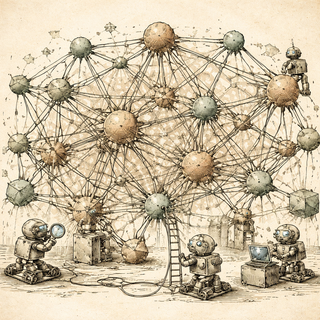
Disclaimer: This blog post is a simplified summary of published research for educational purposes. The accompanying illustration is artistic and does not depict actual model architectures, data, or experimental results. Always refer to the original paper for technical details.
References
- Fitzpatrick, P. C., Heusser, A. C., & Manning, J. R. (2026). Text embedding models yield detailed conceptual knowledge maps derived from short multiple-choice quizzes. Nature Communications. DOI: 10.1038/s41467-026-69746-w
- Liu, Q., Shen, S., Huang, Z., Chen, E., & Zheng, Y. (2022). A Survey of Knowledge Tracing. ACM Computing Surveys. https://dl.acm.org/doi/10.1145/3569576
- Piech, C., et al. (2015). Deep Knowledge Tracing. Advances in Neural Information Processing Systems. Stanford Deep Knowledge Tracing
- Ruiz, S., et al. (2014). ALAS-KA: A learning analytics extension for better understanding the learning process in the Khan Academy platform. Computers in Human Behavior. ScienceDirect
- Sentence Transformers Documentation. https://www.sbert.net/