3 reasons this paper matters, starting with the least obvious. First, it quietly messes with our sense of time. Second, it suggests dryland soils are less like vaults and more like ancient pantries with a door that does not always stay shut. Third, if climate models have been treating that pantry like a sealed container, then some of our neat little carbon forecasts may have been wearing fake mustaches.
Soil organic carbon sounds like one of those phrases built in a lab to scare away civilians, but the idea is simple: dead plants, microbes, roots, and assorted biological leftovers get worked into soil, where some carbon hangs around for days, some for decades, and some for centuries or longer. The big question is not just how much carbon is in the ground, but how long it stays there before microbes cash it out as CO2. That matters a lot in drylands, which cover about 41% of Earth’s land area and store an enormous amount of soil carbon.
Wang and colleagues tackled that question with radiocarbon, which is basically timekeeping for carbon atoms. Because atmospheric nuclear testing in the 1950s and 1960s flooded the atmosphere with extra carbon-14, scientists can now spot "bomb carbon" in newer material, while older carbon shows the radioactive wear and tear of time. It is part physics, part ecology, part cosmic bookkeeping, which is honestly a rude amount of competence for one method.
Across 97 dryland sites on six continents, the team found that bulk soil organic carbon in topsoils had a mean age of about 2,100 years, while the carbon coming out as respired CO2 averaged about 520 years old (Wang et al., 2026). Read that again. Some of the carbon being breathed out by soil microbes is not fresh lunch. It is carbon that has been sitting around since the Roman Empire was still arguing with itself.
The old stuff is not as retired as we hoped
That is the paper’s real plot twist. Older soil carbon has often been treated as relatively protected, either physically tucked away in aggregates or chemically stuck to minerals. Not immortal, exactly, but at least hard to disturb. This study says: slow down. In drylands, microbes are still reaching into that older stock, especially after wetting events.
The authors also found an aridity threshold around 0.87, beyond which carbon signatures shifted abruptly toward older material. Translation: when places get dry enough, the whole system changes character. Less plant input, lower productivity, less fresh carbon arriving, more dependence on old material. It is the ecological version of living off savings because the paycheck stopped clearing.
That fits uncomfortably well with other recent work. A 2025 Nature Geoscience study found that rain-induced carbon pulses in drylands have been underestimated, with pulse events contributing nearly 17% of annual ecosystem respiration across study sites (Nguyen et al., 2025). Another 2026 paper reported that drylands are playing an outsized role in the slowdown of global vegetation carbon uptake (Nature Geoscience, 2026). Add in evidence that warming has intensified global drought severity (Gebrechorkos et al., 2025), and the vibe becomes less "stable background ecosystem" and more "load-bearing chapter in the climate story."
Why models should lose a little sleep
One of the paper’s sharpest points is that current machine-learning estimates and Earth system models tend to predict much younger respired carbon, often under 50 years, compared with the roughly 520-year mean inferred here. That is not a rounding error. That is the scientific equivalent of showing up for a blind date and realizing the profile photo was from 1998.
The implication is not that every climate model is broken and should be launched into the sea. It is that dryland carbon turnover may involve older, more vulnerable pools than many models currently represent. If true, then warming, drought, and episodic rewetting could unlock carbon that had been treated as safely parked.
There is also a philosophical sting here. We like to imagine nature keeping tidy ledgers: young carbon cycles quickly, old carbon rests in peace, and the planet, while chaotic, at least follows categories we can print on a figure legend. But soils do not respect our filing system. They are archives that decompose, savings accounts with tiny microbial burglars, memory itself rendered in dust and chemistry.
The catch, because there is always a catch
This is not a final verdict on all soils everywhere. The study focuses on drylands and relies heavily on radiocarbon plus incubation-based respiration measurements, which are powerful but still simplified windows into field reality. The paper also had to carefully separate organic carbon signals from inorganic carbonate effects, because dryland soils love giving scientists extra homework.
Still, the message lands cleanly: old carbon in drylands is not just sitting there being decorative. Under the right conditions, it can re-enter the atmosphere. Which means the future of climate may depend, in part, on whether ancient carbon remains a long sleep or gets dragged back onstage for an unwanted encore.
References
-
Wang, H., Maestre, F.T., Lu, N. et al. Persistence and turnover of soil organic carbon in global drylands. Nature Communications 17, 3565 (2026). DOI: 10.1038/s41467-026-70623-9
-
Nguyen, N.B., Migliavacca, M., Bassiouni, M. et al. Widespread underestimation of rain-induced soil carbon emissions from global drylands. Nature Geoscience 18, 869-876 (2025). DOI: 10.1038/s41561-025-01754-9
-
Zhou, Z., Ren, C., Wang, C. et al. Global turnover of soil mineral-associated and particulate organic carbon. Nature Communications 15, 5329 (2024). DOI: 10.1038/s41467-024-49743-7
-
von Fromm, S.F. et al. Controls on timescales of soil organic carbon persistence across sub-Saharan Africa. Global Change Biology 30, e17089 (2024). DOI: 10.1111/gcb.17089
-
Gebrechorkos, S.H. et al. Warming accelerates global drought severity. Nature 642, 628-635 (2025). DOI: 10.1038/s41586-025-09047-2
-
Dryland dominance in the slowdown of global vegetation carbon uptake. Nature Geoscience (2026). DOI: 10.1038/s41561-026-01957-8
-
Xiao, L., Wang, G., Wang, M. et al. Younger carbon dominates global soil carbon efflux. Global Change Biology 28, 5587-5599 (2022). DOI: 10.1111/gcb.16311
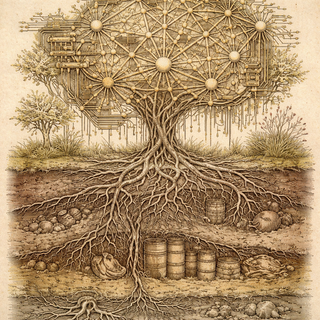
Disclaimer: This blog post is a simplified summary of published research for educational purposes. The accompanying illustration is artistic and does not depict actual model architectures, data, or experimental results. Always refer to the original paper for technical details.