Autonomous driving papers arrive with such relentless optimism that you could be forgiven for treating each new one like a movie trailer promising "this time the sequel is profound." Most of them offer another clever stack of neural machinery, another promise that the car will finally stop behaving like a very confident teenager in a Costco parking lot. But this new Nature Communications paper on CogniDrive might actually matter, because it is not just making the model bigger or the sensors shinier - it is asking a more human question: what if safer driving requires not one kind of machine intelligence, but two [1]?
That idea comes from dual-process theory, the old psychological split between fast intuition and slower reflection. Humans use both. You do not derive first principles before tapping the brake when a bike swerves into view. But you also do not navigate a bizarre construction detour on pure vibes. CogniDrive borrows that split and turns it into an autonomous driving architecture: InstinctNav handles quick, intuitive decisions, while ReflectPlan slows down to reason, learn from feedback, and improve over time [1].
Two Minds, One Steering Wheel
At the heart of the paper is a quietly radical claim: current driving systems struggle not only because they miss objects, but because they often fail at judgment. The hard part is not spotting a pedestrian. The hard part is understanding whether that pedestrian looks like someone about to step into the road, whether the weird truck angle means a sudden merge is coming, and whether the safe move now creates a worse problem three seconds later. Driving, in other words, is perception soaked in context.
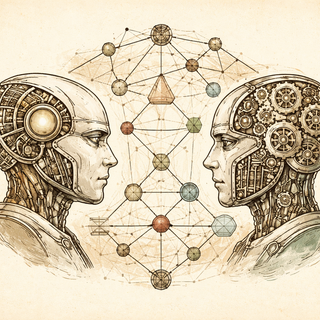
CogniDrive tries to handle that by combining imitation learning, retrieval-augmented generation, self-reflection, and a vision-language model for hazard detection [1]. InstinctNav learns from examples and retrieves similar past experiences, which gives it a kind of "seen something like this before" reflex. ReflectPlan then uses reward signals encoded in language prompts and self-reflection to rethink decisions and generalize beyond the exact situations in training data [1]. It is less "one giant black box" and more "a fast driver with an annoying but useful inner philosopher."
That last part is where the paper gets interesting. Deliberate practice theory usually belongs to the worlds of violinists, chess players, and people who voluntarily wake up at 5 a.m. to optimize themselves. Here, the authors repurpose it for machines: feed the system structured experience, make it reflect on mistakes, then push it to internalize better habits [1]. If this works at scale, it hints at a future where driving models do not merely absorb data like a sponge in a flood, but improve more like apprentices.
Why This Feels Bigger Than Another Model
Recent research has been moving in this direction. DriveGPT4 showed that large language models could make end-to-end driving systems more interpretable by tying actions to explanations [2]. Driving with LLMs explored object-level vector inputs plus language reasoning to improve context understanding [3]. DriveLM framed driving as graph-structured question answering across perception, prediction, and planning, which is a fancy way of saying the model has to explain its homework instead of blurting out the final answer [4]. And newer benchmarks such as DriveLMM-o1 and AutoDriDM focus on step-by-step reasoning and decision quality, not just whether the model guessed the last token correctly with enough swagger [5,6].
That broader trend matters because autonomous driving has a long-tail problem from hell. Roads are a museum of rare nonsense: mattresses on highways, hand gestures from construction workers, half-faded lane markings, rain that turns sensors into impressionist art. A system that only memorizes common patterns will look brilliant right up until the moment reality improvises.
CogniDrive’s authors also argue that evaluation itself has been too narrow, so they add metrics around safety, comfort, and energy efficiency [1]. That sounds less glamorous than "state-of-the-art," but honestly it is the adult in the room. Nobody wants a self-driving car that is technically correct and emotionally indistinguishable from a shopping cart being chased downhill.
The Philosophical Bit, Since We Are Apparently Here Now
What makes this paper linger in the mind is not just the engineering. It is the suggestion that robust machine behavior may require something like layered cognition: instinct first, reflection second, experience folded back into action. That does not mean the car is conscious. Let us all take a calming breath before someone writes a headline about existential sedans. But it does mean the field is inching away from the fantasy that intelligence is a single smooth quantity you can pour into a larger GPU cluster and call it destiny.
Industry seems to be converging on similar instincts. Waymo has described a foundation-model stack with separate roles for driver, simulator, and critic, plus validation layers for safety [7]. NVIDIA, in January 2026, highlighted reasoning vision-language-action models and scenario generation for edge cases as part of its autonomy roadmap [8]. The common theme is hard to miss: perception alone is not enough. Cars need something closer to structured judgment.
If you have ever tried to map one of these perception-to-planning pipelines, you know it can turn into conspiracy-board spaghetti in about six minutes. A tool like mapb2.io actually fits this topic nicely, because these systems increasingly live or die by how well their reasoning chains are organized, not just how many parameters they can bench press.
And maybe that is the deeper point. The road is not merely a visual scene. It is a moral scene, a probabilistic scene, a social scene. To drive well is to act under uncertainty while other minds, human and otherwise, keep surprising you. If CogniDrive holds up under reproduction and broader testing, it suggests the next leap in autonomy may come from machines that do not just react faster, but reconsider better.
References
[1] Zhang X, Hu T, Lyu J, et al. Autonomous driving system based on dual process theory and deliberate practice theory. Nature Communications. Published April 22, 2026. DOI: https://doi.org/10.1038/s41467-026-72030-6
[2] Xu Z, Zhang Y, Xie E, et al. DriveGPT4: Interpretable End-to-end Autonomous Driving via Large Language Model. arXiv:2310.01412. DOI: https://doi.org/10.48550/arXiv.2310.01412
[3] Chen L, Sinavski O, Hunermann J, et al. Driving with LLMs: Fusing Object-Level Vector Modality for Explainable Autonomous Driving. arXiv:2310.01957. DOI: https://doi.org/10.48550/arXiv.2310.01957
[4] Sima C, Renz K, Chitta K, et al. DriveLM: Driving with Graph Visual Question Answering. ECCV 2024 Oral. arXiv:2312.14150. DOI: https://doi.org/10.48550/arXiv.2312.14150
[5] Ishaq A, Lahoud J, More K, et al. DriveLMM-o1: A Step-by-Step Reasoning Dataset and Large Multimodal Model for Driving Scenario Understanding. arXiv:2503.10621. DOI: https://doi.org/10.48550/arXiv.2503.10621
[6] Tang Z, Wang Z, Wang Y, et al. AutoDriDM: An Explainable Benchmark for Decision-Making of Vision-Language Models in Autonomous Driving. arXiv:2601.14702. DOI: https://doi.org/10.48550/arXiv.2601.14702
[7] Waymo. Demonstrably Safe AI For Autonomous Driving. Published December 2025. https://waymo.com/blog/2025/12/demonstrably-safe-ai-for-autonomous-driving/
[8] NVIDIA. NVIDIA Presents Blueprint for the Future at CES. Published January 2026. https://blogs.nvidia.com/blog/2026-ces-special-presentation/
Disclaimer: This blog post is a simplified summary of published research for educational purposes. The accompanying illustration is artistic and does not depict actual model architectures, data, or experimental results. Always refer to the original paper for technical details.