A few harvests from now, your breakfast may come from crops that treat heat waves, drought, and salty soil like minor paperwork. The field still looks innocent enough - rows of green, wind doing its usual act - but under the hood, breeding has gone from patient guesswork to something closer to a well-run stakeout. Sensors watch. Genomes talk. AI shuffles the evidence. And somewhere in that pile of biological gossip, scientists are trying to figure out which plants will keep their cool when the climate very much does not.
That is the scene in Turbocharging crop breeding with integrated biotechnology for a climate-resilient future, a 2026 review by Wang, Yang, and Xu. Their argument is plain: old-school breeding still matters, but climate change has made the job nastier, faster, and less forgiving. You are not just picking the best-looking plant anymore. You are trying to predict how genes, traits, and the environment will collide months or years down the line - which is a bit like trying to forecast a family argument from a seating chart.
The Usual Suspects
Plant breeding used to lean heavily on visible traits. Bigger grain. Better yield. Less disease. That worked, up to a point. The trouble is that climate resilience is not one neat trait wearing a name tag. It is a crowd scene. Drought tolerance, heat tolerance, root architecture, flowering time, nutrient use, stress recovery - everybody is talking at once.
This is where modern biotech barges in through the side door. Genomics shows what is in the DNA. Phenomics measures what the plant actually does in the field. Environmental data adds the weather, soil, and stress conditions that make everything complicated in the first place. AI then tries to connect those dots without collapsing into a dramatic fainting spell.
The paper pushes for integrating all of that into one predictive breeding framework. Not just "collect more data" - science has enough hard drives already - but connect genome, phenotype, and environment in ways that help breeders make sharper decisions earlier.
AI Enters the Greenhouse
One of the key ideas here is genomic selection. In simple terms, instead of waiting forever to see how every plant performs, breeders use genome-wide markers to estimate which candidates are likely to be winners. It is less crystal ball, more statistical lineup. According to recent surveys and reviews, adding deep learning and environmental data can improve those predictions, especially for traits that behave differently across locations and seasons (Jubair and Domaratzki, 2023; Rane et al., 2024).
That matters because climate resilience is a moving target. A variety that looks heroic in one region can turn into a nervous wreck somewhere else. The model has to understand not just the plant, but the plant-in-context. Wang and colleagues make that point repeatedly: breeding needs to stop treating genes like they operate in a vacuum. They do not. They live in weather.
And then there is phenotyping - the glamorous term for measuring what plants are doing. Drones, imaging systems, and automated sensors now collect field data at scales that would have made older breeding programs stare into the middle distance. It is the agricultural version of upgrading from a notebook and a hunch to a surveillance van with six monitors. If you are the sort of person who likes sketching messy systems to stay sane, this is the kind of genome-phenome-environment spaghetti that tools like mapb2.io were practically invented for.
Why This Case Matters
The stakes are not subtle. A 2025 Nature study estimated that each additional 1 degree C of global warming could cut staple-crop production by about 120 calories per person per day, even after accounting for adaptation efforts (Kotz et al., 2025). That is not a rounding error. That is breakfast leaving the premises.
So the appeal of AI-guided, biotech-heavy breeding is obvious. If breeders can identify resilient lines faster, stack useful traits more precisely, and avoid wasting years on dead ends, the whole pipeline speeds up. Reviews from 2024 and 2025 argue that combining multi-omics, predictive modeling, and advanced phenotyping could make crop improvement more targeted and less dependent on brute-force trial and error (Amin et al., 2025; Ponce et al., 2024).
Industry has noticed. In 2024, Bayer described using generative AI and integrated agronomy data to help deliver crop advice faster across soils, weather conditions, and regions. Different problem, same general mood: too much data, not enough clean decisions, and AI getting hired to sort the file cabinet before everyone loses the plot.
The Fine Print in the Rain
There is still a catch. Several, actually. Models are only as good as the data they inherit, and biology loves making fools of neat predictions. Data from one crop, region, or season may not travel well. High-tech breeding also risks widening the gap between well-funded programs and everyone else. Fancy pipelines are great until they meet patchy infrastructure, limited training data, or the old enemy known as reality.
Wang and colleagues are honest about that. Their review is not selling a magic bean. It is selling coordination. Better data integration. Better mechanistic understanding. Better chances of designing crops that can handle a hotter, stranger century without pretending one gene tweak solves everything.
That is the real plot twist. The future of crop breeding may not hinge on one miracle technology. It may come from getting the whole crew - genomics, phenotyping, biotechnology, and AI - to stop working separate corners and finally compare notes.
References
- Wang Z, Yang D, Xu C. Turbocharging crop breeding with integrated biotechnology for a climate-resilient future. Journal of Integrative Plant Biology. 2026. DOI: 10.1111/jipb.70261. PubMed: PMID 42010794
- Jubair S, Domaratzki M. Crop genomic selection with deep learning and environmental data: A survey. Frontiers in Artificial Intelligence. 2023;5:1040295. DOI: 10.3389/frai.2022.1040295. PMCID: PMC9871498
- Rane J, et al. Harnessing the power of machine learning for crop improvement and sustainable production. Frontiers in Plant Science. 2024;15:1417912. DOI: 10.3389/fpls.2024.1417912
- Ponce KS, et al. Creating Climate-Resilient Crops by Increasing Drought, Heat, and Salt Tolerance. Plants. 2024;13(9):1238. DOI: 10.3390/plants13091238. PubMed: PMID 38732452
- Amin A, Zaman W, Park S. Harnessing Multi-Omics and Predictive Modeling for Climate-Resilient Crop Breeding: From Genomes to Fields. Genes. 2025;16(7):809. DOI: 10.3390/genes16070809. PMCID: PMC12294880
- Kotz M, et al. Impacts of climate change on global agriculture accounting for adaptation. Nature. 2025. DOI: 10.1038/s41586-025-09085-w
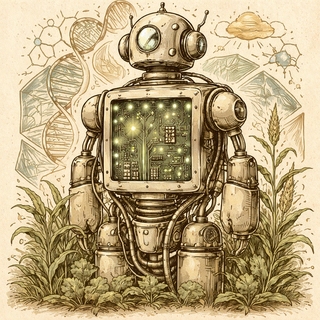
Disclaimer: This blog post is a simplified summary of published research for educational purposes. The accompanying illustration is artistic and does not depict actual model architectures, data, or experimental results. Always refer to the original paper for technical details.