In The Prestige, Christian Bale's character keeps a locked diary full of encrypted secrets about how his magic trick actually works. For decades, carbon nanotube researchers have had their own locked diary - except nobody wrote in it, because nobody could figure out the trick. The trick? Why adding a tiny pinch of sulfur to a nanotube reactor completely changes everything about the tubes that come out.
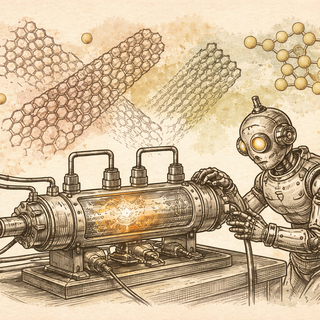
The World's Tiniest Mystery
Single-walled carbon nanotubes (SWCNTs) are basically graphene sheets rolled into impossibly thin cylinders - we're talking 0.4 to 2 nanometers across. They're stronger than steel, conduct electricity like copper or act as semiconductors depending on how they're rolled, and they've been the darling of nanotechnology since the 1990s. The most popular way to make them is chemical vapor deposition (CVD): you blast hydrocarbon gas over iron nanoparticles at screaming-hot temperatures, and carbon atoms assemble themselves into tubes on the catalyst surface.
Here's where it gets weird. Engineers discovered years ago that tossing a bit of sulfur into the mix - like a chef adding a mystery spice - dramatically changes the diameter of the resulting nanotubes. Smaller tubes, more uniform tubes, different tubes. But why? Nobody could watch atoms rearranging themselves on a nanoscale iron blob at 1000°C in real time, and traditional computer simulations were either too expensive or too crude to capture the chemistry.
Enter Hao An, Feng Ding, and colleagues, who just published their answer in ACS Nano (An et al., 2025). Their secret weapon: an AI that learned quantum mechanics.
Teaching a Neural Network to Think Like a Physicist
The team used a machine learning force field (MLFF) - essentially a neural network trained on thousands of quantum mechanical calculations - to predict how iron, carbon, and sulfur atoms interact. Think of it as building a cheat sheet so accurate that your molecular dynamics simulation runs millions of times faster than brute-force quantum calculations, but barely loses any precision.
Ding's group had previously built a similar force field called DeepCNT-22 for iron-carbon systems, which they used to simulate full nanotube growth at near-microsecond timescales (Hedman et al., Nature Communications, 2024). That work showed the tube-catalyst interface is wildly dynamic - chirality fluctuates, defects form and heal, and the whole process looks less like construction and more like controlled chaos. The new study extends this framework to the three-element iron-carbon-sulfur system, which is where the real magic trick hides.
The Sulfur Bouncer Effect
What they found is elegant. Sulfur atoms, when added to an iron catalyst particle, rush to coat the surface first - like a VIP section roping off half the dance floor. This sulfur-passivated region becomes inhospitable to carbon. Carbon atoms can't adsorb there, can't nucleate tubes there, can't do much of anything there.
So carbon gets squeezed into the remaining sulfur-free zone. A smaller stage means a smaller nanotube grows from it. Add more sulfur, and the carbon-friendly zone shrinks further, producing even thinner tubes. But push it too far - dump in too much sulfur - and you poison the catalyst entirely. The iron particle basically puts up a "closed" sign.
This "territorial segregation" model neatly explains a pile of experimental observations that previously seemed disconnected: why moderate sulfur gives you thinner SWCNTs, why too much sulfur kills growth, and why sulfur promotes the transition from single-walled to double-walled tubes at higher concentrations (Laiho et al., Chemical Engineering Journal, 2025). If you enjoy visualizing how these competing regions partition a catalyst surface, tools like mapb2.io are great for mapping out spatial relationships in complex systems.
Why This Matters Beyond the Lab
Controlling nanotube diameter means controlling electronic properties - and that's the bottleneck for using SWCNTs in next-generation transistors, sensors, and energy devices. A recent comprehensive review in Nanoscale catalogs how computational methods have evolved from rough estimates to atom-precise simulations (Wang et al., 2025), and this paper lands squarely at the frontier. Meanwhile, other groups are using similar MLFF approaches to crack chirality-dependent growth kinetics on cobalt catalysts (Sun et al., JACS, 2025), suggesting we're entering an era where AI doesn't just analyze materials - it explains them.
The locked diary is finally open. Turns out the prestige wasn't sulfur doing something exotic. It was sulfur doing something simple - hogging the surface - with consequences nobody could see until a neural network learned to look.
References
- An, H., Qian, C., Ding, L., Wang, X., Li, P., Kim, S., & Ding, F. (2025). The Role of Sulfur in Single-Walled Carbon Nanotube Growth. ACS Nano. DOI: 10.1021/acsnano.5c13470
- Hedman, D., McLean, B., Bichara, C., Maruyama, S., Larsson, J. A., & Ding, F. (2024). Dynamics of growing carbon nanotube interfaces probed by machine learning-enabled molecular simulations. Nature Communications, 15, 4076. DOI: 10.1038/s41467-024-47999-7
- Sun, S., Maruyama, S., & Li, Y. (2025). Chirality-Dependent Kinetics of Single-Walled Carbon Nanotubes from Machine-Learning Force Fields. JACS, 147(8), 7103-7112. DOI: 10.1021/jacs.4c18769
- Wang, L., Tricard, N., Chen, Z., & Deng, S. (2025). Progress in computational methods and mechanistic insights on the growth of carbon nanotubes. Nanoscale, 17, 11812-11863. DOI: 10.1039/D4NR05487C
- Laiho, P., et al. (2025). Controllable growth transition from single-walled to double-walled carbon nanotubes using sulfur in an aerosol CVD reactor. Chemical Engineering Journal.
Disclaimer: This blog post is a simplified summary of published research for educational purposes. The accompanying illustration is artistic and does not depict actual model architectures, data, or experimental results. Always refer to the original paper for technical details.