“Despite unprecedented technological progress, most drug candidates continue to fail in clinical trials, reflecting a persistent gap between preclinical models and human biology.”
That is how this Science review opens, and honestly, it lands like a tranquilizer dart to the ego. After decades of shinier machines, larger datasets, and enough PowerPoint arrows to terrify a statistician, drug development still keeps face-planting when it reaches actual humans. Here, in the wild, we observe a familiar creature: the promising drug candidate. Majestic in preclinical studies. Less majestic when reality shows up.
Wu and colleagues argue that the old setup has a basic problem. We have spent a lot of time asking animal models to predict human biology, which is a bit like asking a very talented raccoon to review your tax return. The raccoon may be doing its best. The raccoon is still not the IRS. Their proposed alternative is a family of tools called new approach methodologies, or NAMs, which include human-derived cell systems, organoids, organs-on-chips, and AI models built to forecast safety and efficacy using data that look more like us and less like a mouse with an unfortunate assignment [1].
Meet the Local Wildlife: Chips, Cells, and Math
NAMs are not one gadget. They are more like an ecosystem.
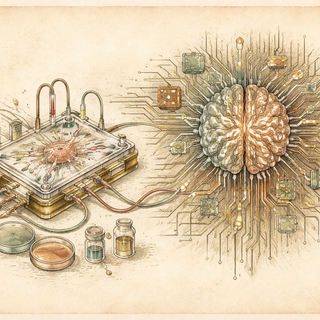
Some are biological. Organoids are miniature lab-grown tissue models, and organ-on-chip systems push that idea further by putting living human cells into microfluidic devices that can mimic blood flow, tissue interfaces, and mechanical forces. Think tiny synthetic habitats where cells can behave a little more like they do inside a real body, instead of sulking in a flat dish like office workers under fluorescent lighting. Reviews from 2024 describe just how fast these platforms are maturing, especially for liver toxicity and pharmacology studies [2,3].
Some are computational. AI models can scan chemical space, predict molecular properties, prioritize compounds, suggest synthesis routes, and help flag toxicity earlier than the old “test everything and pray for a signal” workflow. Nature Medicine’s 2025 review lays out how AI is spreading across target identification, preclinical assessment, and even post-market surveillance, while other 2024 reviews focus on generative models for designing new molecules from scratch [4,5]. Which sounds elegant until you remember the model is still only as good as the data it was fed - and biomedical data have the occasional bad habit of being incomplete, biased, or held together by one heroic postdoc and a folder called final_final_v2_reallyfinal.
Why This Review Hits a Nerve
The paper’s core point is not “AI will save pharma.” Blessedly, it is more sober than that.
The point is that human biology should stop being the surprise twist at the end of the movie. If your preclinical stack includes human stem-cell models, microphysiological systems, and AI tools trained on human-relevant data, you have a better shot at catching failure before the expensive part where everyone starts using words like “Phase II setback” with the emotional tone of a weather report.
That matters because clinical failure is not just academically annoying. It is ruinously expensive, painfully slow, and rough on patients waiting for treatments that looked good on paper. The review also lands at a moment when regulation is shifting. The paper discusses reforms such as the FDA Modernization Act 3.0, and separately, on March 18, 2026, the FDA issued draft guidance describing how developers can validate NAMs for regulatory use and move beyond animal testing as the default [6]. Translation: the zookeepers are starting to redesign the enclosure.
The Herd Is Moving, But Slowly
Before we declare victory and release the confetti cannons, the field still has several predators lurking in the grass.
First, validation. A liver chip that looks gorgeous in a paper still has to prove it is reliable, reproducible, and fit for a specific regulatory use. “Cool demo” and “accepted evidence” are not the same species.
Second, integration. A cell model, a chip model, and an AI model do not magically become wise when placed in the same room together. Someone has to connect them into a workflow that biologists, toxicologists, clinicians, and regulators can actually trust.
Third, data quality. AI in drug development has impressive moments, but benchmark work in 2025 showed that even flashy AI docking systems can struggle on physical plausibility when tested rigorously [7]. Nature, as usual, remains unimpressed by marketing decks.
Still, the big idea here is hard to ignore: if drug development becomes more human-centric earlier, then fewer bad candidates may survive by accident and fewer good ones may die because the model was built for the wrong animal. That is a better scientific story, a better ethical story, and frankly a less absurd business model.
In the closing light, our camera pans across the modern preclinical savanna. The mouse model still exists, twitching nobly in the underbrush. But around it, new organisms are evolving - chips pulsing with human cells, organoids forming tiny stand-ins for tissue, AI systems sniffing through molecular possibility space like caffeinated truffle pigs. None of them is magic. Together, though, they may finally help drug development spend less time guessing what humans will do once the trial starts. Which would be nice. Humans, as a rule, prefer not to be the beta test.
References
-
Wu X, Wu MA, Zou J, Kleinstreuer N, Wu JC. Reimagining human-centric drug development with new approach methodologies. Science. 2025. DOI: 10.1126/science.aeb0045
-
Mehta V, Karnam G, Madgula V. Liver-on-chips for drug discovery and development. Materials Today Bio. 2024;27:101143. DOI: 10.1016/j.mtbio.2024.101143. PMCID: PMC11279310
-
Doost NF, Srivastava SK. A Comprehensive Review of Organ-on-a-Chip Technology and Its Applications. Biosensors. 2024;14(5):225. DOI: 10.3390/bios14050225. PMCID: PMC11118005
-
Zhang K, Yang X, Wang Y, et al. Artificial intelligence in drug development. Nature Medicine. 2025;31:45-59. DOI: 10.1038/s41591-024-03434-4
-
Gangwal A, Ansari A, Ahmad I, et al. Generative artificial intelligence in drug discovery: basic framework, recent advances, challenges, and opportunities. Frontiers in Pharmacology. 2024;15:1331062. DOI: 10.3389/fphar.2024.1331062. PMCID: PMC10879372
-
U.S. Food and Drug Administration. FDA Releases Draft Guidance on Alternatives to Animal Testing in Drug Development. March 18, 2026. https://www.fda.gov/news-events/press-announcements/fda-releases-draft-guidance-alternatives-animal-testing-drug-development
-
Gu S, Shen C, Zhang X, et al. Benchmarking AI-powered docking methods from the perspective of virtual screening. Nature Machine Intelligence. 2025;7:509-520. DOI: 10.1038/s42256-025-00993-0
Disclaimer: This blog post is a simplified summary of published research for educational purposes. The accompanying illustration is artistic and does not depict actual model architectures, data, or experimental results. Always refer to the original paper for technical details.