The Scene of the Crime
The evidence was right there in the joint. Not a human joint - a robot joint. Specifically, a flexible one. See, most robotics textbooks pretend that when a motor turns, the link it's attached to moves in perfect lockstep. Neat. Tidy. A beautiful lie.
Real robot joints have springs, harmonic drives, and elastic couplings that make the motor angle and the link angle two very different numbers. Your motor says "I'm at 45 degrees" while the link wobbles around like it had three espressos. Engineers call this the Spong model. I call it mechanical gaslighting.
Now add input delay to the mix - that tiny but devastating lag between when the controller says "move" and when the actuator actually does something about it. We're talking milliseconds, but in high-speed robotics, milliseconds are an eternity. It's like trying to parallel park via text message.
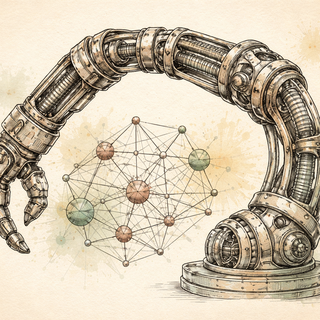
Hui Ma and colleagues looked at this crime scene and decided enough was enough (Ma et al., 2026).
The Suspects: Three Neural Networks in a Trench Coat
Here's where it gets spicy. The team didn't just slap a PID controller on the problem and call it a day. They brought in reinforcement learning - specifically, an actor-critic architecture with an extra accomplice.
Meet the crew:
- The Identifier: Learns the unknown system dynamics on the fly. Think of it as the forensic analyst, piecing together how the robot actually behaves versus how the textbook says it should.
- The Critic: Evaluates whether the current control strategy is any good by approximating the optimal cost function. The judge, basically.
- The Actor: Actually generates the control signals. The one doing the work while the other two backseat drive.
All three are neural networks, and they're trained simultaneously using something called "revised terms and prediction errors" - fancy language for "we made the learning converge faster so we don't need a supercomputer and a prayer."
This trio effectively solves the Hamilton-Jacobi-Bellman equation without anyone having to solve it analytically, which is great because solving HJB equations for nonlinear systems is the controls engineering equivalent of untangling Christmas lights in the dark.
The Breakthrough: A Funnel You Can't Escape
The real headline here is the prescribed-time prescribed performance method. In control theory, prescribed performance means you force the tracking error to live inside a shrinking funnel - a time-varying envelope that gets tighter and tighter until the error is negligibly small (Bechlioulis & Rovithakis, 2008).
But this paper goes further. Not only does the error have to stay in the funnel, the researchers predetermine exactly when the error converges. You don't just say "the error will eventually get small." You say "the error will be this small by exactly t = 2.5 seconds." Like setting a reservation at a restaurant and the robot actually showing up on time.
They handle the input delay through an auxiliary system combined with dynamic surface control - essentially building a mathematical side channel that absorbs the delay's destabilizing effects before they can wreak havoc. The delay gets folded into the coordinate transformation so the rest of the stability analysis can proceed as if it doesn't exist. Clean. Surgical. Mildly unsettling in its elegance.
Why Should You Care (If You're Not a Controls Engineer)?
Flexible-joint robots aren't exotic lab curiosities. They're the collaborative robots working alongside humans in factories, the lightweight arms on surgical systems, the compliant actuators in exoskeletons. Every cobot from Universal Robots or KUKA uses some form of joint compliance for safety. If you want these machines to be both gentle and precise, you need control methods that handle the wobble.
Recent work has pushed actor-critic RL into increasingly real-world robotic domains - from agile drone flight (Romero et al., 2025, arXiv:2306.09852) to adaptive backstepping with input delays (Applied Intelligence, 2025). This paper sits right at that intersection, combining guaranteed transient performance with learning-based optimality. If you're into visualizing how these complex control architectures fit together, tools like mapb2.io can help you map out the relationships between the identifier, actor, and critic networks - because honestly, a flowchart helps.
The Verdict
The simulation results check out. The method keeps errors in bounds, converges on schedule, and handles delay without breaking a sweat. The case file remains open for hardware validation - simulations are confessions, not convictions. But the theory is tight, the math is sound, and somewhere, a flexible-joint robot arm is finally hitting its marks.
References
- Ma, H., Zhu, L., Zhou, Q., Li, H., & Lei, Y. (2026). Actor-Critic-Based Prescribed Performance Optimal Control for Flexible-Joint Robots With Input Delay. IEEE Transactions on Neural Networks and Learning Systems. DOI: 10.1109/TNNLS.2026.3680090
- Romero, A., et al. (2025). Actor-Critic Model Predictive Control: Differentiable Optimization meets Reinforcement Learning. IEEE Transactions on Robotics. arXiv: 2306.09852
- Neural network-based adaptive reinforcement learning for optimized backstepping tracking control of nonlinear systems with input delay. (2025). Applied Intelligence. DOI: 10.1007/s10489-024-05932-x
- Bechlioulis, C.P., & Rovithakis, G.A. (2008). Robust Adaptive Control of Feedback Linearizable MIMO Nonlinear Systems With Prescribed Performance. IEEE Transactions on Automatic Control, 53(9), 2090-2099.
- Reinforcement learning-based adaptive tracking control for flexible-joint robotic manipulators. (2024). AIMS Mathematics. DOI: 10.3934/math.20241328
Disclaimer: This blog post is a simplified summary of published research for educational purposes. The accompanying illustration is artistic and does not depict actual model architectures, data, or experimental results. Always refer to the original paper for technical details.