Thousands of papers wash ashore every day, and most of them pass by like fog in the night. This one earned my attention because it goes after a part of genome biology that even the sharpest sequence models have mostly sailed around - what happens when entirely different chromosomes sidle up together and start influencing gene regulation like suspicious crewmates whispering below deck. [1]
Not Just a String, but a Very Cramped Ship Cabin
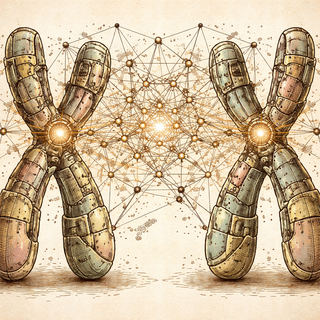
Your DNA is not laid out neatly like pearls on a string. It is more like two meters of rope crammed into a space so tiny it ought to violate maritime safety codes. Inside the nucleus, chromosomes occupy preferred "territories," and big regions of the genome sort into active A compartments and quieter B compartments. Those neighborhoods matter because genes are not regulated only by what sits nearby on the same chromosome. Sometimes the action happens across chromosomes, in trans, which is biology's way of saying, "the plot has left the local zip code." [2][3][4]
That is the bit TwinC tackles. The model, described by Jha and colleagues in Nature Communications, predicts inter-chromosomal contacts directly from DNA sequence using an interpretable convolutional neural network. In plain English, it asks: can the raw letters of DNA tell us which distant pieces of the genome are likely to cozy up in 3D space? Turns out, quite a bit, yes. [1]
The Crew Finally Stops Ignoring the Other Ships
A lot of earlier models focused on cis interactions, meaning contacts within the same chromosome. Fair enough - that harbor is easier to map. Tools like C.Origami and ChromaFold showed that machine learning can do a respectable job predicting 3D genome structure from sequence plus accessibility or chromatin features. But TwinC goes after the rougher water: trans contacts, which are sparser, noisier, and historically harder to measure with confidence. [5][6]
The authors trained TwinC on heart Hi-C data and reported an AUROC around 0.80 on held-out chromosome pairs. That is not "the model has solved biology, lower the flags and head home" territory. But for trans-genome prediction, it is a strong signal that sequence contains real navigational clues. They also trained on the GM12878 cell line and checked the results against DNA SPRITE, an orthogonal assay that does not rely on the same ligation tricks as Hi-C. That matters. If two different measuring tools point at the same coastline, you trust the map a bit more. [1]
What the Model Thinks Matters, and Why That Is the Juicy Part
The most interesting part is not just that TwinC predicts contacts. It gives us a peek at why. The model highlights A/B compartment status, chromatin accessibility, clusters of transcription factor motifs, and G-quadruplexes as features tied to trans contacts. [1]
If that last one sounds like a prog-rock album, fair enough. G-quadruplexes are unusual four-stranded DNA structures that can form in guanine-rich regions. TwinC suggests they may help mark places likely to participate in long-range genome mingling. That does not prove causation. It does tell experimental biologists where to point the expensive microscopes and pipettes next, which is half the battle in modern genomics and at least 80% of the caffeine bill. [1][7]
The compartment result also passes the smell test. Active A compartments tend to mix with other active regions, while quieter B compartments are more wallflowers at the nuclear perimeter. TwinC found AA contacts were easier to predict than BB ones, which fits what we know about nuclear organization. The ship is not drifting blind here. [1][3]
Why You Should Care, Even If You Do Not Spend Evenings Reading Hi-C Papers
If results like this hold up and expand, the payoff is practical. Models that predict 3D genome behavior from sequence can help researchers prioritize which noncoding variants might disrupt regulation, decide where to run costly follow-up experiments, and maybe one day chart how genome architecture goes off course in heart disease, cancer, or developmental disorders. Reviews over the last few years have made the same point: experimental 3D genomics is powerful, but it is expensive, sparse, and difficult to scale, so predictive models are becoming essential navigation tools rather than party tricks. [4][5][8]
Still, keep one hand on the railing. TwinC works at 100-kilobase resolution, and trans contacts remain sparse enough that the authors had to frame the task as classification rather than precise contact-frequency prediction. This is a model of patterns, not a magical periscope into every nucleus. Biology, as ever, enjoys hiding the reef just beneath the waterline. [1]
What I like here is the restraint. The paper does not claim the genome has been fully decoded by a hardworking pile of convolutions and GPUs sweating like overworked cabin boys. It claims something narrower, and more believable: sequence carries enough information to predict a neglected layer of 3D genome organization, and interpretable AI can help us identify the molecular flags that guide that organization. That is a worthy chart to add to the logbook.
References
[1] Jha A, Hristov B, Wang X, et al. Prediction and functional interpretation of inter-chromosomal genome architecture from DNA sequence with TwinC. Nature Communications (2026). DOI: 10.1038/s41467-026-72031-5. PubMed: 42009674
[2] Wikipedia contributors. Chromosome territories. Wikipedia. https://en.wikipedia.org/wiki/Chromosome_territories
[3] Wikipedia contributors. Nuclear organization. Wikipedia. https://en.wikipedia.org/wiki/Nuclear_organization
[4] Li Y, Liang Y, Lin J, et al. Three-dimensional genome structure and function. MedComm (2023). DOI: 10.1002/mco2.326. PubMed: 37426677
[5] Tan J, Shenker-Tauris N, Rodriguez-Hernaez J, et al. Cell-type-specific prediction of 3D chromatin organization enables high-throughput in silico genetic screening. Nature Biotechnology 41, 1140-1150 (2023). DOI: 10.1038/s41587-022-01612-8
[6] Gao VR, Yang R, Das A, et al. ChromaFold predicts the 3D contact map from single-cell chromatin accessibility. Nature Communications (2024). DOI: 10.1038/s41467-024-53628-0. PMCID: PMC11530433
[7] Wikipedia contributors. G-quadruplex. Wikipedia. https://en.wikipedia.org/wiki/G-quadruplex
[8] Beagan JA, Phillips-Cremins JE, Li G, Ma J, Misteli T. Computational methods for analysing multiscale 3D genome organization. Nature Reviews Genetics (2024). DOI: 10.1038/s41576-023-00638-1
[9] Hammal F, de Langen P, Bergon A, et al. Inter-chromosomal contacts demarcate genome topology along a spatial gradient. Nature Communications (2024). DOI: 10.1038/s41467-024-53983-y. PubMed: 39532865
Disclaimer: This blog post is a simplified summary of published research for educational purposes. The accompanying illustration is artistic and does not depict actual model architectures, data, or experimental results. Always refer to the original paper for technical details.