That walnut-sized lump of tissue sitting behind your breastbone just got a massive career upgrade.
For most of modern medicine, the thymus has been treated like a biological appendix with a slightly better PR team. Sure, it cranks out T cells when you're a kid, training your immune system to tell the difference between "self" and "definitely not self." But by the time you hit puberty, it starts shrinking - fatty tissue creeping in like weeds through a sidewalk - and by adulthood, most doctors figured it was basically retired. An immunological has-been. The gland equivalent of that gym membership you swore you'd use.
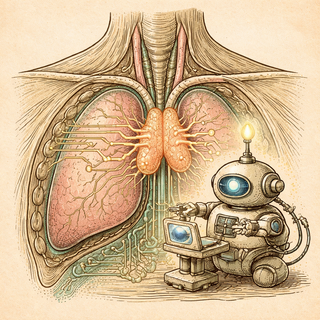
Turns out the thymus has been quietly running the show this whole time, and nobody was paying attention.
An AI Reads 27,000 Chest Scans (So You Don't Have To)
A team led by Simon Bernatz and Hugo Aerts at Mass General Brigham and Goethe University Frankfurt trained a deep learning model to do something radiologists never really bothered with: score your thymus. The AI analyzed routine chest CT scans - the kind taken for lung cancer screening, not some exotic imaging protocol - measuring the organ's size, shape, and tissue composition to generate what they call a "thymic health score." Less fatty infiltration equals better immune function. Think of it as a body composition scan, but for a gland most people can't even point to on a diagram.
They ran this model across over 25,000 adults from the National Lung Screening Trial (NLST) and another 2,500 from the Framingham Heart Study - yes, that Framingham Study, the one that's been tracking heart health since your grandparents were young. The results, published in Nature, landed like a grenade in a library (Bernatz et al., 2026, DOI: 10.1038/s41586-026-10242-y).
The Numbers That Made Immunologists Spit Out Their Coffee
People with high thymic health scores had roughly 50% lower risk of dying from any cause over 12 years of follow-up. Cardiovascular death? Down 63%. Lung cancer incidence? 36% lower. And these numbers held up after adjusting for age, sex, smoking status, and comorbidities - the usual suspects that researchers control for so nobody can say "well, duh, healthier people are healthier."
The Framingham cohort independently confirmed the cardiovascular mortality link, which is the scientific equivalent of a second witness corroborating an alibi. This wasn't a fluke. Your thymus, that supposedly washed-up gland, appears to be quietly pulling strings on whether you develop cancer, heart disease, or just... die sooner.
Your Thymus Knows If You Smoke (And It's Judging You)
Here's where it gets personal. Thymic health wasn't just some genetic lottery ticket. Chronic inflammation, smoking, obesity, and physical inactivity all correlated with worse thymic scores. The thymus, it seems, is keeping receipts on your lifestyle choices and adjusting your immune resilience accordingly.
This tracks with what we already knew about thymic involution - the slow, age-related shrinking that replaces functional tissue with fat. A comprehensive review in Science Advances detailed how this process tanks naive T cell production and narrows T cell receptor diversity, essentially shrinking your immune system's vocabulary for recognizing threats (Palmer, 2025). And a landmark 2023 study in the New England Journal of Medicine found that people who had their thymus surgically removed had more than double the risk of cancer and death compared to controls - along with elevated autoimmune disease risk (Kaminski et al., 2023, DOI: 10.1056/NEJMoa2302892). The Bernatz study essentially confirms those surgical findings from the other direction: you don't need to remove the thymus to see the damage. Just let it deteriorate.
The Cancer Immunotherapy Plot Twist
In a companion paper published in the same issue of Nature, the team analyzed over 3,400 cancer patients receiving immune checkpoint inhibitors - those drugs that basically take the brakes off your immune system so it can attack tumors. Patients with robust thymic health showed a 37% lower risk of cancer progression and 44% lower risk of death during treatment, regardless of tumor type (Bernatz et al., 2026, DOI: 10.1038/s41586-026-10243-x). This held up independent of PD-L1 expression and tumor mutational burden - the biomarkers oncologists currently use to predict who'll respond to immunotherapy.
Translation: the reason immunotherapy works brilliantly for some patients and barely moves the needle for others might partly come down to how well their thymus weathered the years. The organ everyone forgot about could be the missing variable in precision oncology.
What This Actually Means For You
Nobody's going to prescribe you a thymus supplement (yet). The AI scoring tool isn't ready for your next physical. But the implications are wild. If thymic health is modifiable through lifestyle - and the smoking, obesity, and exercise data suggest it is - then we might be looking at an entirely new axis for preventive medicine. Not just "eat well so your heart doesn't explode," but "eat well so your thymus keeps your entire immune system from quietly falling apart."
If you're the kind of person who likes mapping out complex systems visually, the thymus is turning out to be a hub node in the body's aging network that nobody had on the diagram.
As Aerts put it: "The thymus has been overlooked for decades and may be a missing piece in explaining why people age differently." Decades. An entire organ, sitting right there behind the sternum, doing critical work while medicine collectively shrugged. Somewhere, the thymus is saying I told you so.
References
-
Bernatz, S., Prudente, V., Pai, S., et al. (2026). Thymic health consequences in adults. Nature. DOI: 10.1038/s41586-026-10242-y. PMID: 41851466
-
Bernatz, S., Prudente, V., Pai, S., et al. (2026). Thymic health and immunotherapy outcomes in patients with cancer. Nature. DOI: 10.1038/s41586-026-10243-x
-
Kaminski, N., et al. (2023). Health Consequences of Thymus Removal in Adults. New England Journal of Medicine, 389(5), 406-417. DOI: 10.1056/NEJMoa2302892. PMID: 37530823
-
Palmer, D.B. (2025). Age-related thymic involution: Mechanistic insights and rejuvenating approaches to restore immune function. Science Advances. DOI: 10.1126/sciadv.aeb2970
-
Thomas, R., Wang, W., & Su, D.M. (2020). Contributions of Age-Related Thymic Involution to Immunosenescence and Inflammaging. Immunity & Ageing, 17, 2. DOI: 10.1186/s12979-020-0173-8
Disclaimer: This blog post is a simplified summary of published research for educational purposes. The accompanying illustration is artistic and does not depict actual model architectures, data, or experimental results. Always refer to the original paper for technical details.