A robot in Toronto just out-chemisted an entire field of lipid researchers, and nobody told it where to look.
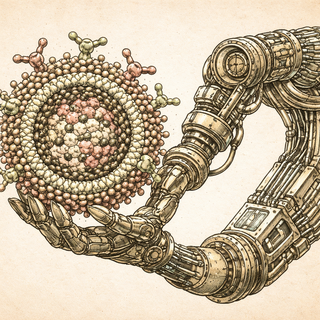
The Robot Chemist With No Hypothesis
LUMI-lab - which stands for Large-scale Unsupervised Modeling followed by Iterative experiments, because acronyms in science are legally required to be forced - is a self-driving laboratory that combines a transformer-based AI model with robotic arms and automated screening equipment. Think of it as a chemistry grad student that never sleeps, never spills reagents, and doesn't need coffee. The platform, developed by Bowen Li's group at the University of Toronto's Leslie Dan Faculty of Pharmacy, just published its debut results in Cell (Xu et al., 2026), and they're kind of wild.
The problem LUMI-lab tackles is one of the biggest bottlenecks in mRNA therapeutics: getting the mRNA into cells without it being shredded by the body's defenses. The delivery vehicles of choice are lipid nanoparticles (LNPs) - tiny fat bubbles that smuggle mRNA past cellular security. You've probably had LNPs injected into your arm already. Both the Pfizer-BioNTech and Moderna COVID-19 vaccines used them. But here's the awkward truth: only three LNP formulations have ever received FDA approval. The chemical space of possible ionizable lipids (the key ingredient that makes LNPs work) is enormous, and traditional screening is painfully slow.
Training on 28 Million Molecules, Then Letting It Loose
LUMI-lab's secret weapon is a transformer-based foundation model pretrained on over 28 million molecular structures - basically giving the AI a chemistry education equivalent to reading every textbook ever written, twice, in a weekend. This pretraining lets the model learn general chemical patterns and structure-property relationships before it ever sees a single lipid nanoparticle, which is critical because LNP data is scarce. You can't train a useful model on sparse data alone, but you can pretrain on the entire known chemical universe and then fine-tune.
This approach mirrors what's happening across AI-driven molecular discovery more broadly. Foundation models like MolE (Gao et al., Nature Communications, 2024) and Uni-Mol2 (Lu et al., 2024) have shown that massive pretraining on molecular data unlocks surprisingly good performance on downstream tasks - a pattern familiar to anyone who's watched language models go from predicting the next word to writing poetry.
Once pretrained, LUMI-lab enters an active learning loop: the AI predicts which lipids are worth making, robots synthesize them, automated assays test how well they deliver mRNA into human bronchial cells, and the results feed back into the model. Rinse and repeat. Over ten cycles, the system autonomously synthesized and screened more than 1,700 lipid nanoparticles.
The Bromine Plot Twist
Here's where it gets genuinely surprising. LUMI-lab independently zeroed in on brominated lipid tails as a key feature for improving mRNA delivery. Nobody told it to look at bromine. There was no prior hypothesis linking bromination to transfection efficiency. The AI just... figured it out.
"The key advance of this AI-driven system is that it independently identified bromination as an important, meaningful design feature without prior hypothesis or researchers telling it to look for it first," said Bowen Li in a press release.
The numbers back up the excitement: brominated lipids made up just 8% of the chemical library but accounted for over 50% of the top-performing candidates. Some of these new lipids outperformed the ionizable lipid used in Moderna's COVID-19 vaccine in preclinical testing. That's not a minor improvement - that's a robot finding a needle in a haystack that the haystack's own builders didn't know existed.
From Petri Dish to Mouse Lungs
The team didn't stop at cell cultures. They took LUMI-6, the top-performing lipid from the screen, formulated it into LNPs carrying CRISPR-Cas9 components, and delivered them directly into mouse lungs via intratracheal administration. The result: 20.3% gene editing efficacy in lung epithelial cells - reportedly the highest efficiency achieved for inhaled LNP-mediated CRISPR delivery in mice. The safety profile matched benchmark clinical lipids, which matters a lot when you're talking about putting things in lungs.
This is particularly relevant for diseases like cystic fibrosis, where delivering gene-editing tools directly to lung tissue has been a persistent challenge. Getting one in five lung cells edited through a single inhalation treatment is the kind of number that makes pulmonologists sit up.
Why Self-Driving Labs Are Having a Moment
LUMI-lab isn't operating in a vacuum. The broader trend of autonomous laboratories - sometimes called self-driving labs or SDLs - is picking up serious momentum (Royal Society Open Science review, 2025). Other platforms like MicroCycle have demonstrated similar closed-loop drug discovery workflows. Machine learning for LNP optimization has been explored through various approaches, from multilayer perceptrons achieving 98% classification accuracy on transfection prediction (Bae et al., Small, 2025) to neural network-guided ionizable lipid design (Chen et al., 2025). What sets LUMI-lab apart is the full integration: foundation model pretraining to handle data scarcity, active learning for efficient exploration, and physical robotics to close the loop without human intervention.
The code is even open-sourced on GitHub, which is increasingly the norm for high-impact AI research but still worth noting when the stakes are drug delivery.
The Bigger Picture
Three FDA-approved LNPs for a therapeutic modality projected to be worth tens of billions of dollars is, to put it mildly, a supply-demand mismatch. The chemical space of potential ionizable lipids is practically infinite, and human intuition can only cover so much ground. LUMI-lab suggests a plausible path forward: let a well-trained AI propose candidates, let robots test them, and let the loop run until something useful falls out - even (especially) if that something is a brominated lipid nobody thought to try.
The real test will be whether LUMI-6 or its descendants survive the long march from mouse lungs to human clinical trials. But as proof of concept for AI-driven molecular discovery in a data-scarce domain, this is about as clean a demonstration as you'll find.
References
-
Xu, Y., Cui, H., Pang, K., Li, G., Gong, F., Dong, S., Wang, B., & Li, B. (2026). LUMI-lab: A foundation model-driven autonomous platform enabling discovery of ionizable lipid designs for mRNA delivery. Cell. DOI: 10.1016/j.cell.2026.01.012 | PMID: 41742414
-
Gao, Z., et al. (2024). MolE: a foundation model for molecular graphs using disentangled attention. Nature Communications, 15, 9207. DOI: 10.1038/s41467-024-53751-y
-
Bae, Y., et al. (2025). Rational Design of Lipid Nanoparticles for Enhanced mRNA Vaccine Delivery via Machine Learning. Small, 21(3), 2405618. DOI: 10.1002/smll.202405618
-
Chen, J., et al. (2025). Artificial intelligence-guided design of lipid nanoparticles for mRNA delivery. Acta Pharmaceutica Sinica B. PMID: 41685167
-
Seifrid, M., et al. (2025). Autonomous 'self-driving' laboratories: a review of technology, methods, and applications. Royal Society Open Science, 12(7), 250646. DOI: 10.1098/rsos.250646
-
Xu, Y., et al. (2025). LUMI-lab: a Foundation Model-Driven Autonomous Platform. bioRxiv preprint. DOI: 10.1101/2025.02.14.638383
Disclaimer: This blog post is a simplified summary of published research for educational purposes. The accompanying illustration is artistic and does not depict actual model architectures, data, or experimental results. Always refer to the original paper for technical details.