Zeolites just got a lot less claustrophobic, and that could change how we process the big, stubborn molecules that usually jam the works.
If you have never thought about a zeolite before, congratulations on having a balanced life. But these crystals are the engine parts of a huge chunk of modern chemistry. They sit inside refinery and chemical processes like precision-machined cylinder heads, full of tiny channels where molecules zip in, react, and roll out as something more useful. The catch is that the classic versions have pretty tight plumbing. Small molecules fit. Big ones hit traffic, overheat, and start causing side reactions like a transmission full of gravel.
That is the hood Xu and colleagues pop open in this 2026 review of extra-large-pore, or ELP, zeolites [1]. Their basic point is simple: chemists are learning how to build zeolites with pores larger than the traditional 8-12 membered ring windows, which gives bulky molecules room to move instead of scraping both mirrors on the way through.
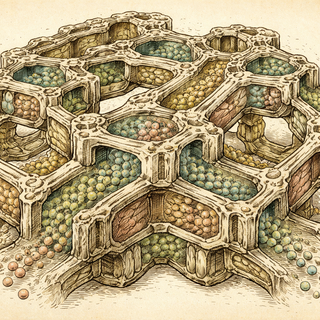
Regular zeolites are famous for shape selectivity. That is chemistry-speak for "only certain molecules can squeeze through the gate." Great when you want discipline. Not great when your feedstock looks like molecular furniture.
ELP zeolites widen those channels enough to bridge the gap between classic microporous materials and roomier mesoporous ones. In plain English: you keep a lot of the structural precision that makes zeolites useful, but you stop forcing oversized molecules through what amounts to a chemical keyhole. Wikipedia’s standard pore-size definitions put micropores below 2 nm and mesopores at 2-50 nm, so this work lives right at that awkward boundary where the old rules start wheezing.
That matters because diffusion is not some side quest here. Diffusion is the fuel line. If molecules cannot get in, out, or past each other efficiently, the catalyst spends its day idling.
What the Review Actually Says Under the Hood
The paper is a review, not one brand-new experiment, but it does something valuable: it lays out the whole repair manual for this fast-growing area. Xu and colleagues walk through how ELP zeolites are built, how their structures are measured, and where they might earn their keep in catalysis, separation, adsorption, and environmental cleanup [1].
A lot of the progress comes from two kinds of tuning.
First, chemists design fancy structure-directing agents, basically molecular jigs that coax the framework into assembling the right way. This is less "throw ingredients in a beaker and pray" and more "custom machine tooling for crystal growth," although chemistry still enjoys occasional acts of chaos.
Second, researchers use top-down tricks, where a parent structure gets reorganized into a more open one. A 2024 Nature paper showed an interchain-expansion route to stable extra-large-pore zeolites, including a framework with 20-, 16-, and 16-ring channels and catalytic promise for bulky alkene oxidations [2]. Another 2024 Nature paper pushed even further with ZMQ-1, a stable zeolite with atomically ordered interconnected channels that edge into mesopore territory [3].
That is the exciting bit. These are not just lab ornaments with huge pores and the structural backbone of wet cardboard. Stability, at least in some cases, is getting good enough that industrial chemists might stop laughing and start taking notes.
The Shop Floor Problems Are Still Very Real
Now for the oily rag portion of the inspection.
The review is blunt about the weak points: expensive multistep templating, heavy reliance on germanium in some syntheses, framework defects, and synthesis routes that are not exactly winning environmental awards [1]. This field still has the energy of a custom race car shop. Incredible prototypes, very impressive machining, and a lot of parts you would not want to source at scale on a Friday afternoon.
There is also a characterization problem. These materials can be tiny, mixed-phase, and annoyingly hard to solve structurally. That is why the recent tooling matters. A 2025 Science paper used micro-electron diffraction plus combinatorial screening to accelerate discovery of stable nano extra-large-pore zeolites, including candidates that improved heavy-oil cracking with higher liquid-fuel yields and less coking than industrial counterparts [4]. That is not just nice crystallography. That is better diagnostics for the whole engine bay.
Why This Could Matter Outside Chemistry Nerd Circles
Zeolites already help refine fuels, clean up pollutants, soften water, and support separation processes. Recent reporting from Northwestern Engineering also notes their relevance to carbon capture, air purification, and sustainable fuel production, with better imaging expected to speed materials discovery [5]. So when people build versions that can handle bigger molecules with less diffusion bottlenecking, you open doors in heavy-oil upgrading, biomass conversion, selective adsorption, and messy real-world feeds that do not behave like textbook toy molecules.
The sneaky interesting angle is data. Xu and colleagues point to machine learning-guided design as part of the future [1]. That is not hype duct-taped onto a chemistry paper. It already has some hardware behind it. The 2024 ZeoSyn project assembled nearly 24,000 zeolite synthesis routes and used machine learning to connect synthesis conditions with resulting frameworks [6]. In mechanic terms, that is finally keeping a decent service log instead of rebuilding the carburetor from folklore every time.
So no, this review does not claim chemists solved porous materials forever. What it shows is that the field has moved from "wouldn't it be nice if the pipes were bigger?" to "we now have multiple workable ways to machine larger channels, inspect them properly, and maybe train computers to help pick the next design." For a part of chemistry that often lives or dies by molecular traffic flow, that is a pretty serious tune-up.
References
- Xu H, Guan X, Lin L, et al. Molecularly engineered zeolites with extra-large-pore architectures and functional opportunities. Chemical Society Reviews (2026). DOI: https://doi.org/10.1039/D5CS00473J. PubMed: https://pubmed.ncbi.nlm.nih.gov/41770711/
- Gao ZR, Yu H, Chen FJ, et al. Interchain-expanded extra-large-pore zeolites. Nature 628, 99-103 (2024). DOI: https://doi.org/10.1038/s41586-024-07194-6
- Lu P, Xu J, Sun Y, et al. A stable zeolite with atomically ordered and interconnected mesopore channel. Nature 636, 368-373 (2024). DOI: https://doi.org/10.1038/s41586-024-08206-1
- Ma C, Zhang Z, Zhang M, et al. Accelerated discovery of stable, extra-large-pore nano zeolites with micro-electron diffraction. Science 388(6754), 1417-1421 (2025). DOI: https://doi.org/10.1126/science.adv5073
- Northwestern Engineering News. New Electron Microscopy Technique Reveals Zeolite Structure to Enhance Function. January 2026. https://www.mccormick.northwestern.edu/news/articles/2026/01/new-electron-microscopy-technique-reveals-zeolite-structure-to-enhance-function/
- Pan E, Greer HF, O'Malley AJ, et al. ZeoSyn: A Comprehensive Zeolite Synthesis Dataset Enabling Machine-Learning Rationalization of Hydrothermal Parameters. ACS Central Science 10(3), 729-743 (2024). DOI: https://doi.org/10.1021/acscentsci.3c01615
- Chen FJ, Yu J. Discovery of Stable Extra-large Pore Zeolites Based on Rational Design of Structure-directing Agents. Accounts of Chemical Research 58(15), 2402-2414 (2025). DOI: https://doi.org/10.1021/acs.accounts.5c00223
Disclaimer: This blog post is a simplified summary of published research for educational purposes. The accompanying illustration is artistic and does not depict actual model architectures, data, or experimental results. Always refer to the original paper for technical details.