Breaking from the nucleus: transcription can either give DNA replication a helpful tailwind or slam it head-on into trouble, and this paper catches both behaviors at nucleosome-level detail.
If you spend enough time around molecular biology, you develop a soft spot for overworked cellular machinery. DNA replication is one of those little heroes. It has one job - copy the genome without turning the place into a smoking crater. Meanwhile transcription is nearby, loudly reading genes into RNA like a coworker on speakerphone. Put them on the same stretch of DNA and, yes, things get weird.
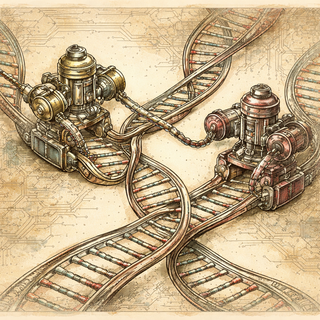
In this Molecular Cell paper, Zhengrong Zhangding and colleagues introduce Repli-MiC, short for replication-associated Micro-C, to watch how replication forks move through chromatin in mammalian cells at very high resolution (Zhangding et al., 2026). The big surprise is not just that transcription interferes with replication. We already suspected that. The surprise is that transcription has two opposite effects, depending on direction. When transcription runs in the same direction as replication, it biases sister forks to move faster that way. When it comes in head-on, it seems to gum up elongation and weaken what the authors call replication fountains.
Here is the bar-stool version. DNA replication copies DNA. Transcription reads DNA into RNA. Both need access to the same DNA template, and DNA is not a four-lane highway. It is more like a narrow hiking trail with one angry goose on it.
Researchers have spent years studying transcription-replication conflicts, because these clashes can trigger replication stress, DNA breaks, and genome instability. Recent reviews and mechanistic studies have hammered home that head-on encounters are usually worse than co-directional ones, especially when RNA-DNA hybrids called R-loops pile up (Browning and Merrikh, 2024, Gaillard and Aguilera, 2023, Stoy et al., 2023).
This new paper adds something the field badly needed: a way to watch the whole replication elongation landscape in mammalian chromatin without squinting at indirect clues like a wildlife rehab volunteer trying to diagnose a falcon with a flashlight and optimism.
Meet the replication fountain
The paper’s central idea is delightfully odd. The authors identify replication fountains, dynamic chromatin-interaction structures generated by coupled sister replication forks. Think of them as splash patterns in 3D genome contact data that reveal how the two forks are progressing through local chromatin.
To analyze those patterns, the team paired Repli-MiC with a reinforcement-learning-based computational framework. That sounds intimidating, but the job is simple: teach the algorithm to detect and quantify these fountain structures without a human nudging every result. Basically, the model becomes the patient rehab volunteer who finally learned the difference between “normal bird twitch” and “please call the vet.”
Using that setup, the authors found that co-directional transcription does not merely avoid disaster. It actually biases sister fork speed toward the transcriptional orientation while preserving fork coupling. In contrast, head-on transcription weakens replication fountains, consistent with impaired fork elongation.
TOP1, please report to the front desk
One especially juicy result involves DNA topoisomerase I (TOP1), the enzyme that relieves torsional stress during replication and transcription. DNA gets overwound and underwound during these processes, and TOP1 is one of the exhausted custodians trying to keep the cords untangled.
When the authors depleted TOP1, the co-directional bias became even stronger. That matters because topological stress is already a known player in transcription-replication conflicts and genome instability (Yao et al., 2025, Duardo et al., 2024, PMID: 38787953, PMCID: PMC11122683). It also matters outside pure basic science, because TOP1-targeting drugs such as irinotecan and topotecan are already used in cancer treatment (NCI).
So this is not just a lovely mechanistic bird rescue story. It points toward a better map of where replication gets stressed, why some genomic regions become fragile, and how transcription direction and DNA topology might shape that risk in normal cells and cancer cells. Recent work has even shown that dialing up transcription-replication conflict can expose vulnerabilities in certain cancers, including ecDNA-positive tumors (Tang et al., 2024).
Why this one sticks
What I like here is the restraint. The paper does not claim that transcription is good or bad for replication in some cartoonish universal sense. It says, more honestly, that transcription is a complicated animal. Sometimes it trots alongside the replication fork like a well-behaved rescue dog. Sometimes it runs straight into traffic.
That is useful. Biology is full of arguments where both sides were right, just at different times, places, or orientations. This study gives the field a sharper way to ask those questions.
And frankly, I am proud of this scrappy little model-plus-assay combo. We brought in a very complicated genome, cleaned off the mud, checked the fork dynamics, and discovered that the problem was not “transcription bad.” It was “direction matters, coupling matters, and TOP1 is working overtime.”
References
- Zhangding Z, Liu X, Liang H, Fan Y, Peng Y, Rao W, Chen W, Hu J. Deciphering the dual effects of transcription on DNA replication elongation by replication-associated Micro-C. Molecular Cell. 2026. DOI: https://doi.org/10.1016/j.molcel.2026.03.034
- Browning KR, Merrikh H. Replication-Transcription Conflicts: A Perpetual War on the Chromosome. Annual Review of Biochemistry. 2024;93:21-46. DOI: https://doi.org/10.1146/annurev-biochem-030222-115809
- Gaillard H, Aguilera A. Transcription-Replication Conflicts as a Source of Genome Instability. 2023. PMID: https://pubmed.ncbi.nlm.nih.gov/37552891/
- Stoy H, Zwicky K, Kuster D, et al. Direct visualization of transcription-replication conflicts reveals post-replicative DNA:RNA hybrids. Nature Structural and Molecular Biology. 2023;30:348-359. DOI: https://doi.org/10.1038/s41594-023-00928-6
- Cuvier O, Martin MM, Koffler-Brill T, et al. Linear interaction between replication and transcription shapes DNA break dynamics at recurrent DNA break clusters. Nature Communications. 2024. DOI: https://doi.org/10.1038/s41467-024-47934-w
- Yao Q, Zhu L, Shi Z, et al. Topoisomerase-modulated genome-wide DNA supercoiling domains colocalize with nuclear compartments and regulate human gene expression. Nature Structural and Molecular Biology. 2025;32:48-61. DOI: https://doi.org/10.1038/s41594-024-01377-5
- Duardo M, Cristini A, Falabella M, et al. Human DNA topoisomerase I poisoning causes R loop-mediated genome instability attenuated by transcription factor IIS. 2024. PMID: https://pubmed.ncbi.nlm.nih.gov/38787953/ PMCID: https://pmc.ncbi.nlm.nih.gov/articles/PMC11122683/
- Tang Y, Kim J, He L, et al. Enhancing transcription-replication conflict targets ecDNA-positive cancers. Nature. 2024. DOI: https://doi.org/10.1038/s41586-024-07802-5
Disclaimer: This blog post is a simplified summary of published research for educational purposes. The accompanying illustration is artistic and does not depict actual model architectures, data, or experimental results. Always refer to the original paper for technical details.