Somewhere between "burn everything" and "hope for the best," there's a middle ground for decarbonizing industries that really, really love high temperatures. Steel plants and cement factories - those smokestacks you see dotting industrial landscapes - need heat that would make your oven jealous. And while we'd love to slap some solar panels on them and call it a day, that's not how physics works when you need to melt rock and metal.
Enter hydrochar: biomass's glow-up after a spa treatment called hydrothermal carbonization (HTC). Basically, you take organic waste like wood chips, corn stalks, or even sewage sludge (yes, really), cook it under pressure in water, and out pops a solid fuel that burns cleaner than coal. The catch? Every batch of biomass is different, making the output about as predictable as a toddler's mood.
When Your Fuel Source Has Trust Issues
The problem with biomass is that it's messy. Not just literally - though there's that too - but in terms of consistency. One pile of wood chips might have different moisture content, chemical composition, and energy potential than the next. Traditional prediction methods for hydrochar quality have struggled because they treat all biomass like it's the same stuff. Spoiler: it's not.
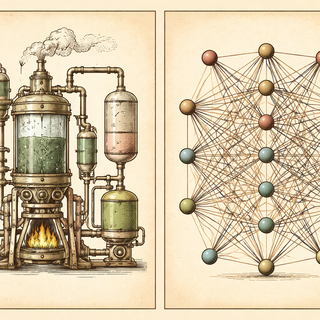
A research team recently tackled this chaos with a clever machine learning approach called Mixture of Experts, or MoEs [1]. Think of it like assembling a panel of specialists instead of asking one generalist to handle everything. One expert knows wood, another knows agricultural waste, a third understands sludge. A "gating network" acts as the traffic controller, routing each biomass sample to whichever expert knows it best.
The Algorithm That Plays Matchmaker
The framework combines clustering algorithms (which group similar biomass types together) with regression models tailored to each cluster. When new data comes in, the gating network decides which expert should handle the prediction. It's autonomous model assignment - no human babysitting required.
The results were impressive enough to make statisticians nod approvingly. The system predicted two critical properties: Higher Heating Value (HHV, basically how much energy you get when you burn the stuff) and Energy Yield (EY, how efficiently the process converts biomass energy into hydrochar energy). Both predictions hit accuracy levels that previous one-size-fits-all models couldn't touch.
But the researchers didn't stop at prediction. They ran multiobjective optimization to find HTC conditions that maximize both HHV and EY simultaneously. For wood chips, corn straw, and sewage sludge, they identified the sweet spots - the specific temperatures, times, and conditions that squeeze the most useful fuel from each feedstock type.
From Spreadsheet to Smokestack
Here's where it gets practical. The team validated their model predictions with actual experiments, confirming that the optimized hydrochar performed as expected. The optimally produced fuel delivered net energy gains while reducing CO₂ emissions compared to fossil alternatives.
For industries that need to decarbonize but can't just "electrify everything," this matters. Cement kilns hit 1,450°C. Steel blast furnaces exceed 2,000°C. These aren't temperatures you reach with a heat pump. Renewable solid fuels like hydrochar offer a path forward, but only if manufacturers can reliably predict what they're getting before they throw it in the furnace.
The MoE framework essentially creates a lookup table for chaos - input your biomass characteristics and process parameters, output your expected fuel properties. No more guessing, no more batch-by-batch surprises.
Why Experts Beat Generalists (At Least in This Case)
Previous machine learning attempts at hydrochar prediction used single models trained on diverse datasets. These approaches work reasonably well when your data is uniform. When it's not - and biomass rarely is - they struggle with the underlying heterogeneity.
The Mixture of Experts approach acknowledges this messiness and works with it rather than against it. By letting specialized models handle subsets of the data they're best suited for, the framework achieves what ensemble methods often aim for but rarely accomplish so elegantly.
Related work on biomass conversion has explored various ML techniques [2, 3], but the gating network innovation here represents a step toward adaptive systems that can handle real-world feedstock variability. For industries managing multiple biomass streams, this flexibility could be the difference between viable and impractical.
The Bigger Picture
Decarbonizing heavy industry remains one of climate action's thornier challenges. These sectors account for roughly 30% of global CO₂ emissions, and most don't have obvious substitutes for fossil fuels. Hydrochar won't single-handedly solve this, but predictive design frameworks like this one lower the barrier to adoption.
When you can tell a cement plant exactly what fuel properties they'll get from their local agricultural waste, processed under specific conditions, the calculation changes. Uncertainty drops. Planning becomes possible. And maybe - just maybe - those smokestacks start burning something that didn't spend millions of years underground.
References
-
Guo J, He X, Deng C, et al. Mixture-of-Experts Machine Learning Framework for Predictive Design of Biomass-Derived Hydrochar to Decarbonize Industrial Heat. Environmental Science & Technology. 2025. DOI: 10.1021/acs.est.6c01833
-
Li J, et al. Machine learning aided prediction of biochar properties from various biomass feedstocks. Bioresource Technology. 2023. DOI: 10.1016/j.biortech.2023.128893
-
Shahbeik H, et al. Using machine learning to predict hydrothermal carbonization products: A review. Journal of Cleaner Production. 2024. DOI: 10.1016/j.jclepro.2024.141250
Disclaimer: This blog post is a simplified summary of published research for educational purposes. The accompanying illustration is artistic and does not depict actual model architectures, data, or experimental results. Always refer to the original paper for technical details.